
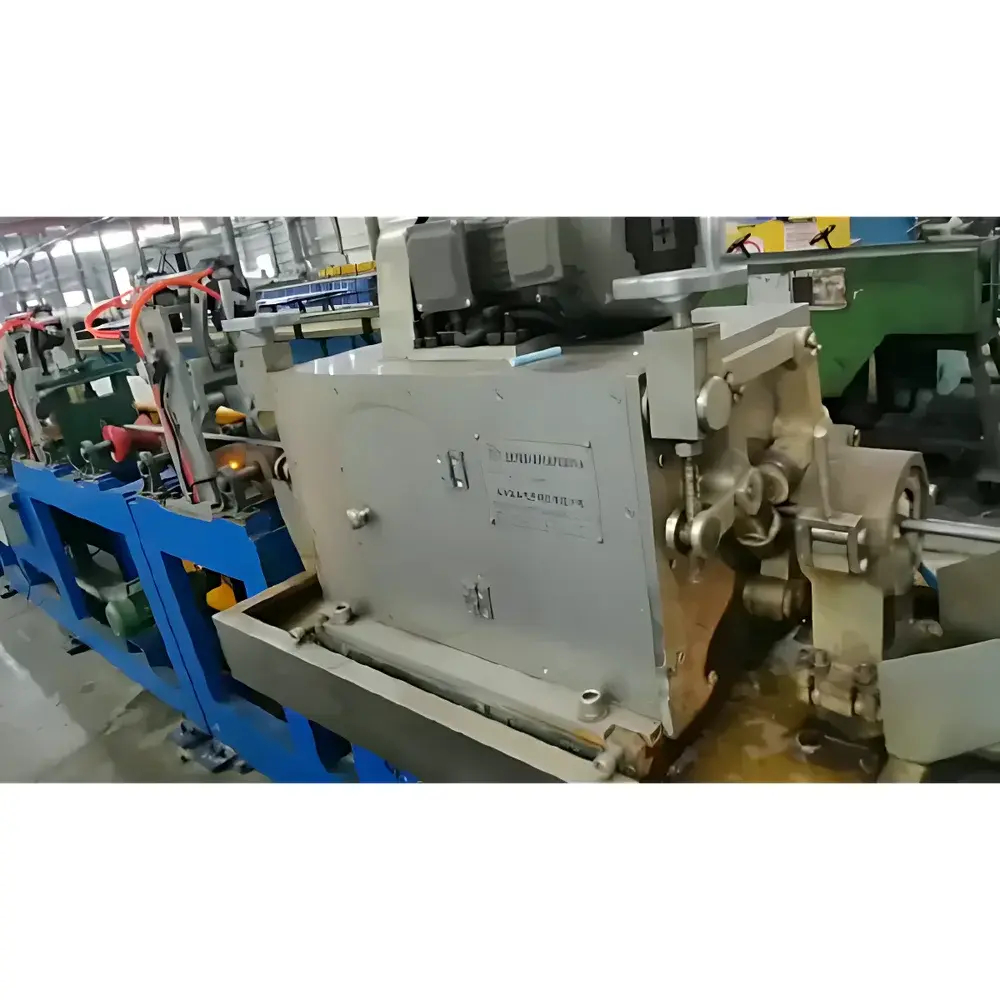
Olympus Immersion C-Scan System for Bar and Tube Inspection
| Brand | Olympus |
|---|---|
| Origin | Shanghai, China |
| Manufacturer Type | Authorized Distributor |
| Origin Category | Domestic (China) |
| Model | Custom-Configurable C-Scan Platform |
| Pricing | Upon Request |
| Application Domain | Industrial NDT of Metallic Bars and Tubes |
Overview
The Olympus Immersion C-Scan System for Bar and Tube Inspection is a fully integrated ultrasonic non-destructive testing (NDT) platform engineered for high-speed, high-fidelity volumetric evaluation of cylindrical metallic products. Operating on the pulse-echo and through-transmission immersion principles, the system utilizes water as a couplant to enable consistent acoustic coupling across curved surfaces—eliminating air-gap interference and ensuring stable signal-to-noise ratio during scanning. Designed specifically for longitudinal inspection of solid bars and hollow tubes with outer diameters ranging from 5 mm to 180 mm, the system delivers full circumferential coverage via precise rotational indexing combined with linear translation. Its modular architecture supports scalable channel configurations (4–32 active UT channels), enabling concurrent A-scan acquisition across multiple focal depths and beam angles—critical for reliable detection of both surface-breaking and subsurface discontinuities such as seams, inclusions, voids, and laminar flaws.
Key Features
- High-speed immersion scanning at up to 60 meters per minute—optimized for inline integration with rolling mill or heat treatment lines
- Custom-engineered mechanical gantry with precision rotary stage and servo-controlled linear motion system, ensuring repeatable positional accuracy within ±0.1 mm
- Field-programmable software architecture supporting real-time C-scan image reconstruction, dynamic gain compensation, and depth-gated amplitude analysis
- Integrated defect marking capability: synchronized pneumatic or laser marking triggered directly from UT signal thresholds
- Real-time wall thickness monitoring mode with dual-element transducer support for accurate measurement of OD/ID variations in tubular products
- Modular channel expansion: 4-channel base configuration expandable to 32 channels without hardware replacement—enabling phased array compatibility and multi-zone inspection strategies
Sample Compatibility & Compliance
The system accommodates round, hexagonal, and square-section metallic bars and tubes manufactured from carbon steel, stainless steel, titanium alloys, and nickel-based superalloys. Sample handling is supported by adjustable V-block supports, centering rollers, and optional motorized feed systems. All signal processing and data output comply with ASTM E114 (Standard Practice for Ultrasonic Pulse-Echo Straight-Beam Examination), ASTM E273 (Standard Practice for Ultrasonic Testing of the Weld Zone of Welded Pipe and Tubing), and ISO 12718 (Non-destructive testing — Ultrasonic testing — Vocabulary). The system’s data logging structure adheres to ISO/IEC 17025 requirements for traceability, including timestamped raw RF data capture, operator ID tagging, and environmental parameter recording (water temperature, transducer frequency, gain settings).
Software & Data Management
The proprietary C-Scan Control Suite provides a Windows-based interface with role-based access control, audit trail logging, and electronic signature support compliant with FDA 21 CFR Part 11 requirements. All inspection records—including B-scan cross-sections, C-scan plan views, and thickness maps—are stored in vendor-neutral HDF5 format with embedded metadata (UT parameters, calibration history, geometry definitions). Batch reporting tools generate PDF and CSV outputs aligned with customer-specific quality documentation templates. Optional integration with MES/ERP systems is available via OPC UA and RESTful API interfaces, enabling automated job dispatch, result upload, and SPC dashboard synchronization.
Applications
- In-process inspection of hot-rolled and cold-drawn bars prior to machining or forging
- Final quality verification of seamless and welded tubing for aerospace hydraulic systems and nuclear steam generator applications
- Rejection screening of billets and blooms entering extrusion or drawing lines
- Periodic integrity assessment of inventory stock in high-value alloy storage facilities
- Root cause analysis support for fatigue failure investigations in rotating equipment shafts
FAQ
What ultrasonic frequencies are supported?
Standard configurations utilize 2.25 MHz, 5 MHz, and 10 MHz immersion transducers; custom broadband transducers up to 25 MHz are available for high-resolution near-surface evaluation.
Can the system be integrated into an existing production line?
Yes—the mechanical frame includes standardized mounting interfaces and I/O terminals compatible with common PLC platforms (Siemens S7, Rockwell ControlLogix); mechanical footprint and weight specifications are provided during pre-installation engineering review.
Is calibration traceable to national standards?
All system calibrations are performed using NIST-traceable reference standards (e.g., ASTM E127 blocks, IIW Type 1 wedges), with calibration certificates issued per ISO/IEC 17025-accredited procedures.
Does the software support automated pass/fail decision logic?
Yes—threshold-based gating, amplitude windowing, and spatial clustering algorithms can be configured to trigger automatic classification (Accept/Reject/Review) based on user-defined flaw size, location, and echo amplitude criteria.
What training and technical support options are available?
Olympus-certified NDT Level II/III instructors deliver on-site operator certification programs; remote diagnostics and firmware updates are accessible via secure TLS-encrypted portal with SLA-backed response times.



