
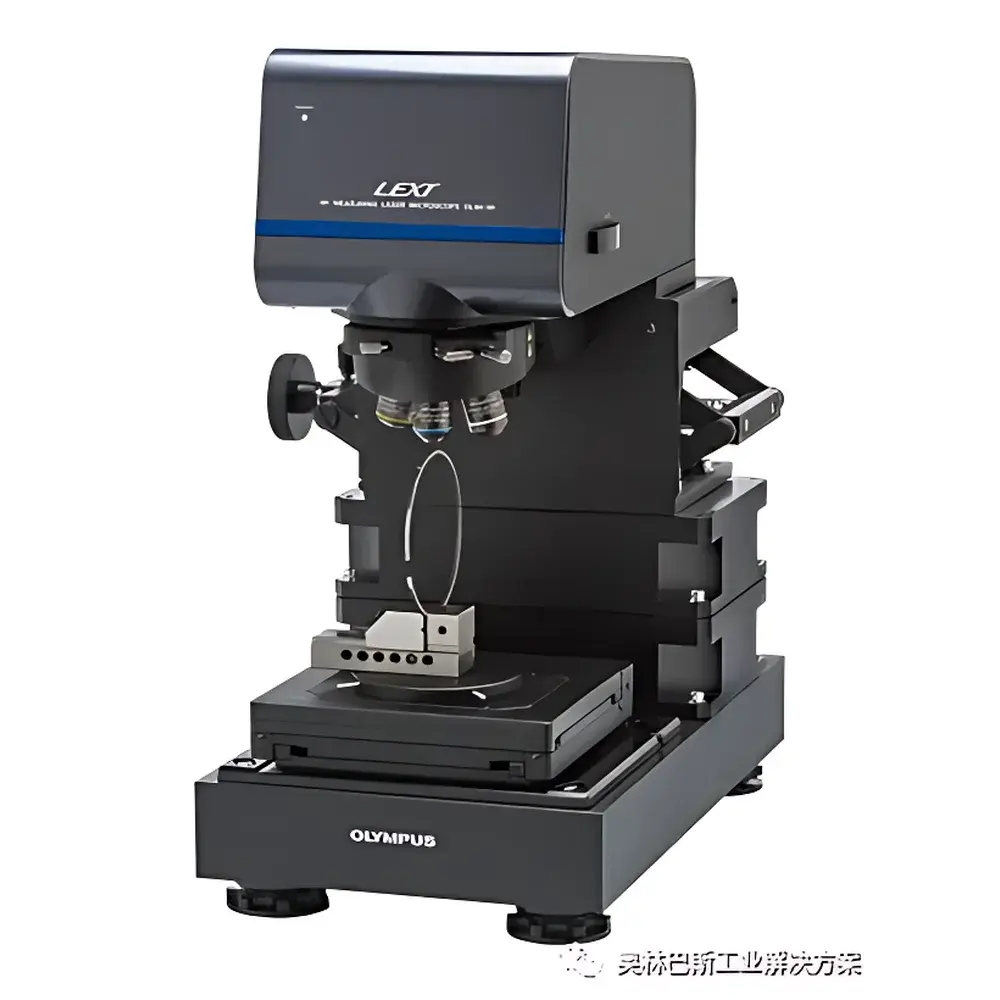
Olympus LEXT OLS5100 Laser Scanning Confocal Microscope
| Brand | Olympus |
|---|---|
| Origin | Japan |
| Manufacturer Type | Original Equipment Manufacturer (OEM) |
| Product Category | Imported Instrument |
| Model | LEXT OLS5100 |
| Pricing | Available Upon Request |
Overview
The Olympus LEXT OLS5100 is a high-precision laser scanning confocal microscope engineered for non-contact, sub-micrometer 3D surface topography measurement and quantitative roughness analysis. Unlike conventional optical microscopes relying on widefield illumination and depth-of-field limitations, the LEXT OLS5100 employs point-scanning confocal optics with a 405 nm violet semiconductor laser as its excitation source. This configuration enables optical sectioning with axial resolution down to ~380 nm (depending on objective and sample reflectivity), eliminating out-of-focus blur and delivering true z-stack-based volumetric reconstruction. The system is optimized for industrial metrology applications where traceable, repeatable surface characterization—aligned with ISO 25178 (Geometrical Product Specifications – Surface Texture) and ASTM E2926 (Standard Test Method for Measuring Surface Roughness Using Confocal Microscopy)—is required in R&D labs, process validation, and quality control environments.
Key Features
- Confocal Laser Scanning Architecture: Utilizes a pinhole-aligned detection path with galvanometric mirror scanning to achieve high signal-to-noise ratio and diffraction-limited lateral resolution (~120 nm at 100× magnification).
- Smart Lens Advisor: An embedded algorithm that evaluates objective suitability based on target measurement parameters—including field of view, vertical range, lateral resolution, and surface slope—assigning a compatibility score to minimize operator-dependent selection errors.
- SmartExperiment Manager: A workflow-driven software module supporting experiment templating, automated multi-point acquisition, batch processing, and metadata-tagged data capture—designed to support GLP-compliant documentation and audit-ready traceability.
- Non-Destructive & Sample-Prep-Free Operation: Enables direct measurement of conductive and non-conductive materials (e.g., metals, ceramics, polymers, coated surfaces) without sputter coating or vacuum chamber requirements.
- Robust Mechanical Platform: Features a granite base, motorized XYZ stage with sub-micron repeatability, and active vibration isolation—engineered for stability in production-floor or shared lab environments.
Sample Compatibility & Compliance
The LEXT OLS5100 accommodates samples up to 210 mm × 210 mm × 50 mm (W × D × H) with optional stage extensions. It supports reflective and semi-reflective surfaces with reflectivity ≥2% (at 405 nm), including machined metal parts, MEMS devices, semiconductor wafers, additive-manufactured components, and biomedical implants. All surface texture parameters—including Sa, Sq, Sz, Sdr, and Sdq—are calculated per ISO 25178-2 and reported with uncertainty estimation per ISO/IEC 17025 guidelines. System validation includes NIST-traceable step-height standards and certified roughness reference specimens (e.g., VDI/VDE 2634 Part 2). The instrument architecture complies with IEC 61000-6-2 (EMC immunity) and IEC 61000-6-4 (EMC emission) standards.
Software & Data Management
OLYMPUS STREAM software (v3.5+) provides full control of acquisition, reconstruction, and analysis workflows. It supports 21 CFR Part 11–compliant user authentication, electronic signatures, and immutable audit trails for all measurement sessions. Raw data is stored in vendor-neutral .OME-TIFF format (with OME-XML metadata embedding), ensuring long-term archival integrity and third-party interoperability. Trend visualization tools enable time-series comparison across batches, while customizable report templates export results directly to PDF, Excel, or CSV—integrated with enterprise LIMS and MES systems via RESTful API.
Applications
- Surface finish verification of precision-machined aerospace components (e.g., turbine blades, fuel nozzles)
- 3D defect analysis of injection-molded polymer parts and battery electrode coatings
- Quantitative wear and scratch depth mapping in tribology studies
- Topographic validation of microstructured surfaces for optical diffusers and anti-reflective textures
- Process capability assessment (Cpk, Ppk) for additive manufacturing post-processing steps
- Failure analysis of delamination, cratering, or thermal damage in electronic packaging
FAQ
What is the typical vertical resolution achievable with the LEXT OLS5100?
Vertical resolution is dependent on objective lens selection and surface reflectivity; typical values range from 0.5 nm to 10 nm RMS under optimal conditions using the 100× objective.
Does the system require vacuum or conductive coating for non-metallic samples?
No—confocal laser microscopy is inherently non-contact and does not require vacuum, sputter coating, or electrical conductivity.
Can measurement data be exported to statistical process control (SPC) platforms?
Yes—STREAM software supports automated export to CSV/Excel formats and integrates with common SPC tools via configurable data pipelines.
Is calibration traceable to national standards?
Yes—Olympus provides factory calibration certificates traceable to NIST and PTB reference artifacts, with optional annual recalibration services.
How does the Smart Lens Advisor determine objective suitability?
It analyzes user-defined measurement goals (e.g., target Sa value, maximum slope, required lateral resolution) against objective specifications—including NA, working distance, magnification, and depth of field—to generate a ranked compatibility score.





