
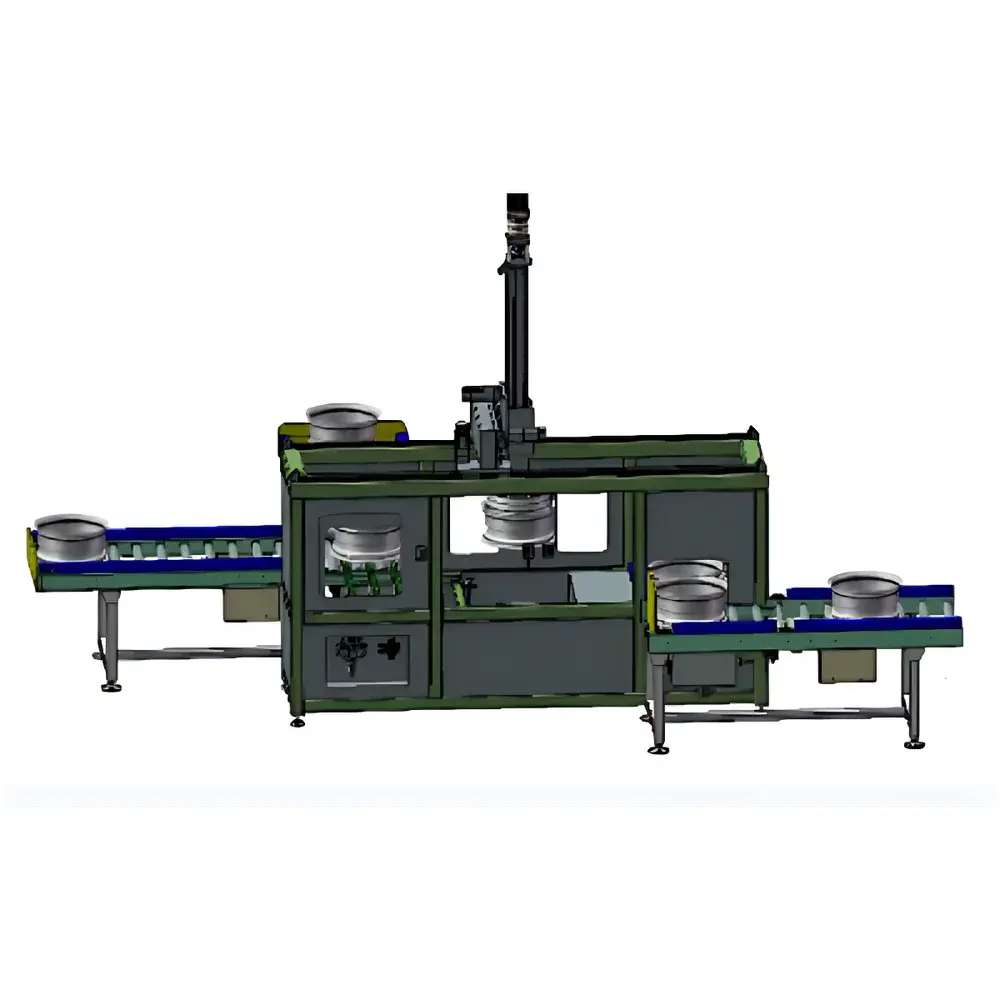
Olympus Wheel Hub Phased Array Ultrasonic Testing System
| Brand | Olympus |
|---|---|
| Origin | Shanghai, China |
| Manufacturer Type | Authorized Distributor |
| Product Origin | Domestic (China) |
| Model | Custom-Configured for Wheel Hub Inspection |
| Pricing | Available Upon Request |
| Application Domain | Automotive Quality Control & Weld Integrity Verification |
Overview
The Olympus Wheel Hub Phased Array Ultrasonic Testing System is a purpose-built automated NDT solution engineered for high-reliability inspection of aluminum and steel automotive wheel hubs. It employs water-coupled phased array ultrasonic testing (PAUT) based on the principles of beam steering, focusing, and dynamic depth correction to achieve full volumetric characterization of critical weld zones—including circumferential T-joints, fillet welds, and fusion boundaries. Unlike conventional single-element pulse-echo methods, this system utilizes multi-element linear or matrix arrays (typically 32–128 elements) driven by programmable time-delay laws to synthesize steerable and focusable acoustic beams without mechanical scanning. This enables rapid, repeatable acquisition of S-scan, C-scan, and sectorial B-scan data across complex curved geometries—specifically optimized for hub flange-to-spoke welds where geometry-induced signal attenuation and mode conversion are prevalent.
Key Features
- Water-immersion PAUT architecture with precision CNC-controlled X-Y-Z rotary positioning stage for consistent standoff distance and coupling stability
- Real-time dynamic depth focusing (DDF) and total focusing method (TFM) support for enhanced defect resolution at varying depths in heterogeneous cast/machined hub substrates
- Automated weld seam tracking via laser-guided edge detection and adaptive path planning to maintain optimal probe alignment over radiused hub contours
- Integrated evaluation logic compliant with ISO 13588:2019 and ASTM E2700–22 for phased array weld assessment, including amplitude-based sizing and time-of-flight diffraction (TOFD)-assisted characterization
- Dual-gate echo amplitude analysis for simultaneous detection of volumetric flaws (porosity, lack of fusion) and planar indications (cracks, incomplete penetration)
- Automated melt depth quantification using back-wall echo shift analysis and lateral wave interference mapping—calibrated against reference standards traceable to NIST SRM 2241
Sample Compatibility & Compliance
This system accommodates wheel hubs ranging from 12″ to 24″ diameter, with flange thicknesses from 15 mm to 45 mm and spoke curvature radii ≥ 50 mm. It supports both cast A356-T6 aluminum alloys and forged 6061-T6 variants, with acoustic velocity calibration performed per material lot. All inspection procedures adhere to OEM-specific internal standards (e.g., Ford WSS-M1A364-B3, GMW14872 Rev. 8), and the reporting framework satisfies ISO 9712 Level 2/3 personnel qualification requirements. Data archives retain full raw RF channel data, scan parameters, and operator credentials for GLP/GMP audit readiness under FDA 21 CFR Part 11-compliant electronic signature protocols.
Software & Data Management
Operation is managed through Olympus NDT Studio™ v4.x—a modular platform supporting offline procedure development, real-time imaging, and post-processing analytics. The software includes embedded AI-assisted flaw classification (trained on >10,000 labeled hub weld scans), configurable pass/fail thresholds aligned with customer-defined acceptance criteria, and automated report generation in PDF/A-2b and XML formats. All measurement metadata—including transducer ID, wedge angle, focal law configuration, water temperature, and UTC-stamped acquisition timestamps—is embedded in DICOM-RT compliant files for long-term archival and cross-system interoperability. Audit trails record every parameter modification, image annotation, and result override with user ID and timestamp—fully traceable for ISO 17025 accredited laboratories.
Applications
- Production-line verification of hub weld integrity prior to machining and balancing
- Root pass and cap pass assessment in robotic MIG/GMAW wheel hub assemblies
- Quantitative measurement of weld penetration depth and fusion zone width per ASME BPVC Section IX
- Discrimination between entrapped slag and micro-cracking in heat-affected zones (HAZ)
- Statistical process control (SPC) integration via OPC UA interface for real-time yield monitoring and trend analysis
FAQ
Does this system support manual or semi-automated operation for R&D validation?
Yes—the hardware platform allows both fully automated production-mode scanning and manual probe manipulation via teach-mode trajectory recording for method development.
Can it inspect hubs with integrated brake caliper mounts or non-uniform spoke profiles?
Yes—customizable scan plans accommodate asymmetric geometries using CAD-guided surface mapping and adaptive focal law recalculations per scan line.
Is third-party calibration certification available?
Olympus-certified service engineers provide annual system performance verification per EN 1330-4 and issue traceable calibration certificates with uncertainty budgets.
What file formats are supported for exporting raw A-scan data?
Raw channel data exports as IEEE 754-compliant binary (.bin) with accompanying JSON metadata, compatible with MATLAB, Python (NumPy), and commercial UT analysis suites.
How is coupling stability maintained during high-speed scanning?
The system uses servo-regulated water level control, pressure-compensated immersion tanks, and real-time acoustic impedance monitoring to detect and flag coupling degradation before data corruption occurs.



