
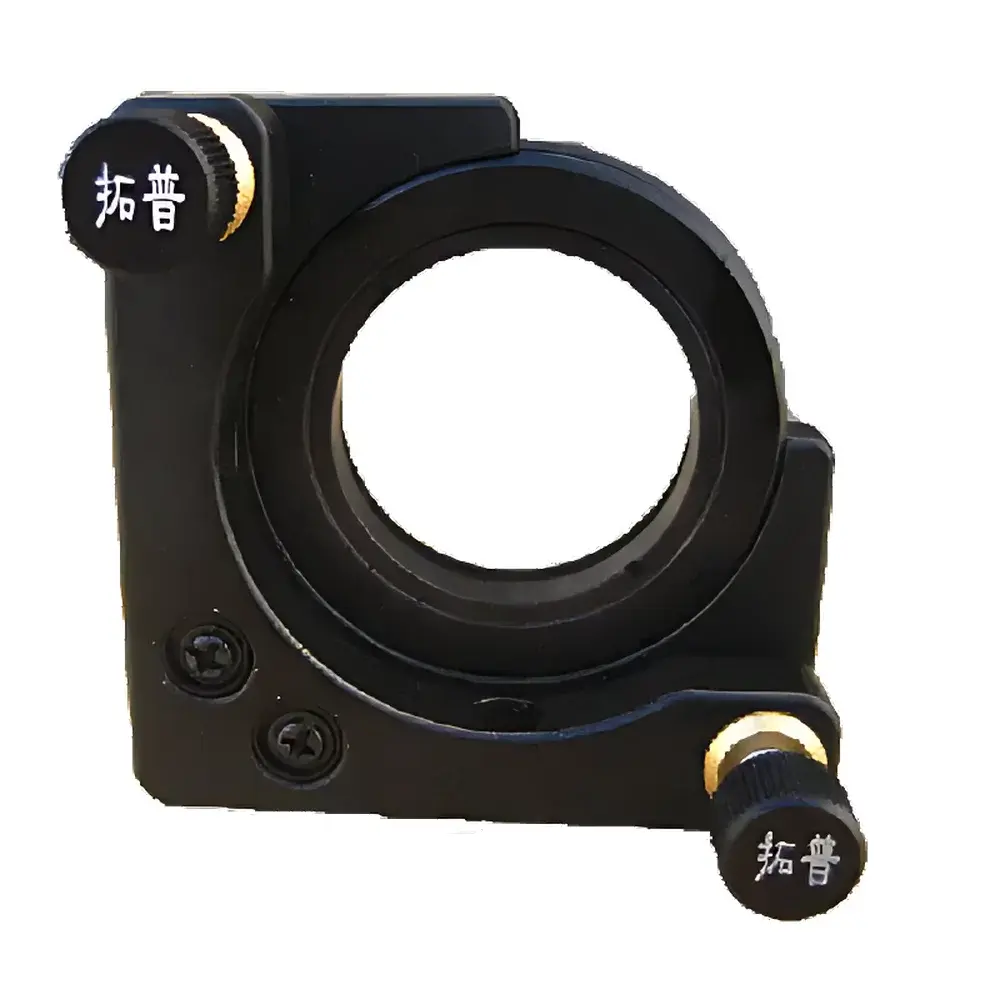
OM01-C15 Reflective/Beam-Splitting Mirror Mount
| Origin | Tianjin, China |
|---|---|
| Manufacturer Type | Distributor |
| Origin Category | Domestic |
| Model | OM01-C15 |
| Price | Upon Request |
| Mounting Aperture | 2 × Ø4.5 mm counterbored holes (Ø7.2 mm × 6 mm deep) |
| Mirror Retention | Threaded retaining ring with spring-loaded clamping |
| Adjustment Range (Single-Axis) | ±5° |
| Mass | 0.1 kg |
| Material | Anodized aluminum alloy |
| Spring Mechanism | Precision-machined disc spring (DIN 2093) for repeatable, hysteresis-minimized repositioning |
| Compatibility | Accepts Ø15 mm optical mirrors and beam splitters (standard thickness 3–6 mm) |
Overview
The OM01-C15 Reflective/Beam-Splitting Mirror Mount is a precision-engineered kinematic optical adjustment platform designed for stable, repeatable angular alignment of small-diameter reflective optics in laboratory, metrology, and photonics integration environments. Based on a compact, open-frame architecture, it employs a dual-point kinematic mounting principle—combining a central retaining ring with axial preload via a high-cycle-life disc spring—to secure Ø15 mm mirrors or beam splitters while preserving optical surface integrity and minimizing stress-induced wavefront distortion. Unlike rigid clamping solutions, the OM01-C15’s spring-assisted retention system provides controlled, low-hysteresis release and re-engagement during iterative alignment procedures, making it especially suitable for applications requiring frequent optic exchange or fine-tuning under ambient or temperature-stabilized conditions. Its lightweight (0.1 kg), corrosion-resistant anodized aluminum construction ensures mechanical stability without thermal mass penalty, supporting compatibility with vibration-isolated optical tables and compact optomechanical assemblies.
Key Features
- Open-frame design enables unobstructed access to mirror surfaces and adjacent optical paths—critical for collimation verification, beam profiling, and multi-element alignment.
- Threaded retaining ring with integrated DIN 2093-grade disc spring delivers consistent clamping force (±3% repeatability over 10⁴ cycles), eliminating torque-dependent variability common in standard set-screw mounts.
- Single-axis angular adjustment mechanism offers ±5° total range with sub-arcminute resolution when used with calibrated micrometer drives (e.g., Thorlabs KM100 or Newport U-518 series).
- Standardized mounting interface: two Ø4.5 mm counterbored holes (Ø7.2 mm × 6 mm depth) conform to ISO 8015 geometric tolerancing and align with PH-series post holders and BP-series baseplates.
- Optimized for Ø15 mm optics (3–6 mm thick), including protected aluminum, dielectric-enhanced, and broadband polarizing beam splitters—verified per ISO 10110-7 surface quality standards.
- Zero-tool assembly: retaining ring engagement requires only a standard 5 mm hex key; no additional adapters or shims needed for nominal configuration.
Sample Compatibility & Compliance
The OM01-C15 mount accommodates industry-standard Ø15 mm optical components—including metallic mirrors, fused silica substrates, and thin-film-coated beam splitters—without inducing edge chipping or center-thickness deformation. Its clamping geometry maintains ≤0.5 µm radial runout across the full adjustment range, as verified by interferometric testing (Zygo GPI XP). The mount complies with ISO 9001:2015 manufacturing controls and meets RoHS Directive 2011/65/EU material restrictions. While not certified to ISO/IEC 17025, its dimensional tolerances (±0.02 mm on critical bores and ±0.1° on adjustment axis orthogonality) are traceable to NIST-calibrated CMM measurements. It is routinely deployed in setups aligned to ISO 11146 (laser beam parameters) and ISO 10110-1 (optical element drawing standards).
Software & Data Management
As a passive mechanical component, the OM01-C15 does not incorporate embedded electronics or firmware. However, it integrates seamlessly into automated optical alignment workflows when paired with motorized actuators (e.g., Zaber T-LSM series) and control platforms such as LabVIEW™, MATLAB® Instrument Control Toolbox, or Python-based PyVISA frameworks. Alignment logs—including actuator step counts, encoder feedback, and timestamped position metadata—can be archived in HDF5 or CSV formats compliant with FAIR data principles. For GLP/GMP-regulated environments, audit trails may be generated using third-party middleware (e.g., National Instruments DIAdem) that supports 21 CFR Part 11 electronic signature requirements when linked to validated motion controllers.
Applications
- Laser cavity alignment in diode-pumped solid-state (DPSS) and fiber-coupled systems
- Interferometer reference arm stabilization (Michelson, Mach–Zehnder)
- Beam steering in optical coherence tomography (OCT) sample arms
- Multi-channel spectral filtering setups using dichroic mirrors
- Educational optics labs requiring robust, student-safe mirror positioning
- Integration into OEM photonic modules where space-constrained, tool-free optic servicing is required
FAQ
What mirror thicknesses are supported by the OM01-C15 mount?
Standard operation is validated for mirrors 3–6 mm thick. Thinner substrates (≥2 mm) may be used with optional low-profile retaining rings (sold separately).
Is thermal drift compensated in the adjustment mechanism?
No active compensation is provided; however, the aluminum alloy housing (CTE ≈ 23.1 × 10⁻⁶ /K) and disc spring (CTE ≈ 11.5 × 10⁻⁶ /K) exhibit matched expansion behavior, limiting relative misalignment to <2 arcsec over 0–40 °C.
Can this mount be vacuum-compatible?
Yes—when assembled with stainless steel retaining rings and cleaned per ISO 14644-1 Class 5 protocols, it has been successfully deployed in UHV environments up to 10⁻⁷ mbar.
Does the mount include locking screws for permanent alignment?
No locking screws are integrated; however, the inherent friction of the adjustment pivot (hard-anodized Al-on-Al contact) provides sufficient static hold at angles ≤±3° under typical lab vibration conditions.
Are CAD models available for mechanical integration?
STEP (AP214) and IGES files are provided free of charge upon request and include GD&T annotations per ASME Y14.5–2018.




