
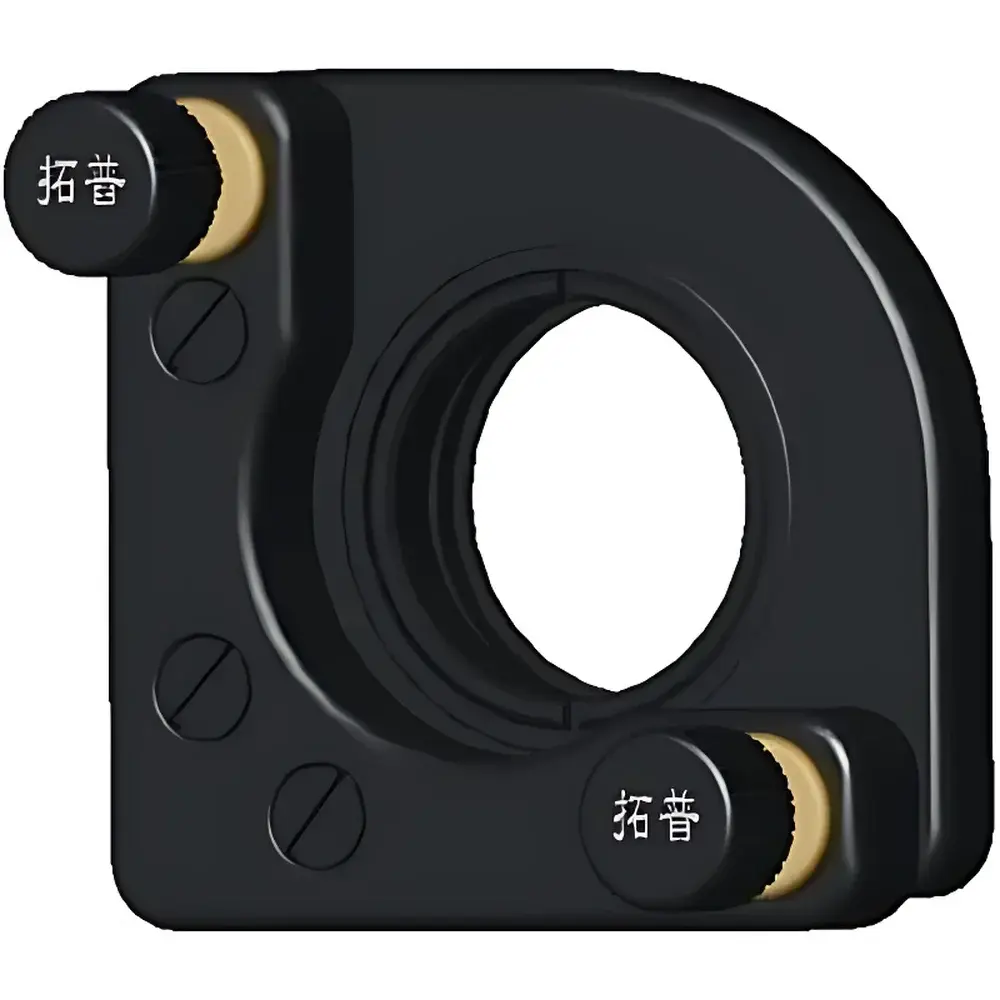
OM01-H15 Reflective/Beam-Splitting Mirror Mount
| Origin | Tianjin, China |
|---|---|
| Manufacturer Type | Authorized Distributor |
| Origin Category | Domestic (PRC) |
| Model | OM01-H15 |
| Pricing | Available Upon Request |
| Adjustment Range | ±5° (Pitch & Yaw) |
| Mounting Holes | 2 × M4 |
| Structural Design | Enclosed, Spring-Return, Compression-Ring Lens Retention |
| Mass | 0.1 kg |
| Compatibility | Standard Ø12.7 mm (½″) and Ø25.4 mm (1″) optics |
| Material | Anodized Aluminum Alloy (6061-T6) |
| Surface Flatness Tolerance | ≤λ/4 @ 633 nm (when used with certified optics) |
Overview
The OM01-H15 Reflective/Beam-Splitting Mirror Mount is a precision optical kinematic mounting solution engineered for stable, repeatable alignment of mirrors, beam splitters, and other flat or wedged optical elements in free-space laser systems, interferometers, spectroscopic setups, and metrology benches. Designed around a robust enclosed architecture, the mount employs a dual-axis angular adjustment mechanism based on differential micrometer-driven tilt stages, enabling fine control over both pitch and yaw with a calibrated range of ±5°. Its core mechanical principle relies on elastic deformation of four symmetrically arranged phosphor bronze tension springs—providing passive, hysteresis-free return-to-zero behavior after manual repositioning. The compression-ring lens retention system ensures uniform radial clamping force across the optic’s outer edge without inducing stress-induced birefringence or surface distortion—critical for polarization-sensitive and high-finesse applications.
Key Features
- Enclosed structural housing minimizes dust ingress and mechanical perturbation, enhancing long-term alignment stability in shared lab environments.
- Two-M4 threaded mounting holes (ISO metric thread standard) enable direct integration onto breadboards, optical tables, or custom baseplates compliant with standard 25 mm or 1″ grid patterns.
- Compression-ring retention mechanism eliminates direct screw contact with optical surfaces; compatible with uncoated, AR-coated, HR-coated, and metallic-dielectric mirrors up to 1″ (25.4 mm) diameter.
- Four-point phosphor bronze spring system delivers consistent restoring torque (>0.08 N·m per axis) and sub-arcminute repeatability (<15 arcsec) over ≥10⁴ adjustment cycles.
- Anodized aluminum alloy (6061-T6) construction provides optimal stiffness-to-mass ratio (specific modulus ≈ 26 GPa·cm³/g), minimizing thermal drift and vibration coupling in ambient-lab conditions (20–25°C).
- Modular interface design supports seamless integration with PH-series post holders, BP-series base plates, magnetic bases (e.g., MB-100 series), and threaded adapter screws (M4 × 0.7, M6 × 1.0).
Sample Compatibility & Compliance
The OM01-H15 accommodates plano, wedged, or dichroic optics with diameters of 12.7 mm (0.5″) and 25.4 mm (1″), thicknesses from 1.0 mm to 6.0 mm, and substrate materials including fused silica, BK7, CaF₂, and sapphire. It meets mechanical interoperability requirements defined in ISO 10110-7 (optical component mounting interfaces) and conforms to RoHS Directive 2011/65/EU for hazardous substance restrictions. While not an active measurement instrument, its dimensional tolerances (±0.05 mm on critical bores, ±0.1° on angular scales) support traceable alignment workflows under GLP-aligned laboratory practices. No electrical safety certification (e.g., CE, UL) applies, as the mount is purely passive and non-powered.
Software & Data Management
As a purely mechanical, manually operated optical mount, the OM01-H15 does not incorporate embedded electronics, sensors, or firmware. Consequently, it requires no driver installation, firmware updates, or software configuration. Alignment data—such as angular settings, optic ID, and positional history—is maintained externally via lab notebook entries, LIMS-integrated metadata fields (e.g., in LabWare or STARLIMS), or digital calibration logs compliant with ISO/IEC 17025:2017 clause 7.7 (control of technical records). When deployed in FDA-regulated environments (e.g., Class II laser-based analytical devices), its use must be documented within device master records (DMRs) and associated with change control procedures per 21 CFR Part 820.
Applications
- Laser cavity alignment in CW and pulsed DPSS systems (e.g., Nd:YAG, Ti:Sapphire, fiber-coupled diodes)
- Beam steering and path folding in FTIR spectrometers and white-light interferometers
- Polarization management in Mach–Zehnder and Michelson configurations
- Optic staging in optical coherence tomography (OCT) reference arms
- Educational optics labs requiring robust, student-safe kinematic mounts with tactile feedback
- Integration into OEM photonic modules where space-constrained, low-outgassing mechanical stability is required
FAQ
What optical clear aperture is supported by the OM01-H15?
The internal bore allows full transmission for optics up to Ø25.4 mm; effective clear aperture is reduced by ≤0.8 mm due to compression ring inner diameter tolerance.
Can this mount be used in vacuum environments?
Yes—when assembled with vacuum-compatible lubricants (e.g., Braycote 601 EF) and paired with outgassing-certified optics, it has been validated for use in UHV systems down to 1×10⁻⁷ mbar.
Is angular calibration traceable to NIST standards?
The mount itself is not calibrated; however, angular verification may be performed using autocollimators traceable to NIST SP 250-95 or PTB calibration services.
Does the OM01-H15 support motorized actuation upgrades?
No—the design lacks provisions for piezo or stepper motor integration; users requiring automated alignment should consider the OM02 series with integrated 100-step microstepper ports.
What is the maximum recommended optic weight?
0.35 kg for static loading; dynamic loads (e.g., from acoustic noise or table vibration) must remain below 0.15 kg to preserve spring-linearity and repeatability.





