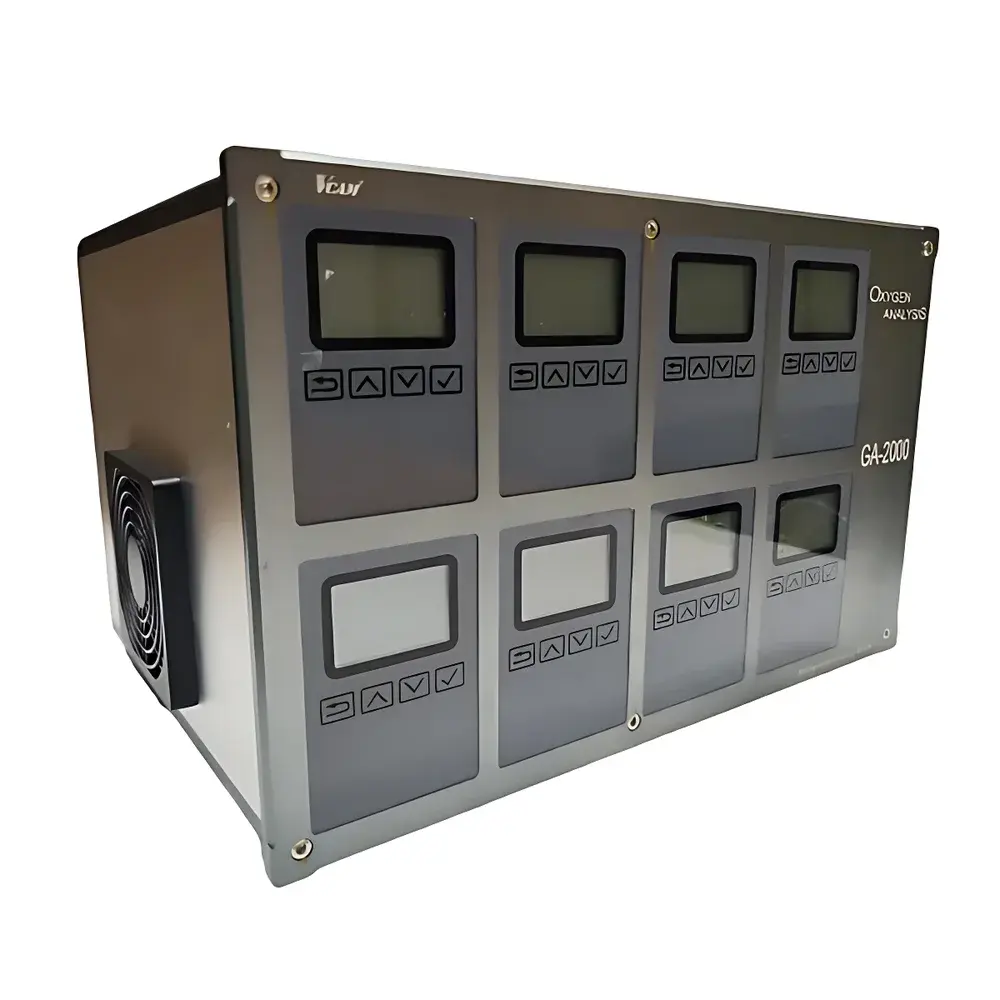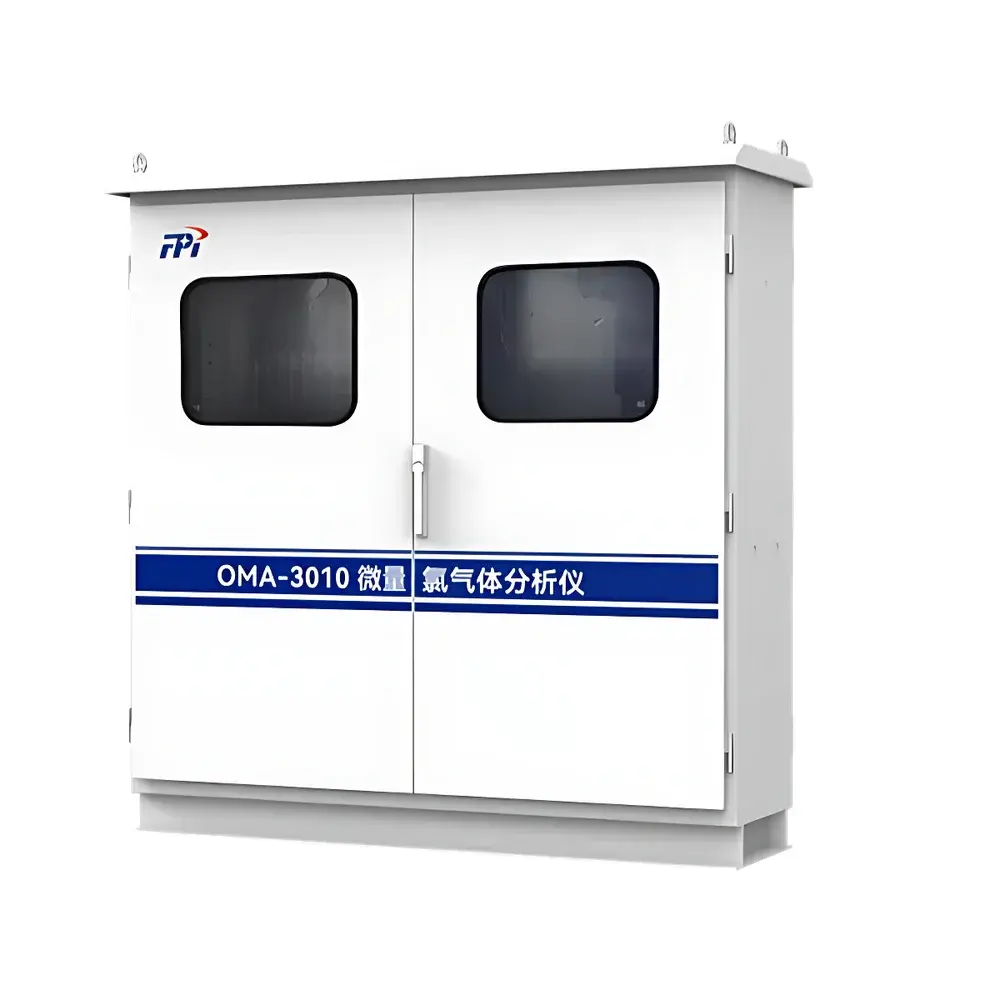
OMA-3010 Trace Chlorine (Cl₂) Analyzer
| Brand | FPI (Fortune Photonics Instrumentation) |
|---|---|
| Model | OMA-3010 |
| Measurement Principle | UV Absorption Spectrophotometry (220–360 nm) |
| Detection Range | 0–1 ppm and 0–10 ppm (auto-switching dual-range) |
| Detection Limit | <50 ppb Cl₂ |
| Sample Gas Temperature | –10 to 60 °C |
| Sample Pressure | 0.05–0.3 MPa (gauge) |
| Corrosion Resistance | Hastelloy C-276 wetted parts, PTFE/PFA-lined flow path |
| Output Interface | 4–20 mA, RS485, Modbus TCP |
| Compliance | CE, RoHS, ISO 9001 certified |
| Enclosure Rating | IP65 |
| Operating Environment | Indoor/Outdoor (with shelter), –20 to +50 °C ambient |
Overview
The OMA-3010 Trace Chlorine (Cl₂) Analyzer is an industrial-grade online gas analyzer engineered for continuous, real-time quantification of trace chlorine in aggressive process streams—particularly critical in chlor-alkali, vinyl chloride monomer (VCM), and polyvinyl chloride (PVC) production facilities. It operates on the principle of ultraviolet (UV) absorption spectrophotometry, leveraging Beer-Lambert law-based quantification at characteristic Cl₂ absorption bands between 220 nm and 360 nm. Unlike electrochemical or amperometric sensors—which suffer from drift, cross-sensitivity, and limited service life—the OMA-3010 employs a solid-state UV light source, high-stability fiber-optic transmission, and a thermoelectrically cooled CCD spectrometer to deliver long-term baseline stability and measurement reproducibility. Its design addresses a well-documented safety hazard in acetylene-based HCl synthesis: residual Cl₂ in HCl main headers can initiate exothermic, uncontrolled reactions with acetylene (C₂H₂), risking thermal runaway and catastrophic equipment failure. By enabling sub-ppm detection with automatic dual-range switching (0–1 ppm / 0–10 ppm), the OMA-3010 supports proactive process intervention before Cl₂ concentrations breach safe operational thresholds defined by internal safety protocols and industry guidelines such as IEC 61511 (functional safety of SIS).
Key Features
- Auto-switching dual-range optical detection: Seamlessly transitions between high-sensitivity (0–1 ppm) and extended-range (0–10 ppm) modes based on real-time Cl₂ concentration—eliminating manual range selection and reducing operator error.
- Corrosion-resistant sample conditioning system: Wetted components fabricated from Hastelloy C-276; all gas-contact surfaces lined with PTFE or perfluoroalkoxy (PFA); integrated heated sample line (optional) to prevent condensation-induced corrosion or analyte adsorption.
- Optical path stabilization: Active temperature control of spectrometer and UV source ensures wavelength accuracy ±0.2 nm and photometric repeatability better than ±1% RSD over 30 days without recalibration.
- Modular architecture: Analyzer head (OMA-3000 platform), preprocessor, and optional H₂S/CO scrubber are field-replaceable units—supporting maintenance under partial shutdown and minimizing mean time to repair (MTTR).
- Self-diagnostic capability: Continuous monitoring of lamp intensity, detector signal-to-noise ratio, optical alignment status, and flow integrity—with configurable alarm thresholds and event logging compliant with ISA-84.01 requirements.
Sample Compatibility & Compliance
The OMA-3010 is validated for use with dry or saturated HCl gas streams containing up to 10% moisture, ≤50 ppm H₂S, ≤100 ppm SO₂, and particulate loadings below 1 mg/m³. It exhibits negligible interference from CO₂, N₂, O₂, and CH₄ across its operating range. The system conforms to electromagnetic compatibility (EMC) standards per EN 61326-1 and carries CE marking for use in Zone 2 hazardous areas when installed with appropriate barrier certification (e.g., ATEX/IECEx-compliant intrinsically safe barriers). All firmware and configuration data adhere to ALCOA+ principles (Attributable, Legible, Contemporaneous, Original, Accurate, Complete, Consistent, Enduring, Available) for regulated environments. Audit trails, user access controls, and electronic signature support align with FDA 21 CFR Part 11 readiness—enabling deployment in GMP-aligned VCM purification trains.
Software & Data Management
The embedded analyzer firmware supports local display via 7-inch capacitive touchscreen with multilingual UI (English, Chinese, Spanish). Remote operation is enabled through OPC UA server integration (v1.04), allowing seamless connection to DCS, MES, or cloud-based IIoT platforms (e.g., Siemens MindSphere, Rockwell FactoryTalk). Historical Cl₂ concentration data—including timestamps, range mode, diagnostic flags, and calibration logs—is stored onboard for ≥90 days and exportable via USB or FTP. Optional FPI CloudConnect module provides encrypted TLS 1.2 telemetry, predictive maintenance alerts (based on lamp decay rate and spectral SNR trends), and over-the-air firmware updates verified via SHA-256 signature.
Applications
- Chlor-alkali plants: Monitoring Cl₂ slip in HCl synthesis reactors and absorbers to maintain <100 ppb Cl₂ in final HCl product per ISO 8573-1 Class 2 purity requirements.
- VCM manufacturing: Ensuring Cl₂-free feed gas to acetylene converters—preventing catalyst poisoning and mitigating explosion risk in front-end synthesis sections.
- Waste gas incineration off-gas streams: Verifying Cl₂ abatement efficiency in scrubber bypass lines where residual halogen species may indicate incomplete neutralization.
- Electrolytic cell house ventilation ducts: Early-warning detection of Cl₂ leakage during membrane cell maintenance or gasket failure events.
- Chemical storage area perimeter monitoring: Integration into facility-wide toxic gas detection networks with programmable relay outputs for ventilation interlock activation.
FAQ
What is the minimum detectable Cl₂ concentration, and how is it verified?
The instrument achieves a limit of detection (LOD) of 30–50 ppb Cl₂ (3σ criterion) using a 1-meter pathlength cell under standard conditions (25 °C, 101.3 kPa). LOD verification follows ISO 11843-2:2000 and is documented in factory calibration certificates traceable to NIST SRM 1971.
Can the OMA-3010 operate continuously in 100% HCl gas without degradation?
Yes—its fully fluoropolymer-wetted preprocessor and Hastelloy C-276 optical cell enable >12 months of uninterrupted operation in 100% HCl at ≤60 °C, as demonstrated in third-party accelerated life testing per ASTM G152.
Is periodic calibration required, and what standards are used?
Zero calibration uses high-purity nitrogen (99.999%); span calibration employs gravimetrically prepared Cl₂/N₂ standard mixtures certified to ISO 6141, with typical intervals of 7–30 days depending on process stability and regulatory expectations.
Does the system support redundant sensor output for safety instrumented systems (SIS)?
Yes—dual 4–20 mA outputs (primary and backup channels) with independent fault diagnostics are available; both channels meet SIL 2 requirements per IEC 61508 when integrated with certified logic solvers.
How is optical window fouling managed in dusty or mist-laden streams?
The system integrates pulsed nitrogen purge (0.2 MPa, 2 L/min) directed tangentially across the quartz windows, supplemented by real-time spectral baseline correction algorithms that compensate for gradual transmittance loss without interrupting measurement.