
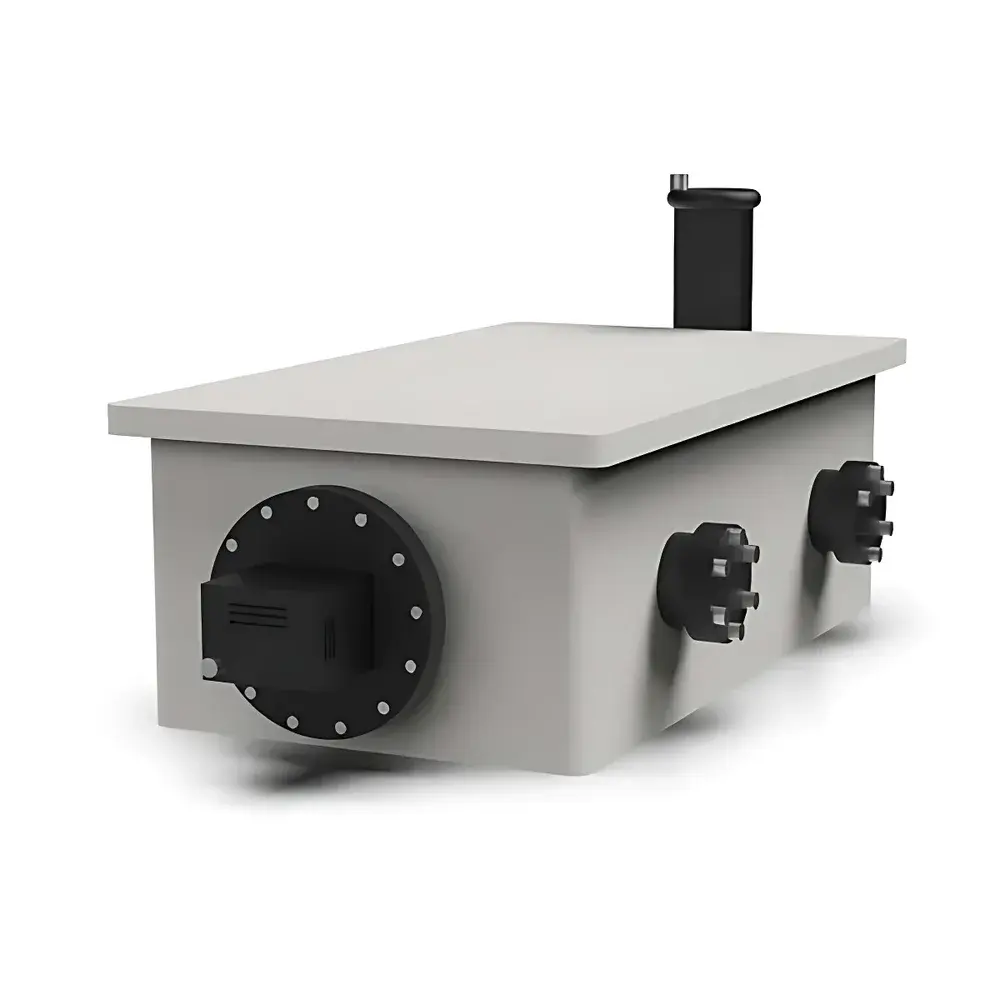
Omni-FD Series Flat-Field Grating Extreme Ultraviolet (EUV) Spectrometer
| Brand | ZOLIX |
|---|---|
| Origin | Beijing, China |
| Manufacturer Type | Direct Manufacturer |
| Model | Omni-FD Series |
| Price | USD 56,000 (FOB Beijing) |
| Grating Configuration | Triple-Grating Turret |
| Incidence Angle | 87° |
| Vacuum Compatibility | ≤1×10⁻⁵ Pa |
| Grating Size | 50 mm × 30 mm |
| Detector Interface | MCP or Vacuum-Compatible CCD/CMOS Camera Mount |
| Spectral Ranges | 1–5 nm (2400 g/mm), 5–20 nm (1200 g/mm), 20–80 nm (300 g/mm) |
| Resolution (FWHM) | 0.02 nm @ 1–5 nm, 0.03 nm @ 5–20 nm, 0.15 nm @ 20–80 nm |
| Energy Range | 12.4–1240 eV |
| Stray Light Suppression | Optimized Entrance Optics with Baffling & Zero-Order Rejection Architecture |
| Focal Plane Adjustment | Continuous Translation Mechanism (±5 mm range) |
| Calibration | In-situ Wavelength Reference via He/Ne/Ar Plasma Lines or Synchrotron White Beam |
Overview
The Omni-FD Series Flat-Field Grating Extreme Ultraviolet (EUV) Spectrometer is an engineered optical instrument designed for high-fidelity spectral analysis in the 1–80 nm wavelength range — spanning the soft X-ray, extreme ultraviolet (EUV), and vacuum ultraviolet (VUV) regions. Built upon aberration-corrected flat-field grating optics, the spectrometer eliminates coma and astigmatism across its entire spectral coverage, enabling simultaneous multi-wavelength detection without refocusing. Its 87° grazing-incidence geometry maximizes diffraction efficiency for short-wavelength radiation while minimizing absorption losses in air — necessitating operation under ultra-high vacuum (UHV) conditions (≤1×10⁻⁵ Pa). The system integrates a motorized triple-grating turret, allowing rapid, repeatable switching among three ruled gratings (300, 1200, and 2400 lines/mm), each optimized for distinct energy bands. This architecture supports quantitative photon flux measurement, spectral line profiling, and absolute radiometric calibration — critical for EUV source characterization, high-harmonic generation (HHG) diagnostics, and plasma emission studies.
Key Features
- Grazing-incidence flat-field design with aberration correction across 1–80 nm, delivering spatially resolved spectra on a planar focal surface
- Triple-grating turret with automated selection: 300 g/mm (20–80 nm), 1200 g/mm (5–20 nm), and 2400 g/mm (1–5 nm), each pre-aligned and calibrated
- UHV-compatible mechanical architecture with all-metal seals and bake-out capability; compatible with standard CF-63 and CF-100 flanges
- Dedicated entrance optics featuring baffle-staged apertures and off-axis masking to suppress stray light and higher-order diffractions
- Zero-order suppression mechanism integrated into the grating mount and detector alignment path, eliminating non-dispersive background contributions
- Motorized focal plane translation stage (±5 mm travel, 1 µm repeatability) for precise focus optimization with varied detector types (MCP, back-thinned CCD, or CMOS sensors)
- In-situ wavelength calibration support using known emission lines from He, Ne, Ar, or Kr plasmas — traceable to NIST-referenced transition energies
Sample Compatibility & Compliance
The Omni-FD Series operates exclusively in vacuum environments and is intended for use with photon-emitting sources such as laser-produced plasmas, synchrotron beamlines, HHG setups, and discharge lamps. It accepts standard vacuum-compatible detectors including microchannel plate (MCP) imaging systems, delay-line anodes, and scientific-grade vacuum CCD/CMOS cameras (e.g., Andor iStar, Princeton Instruments PI-MAX, or custom UHV-integrated sensors). All optical surfaces are coated with Ir, Pt, or SiC multilayers depending on grating configuration to maximize reflectivity in target bands. The instrument complies with ISO 14644-1 Class 5 cleanroom assembly protocols and conforms to CE marking requirements for electromagnetic compatibility (EMC Directive 2014/30/EU) and low-voltage safety (LVD Directive 2014/35/EU). Design documentation supports GLP-compliant validation per ICH Q5A(R2) and ASTM E275-22 for spectral instrument qualification.
Software & Data Management
ZOLIX provides the SpectraView Pro control suite — a Windows-based application supporting full instrument orchestration, including grating selection, slit width adjustment, detector triggering, and real-time spectral acquisition. Raw data export adheres to HDF5 format with embedded metadata (wavelength axis, grating ID, vacuum pressure, timestamp, calibration coefficients), ensuring FAIR (Findable, Accessible, Interoperable, Reusable) principles. The software includes built-in algorithms for dark-current subtraction, pixel-to-wavelength mapping refinement, and line-shape deconvolution using Voigt profile fitting. For regulated environments, optional 21 CFR Part 11 compliance modules are available, providing electronic signatures, audit trails, and role-based access control. API support (DLL and Python bindings) enables integration into LabVIEW, MATLAB, or custom Python automation frameworks used in large-scale experimental campaigns.
Applications
- Calibration and spectral responsivity mapping of EUV photodetectors and lithography masks
- Time-resolved spectroscopy of high-harmonic generation (HHG) sources in attosecond science laboratories
- Line emission analysis from laser-driven or pinch plasmas for fusion diagnostics and atomic physics research
- Vacuum ultraviolet (VUV) characterization of photoresists and optical coatings in semiconductor process development
- Energy-resolved detection in free-electron laser (FEL) beamlines and synchrotron endstations
- Development and validation of theoretical atomic transition databases (e.g., CHIANTI, NIST ASD)
FAQ
What vacuum level is required for stable operation?
The spectrometer requires continuous pumping to maintain ≤1×10⁻⁵ Pa during acquisition; turbomolecular pumps with LN₂ traps or cryo-pumps are recommended.
Can the Omni-FD be integrated with existing UHV chambers?
Yes — standard CF-63 and CF-100 flange interfaces are provided; custom flange configurations (e.g., KF-50, ISO-K) are available upon request.
Is NIST-traceable calibration included?
A factory baseline calibration using He I (58.4 nm) and Ne I (73.6 nm) lines is supplied; full NIST-traceable recalibration services are offered annually.
Does the system support time-gated detection?
Yes — TTL-compatible trigger inputs synchronize grating motion, shutter actuation, and detector gating with sub-microsecond precision.
What maintenance is required for long-term stability?
Annual inspection of grating alignment and UHV seal integrity is recommended; no consumables or optical realignment tools are required under normal operating conditions.




