
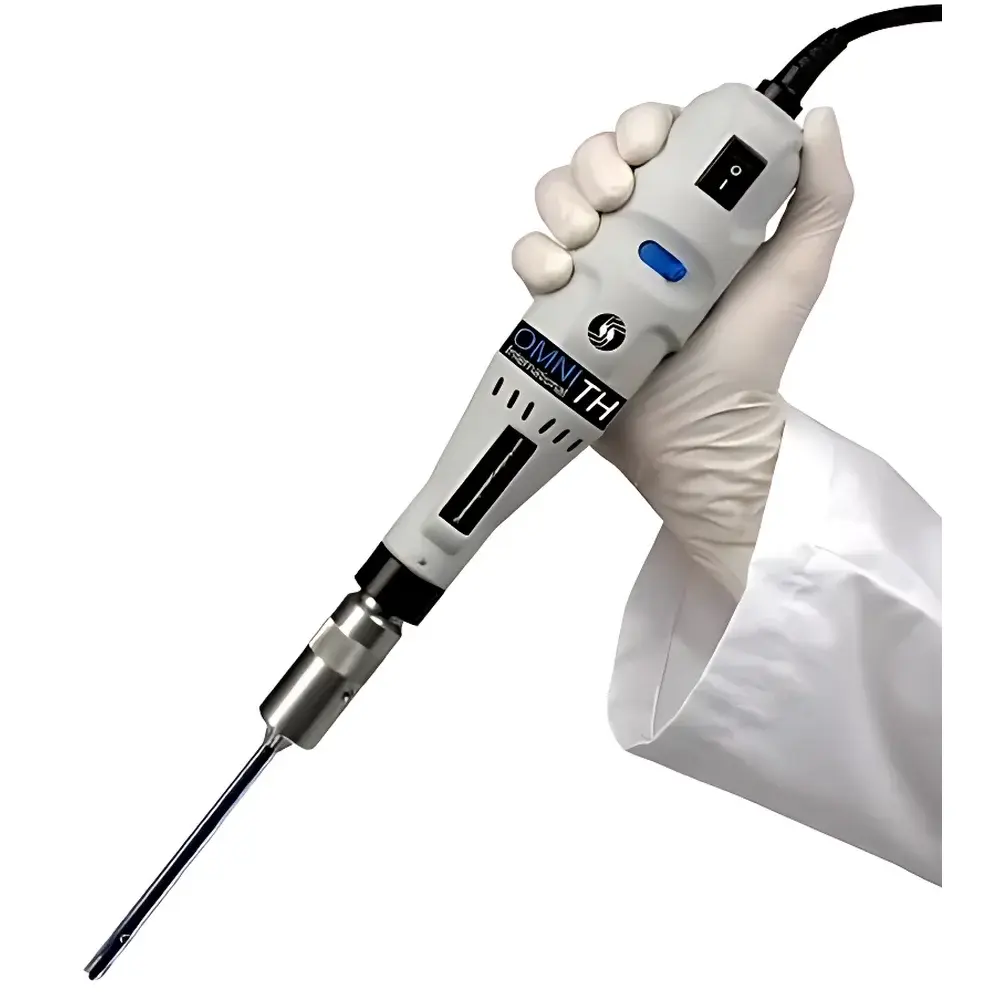
Omni TH Series Tissue Homogenizer
| Brand | Omni |
|---|---|
| Origin | USA |
| Manufacturer Type | Authorized Distributor |
| Product Origin | Imported |
| Model | OMNI-TH |
| Pricing | Upon Request |
| Motor Power | 125 W |
| Sample Volume Range | 0.03–100 mL |
| Operating Noise Level | <72 dB(A) |
| Speed Range | 5,000–35,000 rpm |
| Probe Options | Disposable Plastic or Reusable Stainless Steel Probes |
Overview
The Omni TH Series Tissue Homogenizer is a high-performance, benchtop rotary homogenization system engineered for rapid, reproducible disruption of biological tissues, cells, and soft-to-medium-hard samples in life science laboratories. Based on high-shear rotor-stator principle—where a rapidly rotating probe generates intense localized fluid shear and cavitation within the sample—the TH Series delivers consistent mechanical lysis without significant thermal buildup when operated under recommended duty cycles. Designed specifically for low-to-medium throughput applications (e.g., single-sample or sequential batch processing), it serves as a critical front-end tool in nucleic acid extraction, protein isolation, metabolite profiling, and histopathological sample preparation workflows. Its compact footprint, intuitive speed control, and compliance with international safety standards make it suitable for use in ISO 13485-aligned biobanks, GLP-compliant research labs, and academic core facilities requiring traceable, operator-safe homogenization.
Key Features
- 125 W brushless motor delivering stable torque across the full speed range (5,000–35,000 rpm), optimized for both viscous lysates and low-volume microsamples (down to 0.03 mL)
- Ergonomically contoured housing with non-slip grip and balanced weight distribution—reducing operator fatigue during extended use
- Acoustically damped enclosure achieving <72 dB(A) noise emission at 1 m distance, enabling operation in shared lab environments without dedicated soundproofing
- Dual-probe compatibility: Interchangeable stainless steel probes (autoclavable, corrosion-resistant) and single-use polypropylene probes (certified DNase/RNase-free, reducing cross-contamination risk)
- CE-marked per Directive 2014/30/EU (EMC) and 2014/35/EU (LVD), with documented conformity assessment and technical file available upon request
- Speed adjustment via precision analog dial with visual RPM indicator—no software dependency required for basic operation
Sample Compatibility & Compliance
The TH Series accommodates a broad spectrum of biological matrices—including mammalian tissues (liver, spleen, brain), cultured cells (adherent and suspension), plant leaves, yeast pellets, and bacterial cultures—without requiring pre-freezing or cryogenic assistance. Probe geometry (available in 7 mm, 10 mm, and 15 mm diameters) allows optimization for viscosity and particulate load. All stainless steel probes meet ASTM F899 standard for surgical-grade martensitic stainless steel. Disposable plastic probes are manufactured under ISO 13485-certified conditions and supplied in individually sealed, sterile packaging. The system supports documentation practices aligned with FDA 21 CFR Part 11 requirements when integrated with validated LIMS or ELN platforms via optional analog output (0–10 V) for speed logging.
Software & Data Management
While the TH Series operates as a stand-alone instrument with no embedded firmware or touchscreen interface, it includes an analog voltage output port (0–10 V, linearly proportional to set RPM) compatible with external data acquisition systems (e.g., LabChart, DIAdem, or custom Python/NI LabVIEW scripts). This enables time-stamped speed monitoring, integration into automated SOP execution logs, and audit-trail generation for GxP-regulated environments. Optional accessories include probe calibration fixtures and traceable speed verification kits (NIST-traceable tachometer validation), supporting laboratory quality management systems compliant with ISO/IEC 17025.
Applications
- Routine tissue homogenization prior to RNA/DNA extraction (e.g., TRIzol®-based protocols)
- Preparation of whole-cell lysates for Western blotting and ELISA quantification
- Homogenization of frozen tissue sections (at −20 °C ambient) using chilled probes and pre-cooled tubes
- Disruption of biofilm aggregates and fungal hyphae for microbiome analysis
- Sample prep for LC-MS metabolomics where minimal analyte degradation and oxidation are critical
- Supporting ISO 15189-accredited clinical pathology labs performing standardized tissue processing
FAQ
Is the OMNI-TH compatible with centrifuge tubes from major vendors (e.g., Eppendorf, Sarstedt)?
Yes—standard probe lengths are designed to fit 1.5 mL, 2.0 mL, 15 mL, and 50 mL conical tubes with appropriate depth clearance. Probe tip immersion depth is adjustable via threaded collar.
Can the TH Series be used for homogenizing fibrous or collagen-rich tissues?
It is effective for moderate-fiber tissues (e.g., muscle, heart) when paired with a 10 mm or 15 mm stainless steel probe and pulsed operation (10 s on / 5 s off) to manage heat dissipation.
Does Omni provide IQ/OQ documentation for regulated laboratories?
Yes—validated installation qualification (IQ) and operational qualification (OQ) protocols, including probe calibration certificates and performance verification test methods, are available under NDA upon purchase.
What maintenance is required for long-term reliability?
Routine cleaning of probe shafts and motor housing with 70% ethanol; annual inspection of bearing integrity and electrical insulation resistance (per IEC 61000-4-8) is recommended for GMP environments.




