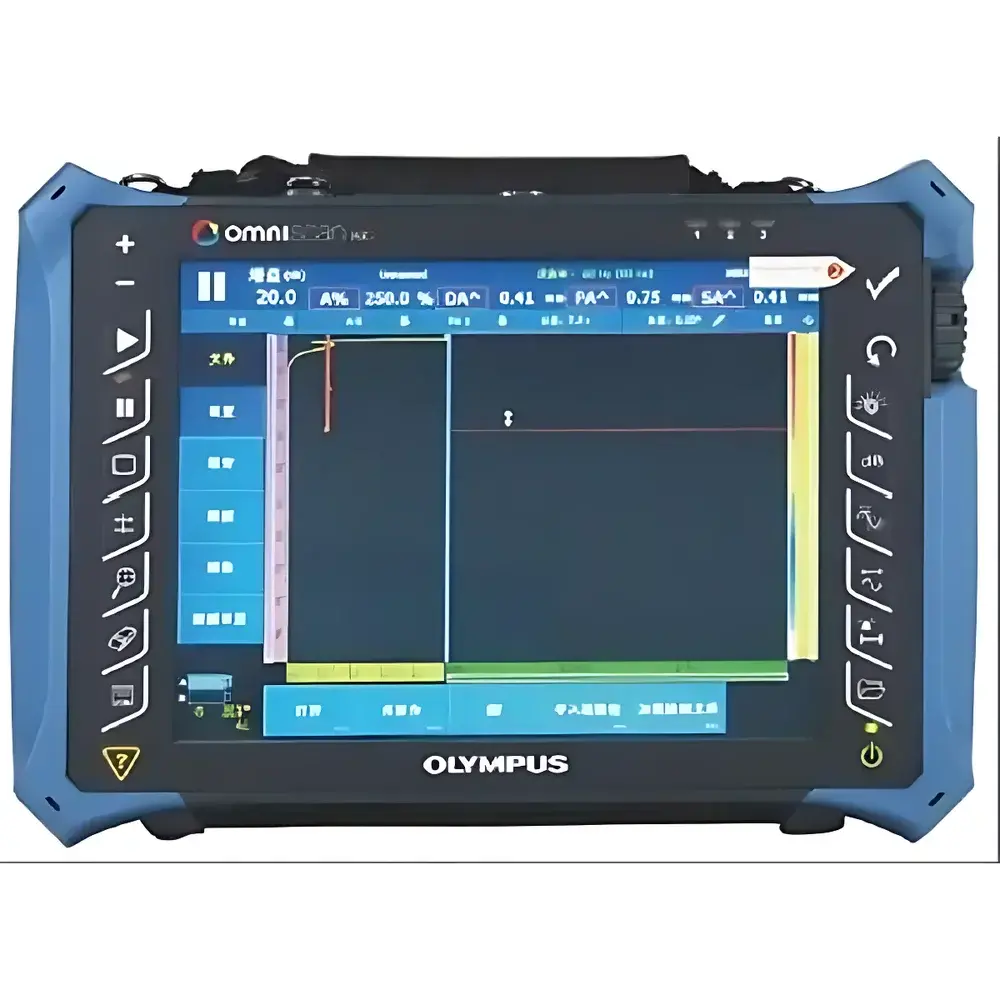
OmniScan MX2 Wind Turbine Blade Automated Inspection & Analysis Software
| Brand | Olympus |
|---|---|
| Origin | Shanghai, China |
| Manufacturer Type | Authorized Distributor |
| Country of Origin | China |
| Model | OmniScan MX2 |
| Pricing | Available Upon Request |
Overview
The OmniScan MX2 Wind Turbine Blade Automated Inspection & Analysis Software is a specialized post-processing and evaluation platform engineered for ultrasonic phased array (PAUT) and time-of-flight diffraction (TOFD) C-scan data acquired from wind turbine blade inspections. Designed to integrate natively with Olympus’ OmniScan family—including the MX2, SX, X3, and NDT-compatible NED platforms—the software processes industry-standard file formats including OPD (OmniScan Parameter Data), ODAT (Olympus Data Archive Template), and NED (NDT Export Data). It implements deterministic image segmentation and geometric measurement algorithms to automate quantitative assessment of critical structural features—most notably adhesive bondline width (glue line width) and internal discontinuities such as delaminations, porosity clusters, or disbonds within spar caps and shear webs. The software operates on the principle of pixel-intensity thresholding combined with morphological analysis applied to calibrated C-scan amplitude maps, enabling traceable, repeatable measurements aligned with ASTM E2700 and ISO 16840-2 guidelines for ultrasonic composite inspection.
Key Features
- Automated bondline width measurement with sub-pixel interpolation and edge-detection validation against user-defined tolerance bands
- Quantitative defect characterization: length, width, maximum projected area, and centroid location for each detected discontinuity
- Multi-format compatibility: native support for OPD (MX2/SX), ODAT (X3), and NED (legacy/enterprise export) file structures without data conversion loss
- Batch processing engine capable of sequential analysis of >100 C-scan datasets per blade—reducing manual review time by ≥70% versus conventional point-and-click workflows
- Configurable pass/fail logic based on configurable dimensional thresholds and amplitude-based signal-to-noise criteria
- Export-ready reporting module generating PDF and CSV outputs compliant with ISO/IEC 17025 documentation requirements
Sample Compatibility & Compliance
The software is validated for use with carbon fiber-reinforced polymer (CFRP) and glass fiber-reinforced polymer (GFRP) wind turbine blades ranging from 40 m to 100+ m in length. It supports standard inspection configurations using linear and matrix array probes operating at frequencies from 1 MHz to 7.5 MHz, with water-path or wedge-coupled setups. All measurement algorithms are traceable to NIST-traceable reference standards (e.g., IMS-1, BMS 5-132 blocks) and comply with the data integrity provisions of FDA 21 CFR Part 11 when deployed in regulated quality assurance environments. Audit trails record operator ID, timestamp, parameter changes, and measurement overrides—supporting GLP/GMP-aligned QA/QC workflows.
Software & Data Management
Deployed as a Windows-based desktop application (64-bit, Windows 10/11), the software employs SQLite-backed local databases for secure storage of inspection metadata, measurement logs, and annotated C-scan images. Raw data remains unaltered; all analyses are non-destructive and stored separately as versioned result sets. Integration with enterprise LIMS or SAP QM modules is supported via standardized XML and JSON APIs. Electronic signatures, role-based access control (RBAC), and encrypted report exports satisfy ISO 9001:2015 Clause 8.5.2 and IEC 61508 functional safety documentation expectations for industrial software tools.
Applications
- Production-line QA of bonded joints in spar cap assemblies during blade manufacturing
- In-service inspection of aging blades for progressive delamination growth monitoring
- Root cause analysis of field failures through retrospective C-scan re-evaluation with updated measurement criteria
- Supplier qualification audits requiring objective, vendor-agnostic defect quantification
- Training and certification of NDT Level II personnel using standardized digital reference datasets
FAQ
Does this software replace certified NDT personnel in final acceptance decisions?
No. It provides objective, reproducible measurements to augment human interpretation—not substitute for Level II or III certified inspectors’ judgment per ISO 9712.
Can measurement parameters be adjusted for different composite layups or probe frequencies?
Yes. Thresholds, kernel sizes, and edge sensitivity are fully configurable per inspection procedure, with saved presets linked to ASME BPVC Section V Article 4 compliance records.
Is cloud deployment or SaaS licensing available?
No. This is an on-premise, node-locked application licensed per workstation; no internet connectivity is required during operation.
What calibration verification protocols does the software support?
It includes built-in verification routines for spatial resolution (using line-pair phantoms) and amplitude linearity (via step-wedge reference scans), aligned with EN 1330-4 and ASTM E1316 definitions.
How is software validation documented for regulated industries?
A complete IQ/OQ/PQ validation package—including test scripts, evidence logs, and summary reports—is provided upon request and conforms to GAMP 5 Category 3 specifications for configurable off-the-shelf software.