
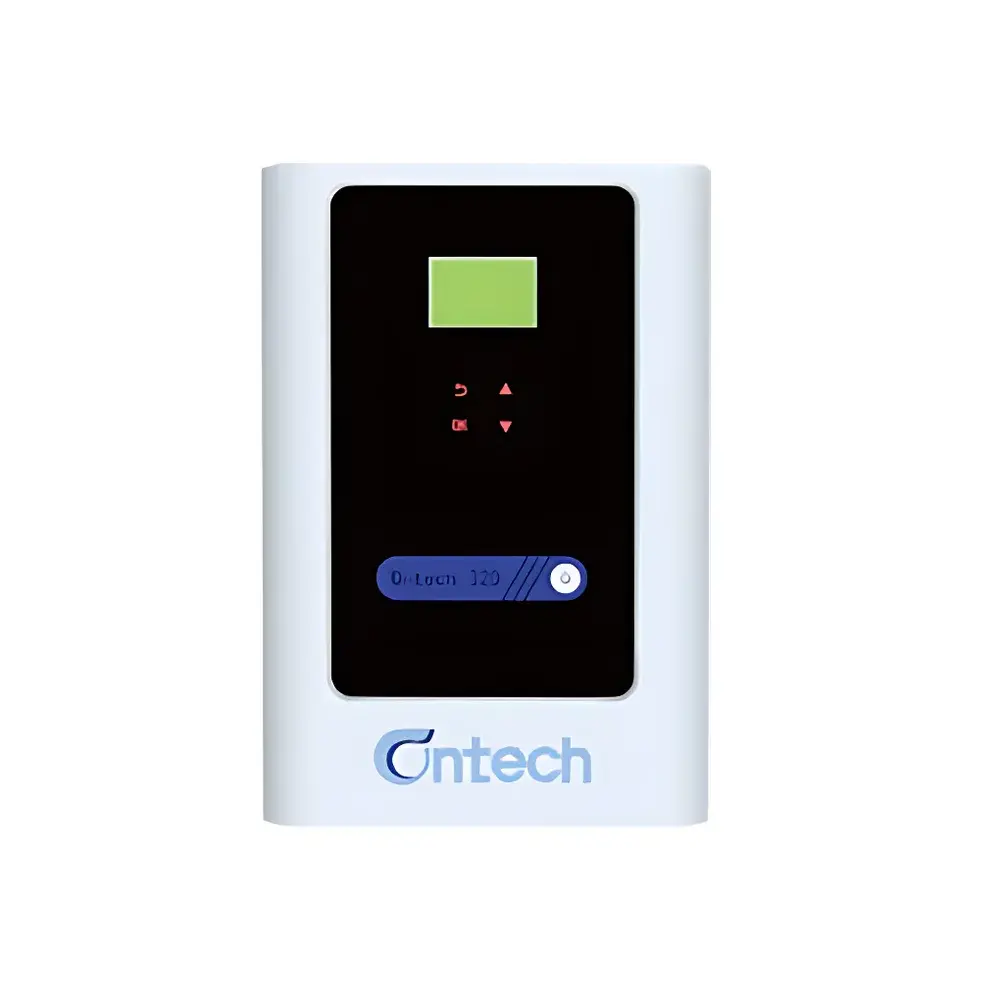
Ontech320 Portable Volatile Organic Compounds (VOC) Analyzer
| Brand | Ontech |
|---|---|
| Model | Ontech320 |
| Detection Principle | Dual FID/PID |
| Explosion Protection | Ex d IIB T4 Gb / Ex ia IIC T4 Ga |
| Compliance | GB 37822–2019 |
| Connectivity | Wireless (2.4 GHz RF), Cloud API Integration |
| Data Storage | On-device + Cloud-synced |
| Response Time (T90) | <3 s (FID), <2 s (PID) |
| Detection Range | 0.1–10,000 ppm (FID), 1–20,000 ppb (PID) |
| Power Supply | Rechargeable Li-ion battery (≥8 h continuous operation) |
| Operating Temperature | −20 °C to +50 °C |
| Ingress Protection | IP65 |
Overview
The Ontech320 Portable Volatile Organic Compounds (VOC) Analyzer is an intrinsically safe, field-deployable gas detection instrument engineered for real-time, quantitative measurement of volatile organic compounds in ambient air and industrial emission sources. It employs dual detection technology—flame ionization detection (FID) and photoionization detection (PID)—to deliver broad-spectrum sensitivity across aliphatic, aromatic, chlorinated, and oxygenated VOCs, as well as select inorganic species such as ammonia and hydrogen sulfide. Designed in accordance with China’s GB 37822–2019 “Control Standard for Unorganized Emissions of Volatile Organic Compounds,” the Ontech320 supports regulatory compliance verification, fugitive emission surveys, and rapid source identification during environmental inspections or emergency response scenarios. Its compact form factor, integrated wireless architecture, and explosion-rated construction enable reliable operation in Zone 1/Zone 2 hazardous areas without compromising analytical integrity or operational flexibility.
Key Features
- Intrinsically safe handheld controller (Ex ia IIC T4 Ga) and explosion-proof FID module (Ex d IIB T4 Gb), certified for use in classified hazardous locations.
- Dual-sensor configuration: FID for total hydrocarbon quantification (0.1–10,000 ppm) and PID (10.6 eV lamp) for low-concentration aromatic/chlorinated VOC detection (1–20,000 ppb).
- Sub-3-second T90 response time ensures dynamic leak detection and real-time plume tracking during walking surveys or mobile monitoring campaigns.
- Wireless bidirectional communication between analyzer and controller eliminates cable constraints, enabling flexible probe positioning and ergonomic one-handed operation.
- Cloud-native data workflow: automatic timestamped upload to secure web platform via encrypted MQTT/HTTPS; supports batch export in CSV and PDF report formats compliant with GLP documentation requirements.
- QR-code–enabled site mapping: scan pre-deployed location tags to auto-load point-specific metadata—including sampling protocol, operator ID, and historical baseline—reducing manual entry errors and audit trail gaps.
Sample Compatibility & Compliance
The Ontech320 is validated for direct analysis of ambient air, stack effluents (diluted), and headspace vapors from soil or water samples. It demonstrates high reproducibility (RSD <5% at 100 ppm hexane) across temperature and humidity gradients (20–90% RH). Regulatory alignment includes full traceability to GB 37822–2019 methodology requirements for unorganized emission monitoring, with built-in calibration verification routines per ISO 17025–recommended practices. While not CE-marked or EPA TO-15/TO-17 certified, its FID/PID performance characteristics are consistent with ASTM D6348–22 Annex A1 guidance for portable VOC screening instruments used in industrial hygiene and environmental compliance applications.
Software & Data Management
The Ontech Cloud Platform provides role-based access control, audit-trail logging (per FDA 21 CFR Part 11 principles), and configurable alert thresholds for exceedance events. Field data is stored locally on the analyzer’s embedded flash memory (≥10,000 records) and synchronized automatically upon Wi-Fi or cellular reconnection. Firmware updates are delivered over-the-air (OTA) with cryptographic signature validation. The controller’s Android-based UI supports offline mode: all measurements, annotations, geotags, and photo attachments are cached and reconciled post-synchronization. Export modules generate audit-ready files containing raw signal traces, calibration logs, zero/span verification timestamps, and user-defined QC flags.
Applications
- Fugitive emission detection at petrochemical facilities, refineries, and chemical manufacturing plants per LDAR (Leak Detection and Repair) protocols.
- Unorganized VOC emission characterization in coating, printing, and adhesive application workshops under GB 37822–2019 enforcement frameworks.
- Rapid odorant source attribution during community complaint investigations, including sulfur-containing and nitrogenous compounds.
- Emergency response triage following chemical spills or process upsets, where immediate hazard zone delineation is required.
- Pre-commissioning verification of abatement system efficiency (e.g., activated carbon beds, thermal oxidizers) via inlet/outlet differential profiling.
- Field validation of fixed-site sensor networks through spatially distributed grab sampling and cross-calibration checks.
FAQ
What certifications does the Ontech320 hold for hazardous area use?
The analyzer’s FID module carries Ex d IIB T4 Gb certification; the handheld controller meets Ex ia IIC T4 Ga requirements. Full ATEX/IECEx equivalency is not claimed, but the design complies with IEC 60079-0 and IEC 60079-11 standards.
Can the instrument be calibrated in the field without external gas standards?
Yes—zero calibration uses ambient air purged through internal catalytic scrubbers; span calibration requires certified gas cylinders (e.g., 100 ppm methane in air for FID, 100 ppb isobutylene for PID), which are supported via automated sequence programming.
Is raw analog output available for integration with SCADA or DCS systems?
No native 4–20 mA or Modbus RTU interface is provided; however, cloud API endpoints support RESTful polling and webhook notifications for enterprise system interoperability.
How is data integrity ensured during intermittent network outages?
All measurements include SHA-256 hashed metadata (time, GPS, sensor ID, battery level); local storage retains full resolution data until successful cloud sync, with conflict resolution based on timestamp precedence.
Does the device support method-specific reporting templates aligned with Chinese environmental inspection forms?
Yes—preconfigured report templates mirror MEE Form HJ 973–2018 and provincial VOC monitoring record sheets, including mandatory fields for inspector signature, facility ID, and sampling duration.







