
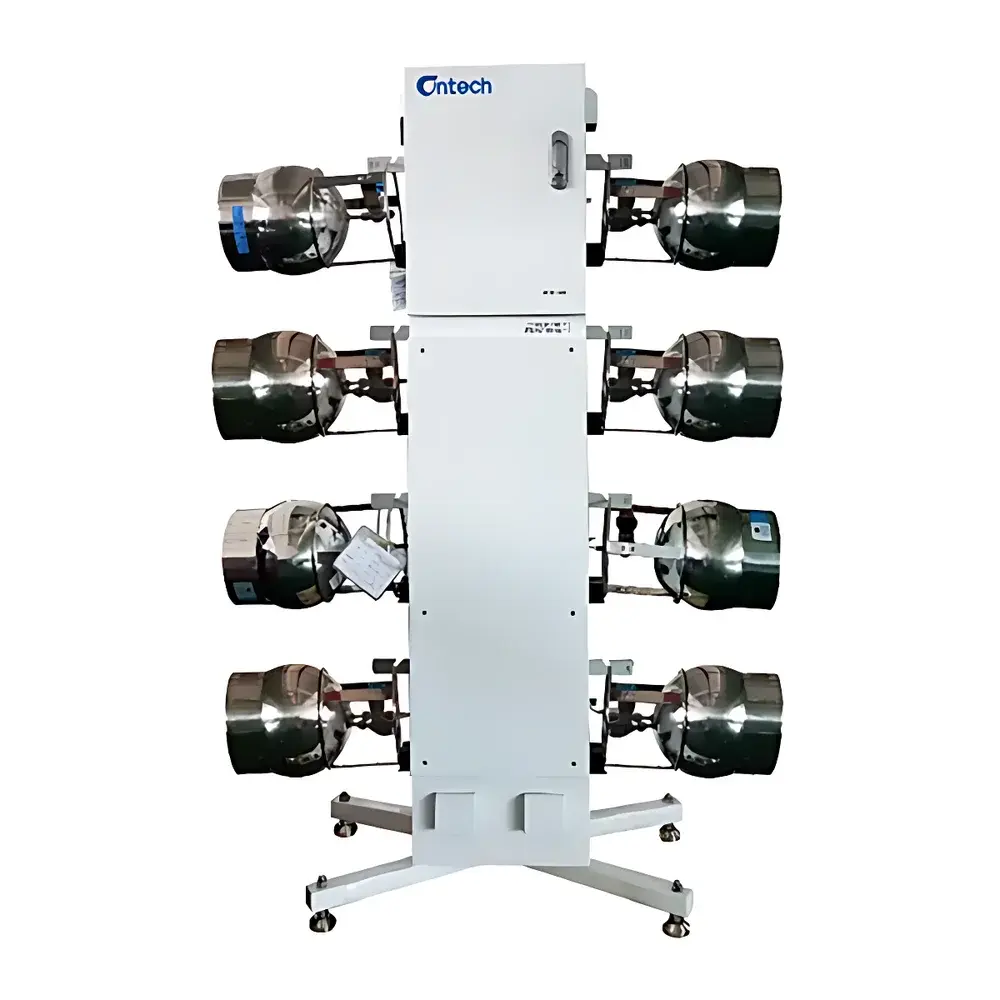
Ontech820 Automated SUMMA Canister Sampling System
| Brand | Ontech |
|---|---|
| Origin | Guangdong, China |
| Manufacturer Type | Authorized Distributor |
| Country of Origin | China |
| Model | Ontech820 |
| Pricing | Upon Request |
Overview
The Ontech820 Automated SUMMA Canister Sampling System is an engineered solution for unattended, time-resolved, and event-triggered collection of volatile organic compounds (VOCs) from ambient air. Designed for regulatory monitoring, odor complaint investigation, and industrial emission verification, the system operates on the principle of pressure-controlled, flow-regulated canister filling—compliant with U.S. EPA Method TO-14A, TO-15, and ASTM D6196. It integrates precision mass flow control, real-time pressure monitoring, and programmable multi-port valving to ensure quantitative, reproducible VOC capture in electropolished stainless-steel SUMMA canisters (typically 6-L or 1-L). Unlike passive samplers or grab-sampling tools, the Ontech820 enables both scheduled and responsive sampling—critical for capturing transient emission events such as fugitive leaks, episodic odors, or short-duration process upsets.
Key Features
- 4G LTE-enabled remote operation via secure web interface and native iOS/Android mobile application—supporting real-time status monitoring, manual trigger initiation, and firmware updates over-the-air
- Dual-mode control architecture: fully programmable automatic scheduling (with calendar-based or interval-based triggers) and event-driven sampling activated by external analog/digital signals—including output from photoionization detectors (PID), metal oxide sensors, or building management systems
- Universal power design: accepts 100–240 VAC input or 12/24 VDC input; compatible with solar panel + deep-cycle battery configurations for off-grid deployment in remote or temporary monitoring sites
- Modular multi-channel configuration: supports 2–16 independent sampling lines with high-integrity solenoid valves featuring PTFE-sealed stainless-steel bodies, rated for continuous exposure to humid, acidic, or oxidizing atmospheres
- Integrated metrology suite: thermal-mass flow sensor (±1.5% reading accuracy), digital pressure transducer (0–30 psia, 0.01 psi resolution), and temperature-compensated timing circuitry
- Optional add-on modules: aldehyde/ketone cartridge sampling train (per EPA TO-11A), integrated PID sensor with configurable alarm thresholds, and NIST-traceable flow calibration port
Sample Compatibility & Compliance
The Ontech820 is validated for use with standard SUMMA canisters (SilcoNert®-coated or electro-polished) and compatible with subsequent analysis by GC-MS, GC-FID, or GC-PID per EPA Compendium Method TO-15A. All wetted materials—including tubing, valves, and manifolds—are selected for minimal VOC adsorption and catalytic reactivity (e.g., electropolished 316L SS, PFA, and Kalrez® seals). The system’s operational parameters meet requirements for data integrity under EPA Contract Laboratory Program (CLP) Quality Assurance Project Plans (QAPPs) and support audit readiness for ISO/IEC 17025-accredited laboratories. Data logs—including timestamped start/stop events, flow profiles, pressure traces, and valve actuation sequences—are stored locally and synchronized to cloud storage with SHA-256 hashing for tamper-evident recordkeeping.
Software & Data Management
The Ontech820 is managed through OntechLink™, a browser-based platform supporting role-based access control (RBAC), TLS 1.2 encrypted communication, and full audit trail functionality compliant with FDA 21 CFR Part 11 and EU Annex 11 expectations. Each sampling event generates a machine-readable metadata file (JSON/XML) containing instrument ID, GPS coordinates (via optional GNSS module), environmental conditions, and QC flags. Raw telemetry data—including second-by-second flow and pressure readings—is exportable in CSV or NetCDF format for integration into LIMS (e.g., LabWare, Thermo Fisher SampleManager) or statistical analysis environments (Python/Pandas, R). Remote diagnostics include predictive valve health monitoring and low-battery/low-signal alerts pushed via SMS or email.
Applications
- Regulatory compliance monitoring at fence-line locations near petrochemical facilities, landfills, and wastewater treatment plants
- Rapid response to community odor complaints—enabling执法人员 (field inspectors) to initiate sampling within seconds of notification via mobile app
- Time-integrated VOC profiling for source apportionment studies using positive matrix factorization (PMF) or chemical mass balance (CMB) modeling
- Validation of continuous emission monitoring systems (CEMS) and ambient air quality networks (e.g., AQS, EEA AirBase)
- Indoor air quality assessments in schools, hospitals, and industrial workplaces where intermittent solvent use occurs
FAQ
Does the Ontech820 support integration with third-party PID sensors?
Yes—the system provides isolated 4–20 mA and 0–5 V analog inputs, along with dry-contact closure capability, enabling seamless interoperability with commercial PID, MOS, or electrochemical gas sensors.
Can sampling sequences be modified remotely after initial deployment?
Yes—all schedule logic, trigger conditions, and valve routing configurations are editable in real time via the OntechLink™ portal without requiring on-site technician intervention.
Is the system suitable for long-term unattended operation (e.g., >30 days)?
With solar/battery power and routine canister replacement, the Ontech820 has demonstrated stable operation exceeding 90 days in field trials across varied climatic zones (humid subtropical to arid desert conditions).
What data security protocols are implemented for remote communications?
All device-to-cloud traffic uses mutual TLS authentication; local data storage employs AES-256 encryption; and user sessions enforce OAuth 2.0 with mandatory MFA for administrative accounts.
Does the system comply with ISO 55001 or similar asset management standards?
While not certified per ISO 55001, the Ontech820’s embedded diagnostics, calibration logging, and firmware version tracking align with core preventive maintenance and traceability requirements outlined in Clause 8.1 of the standard.



