
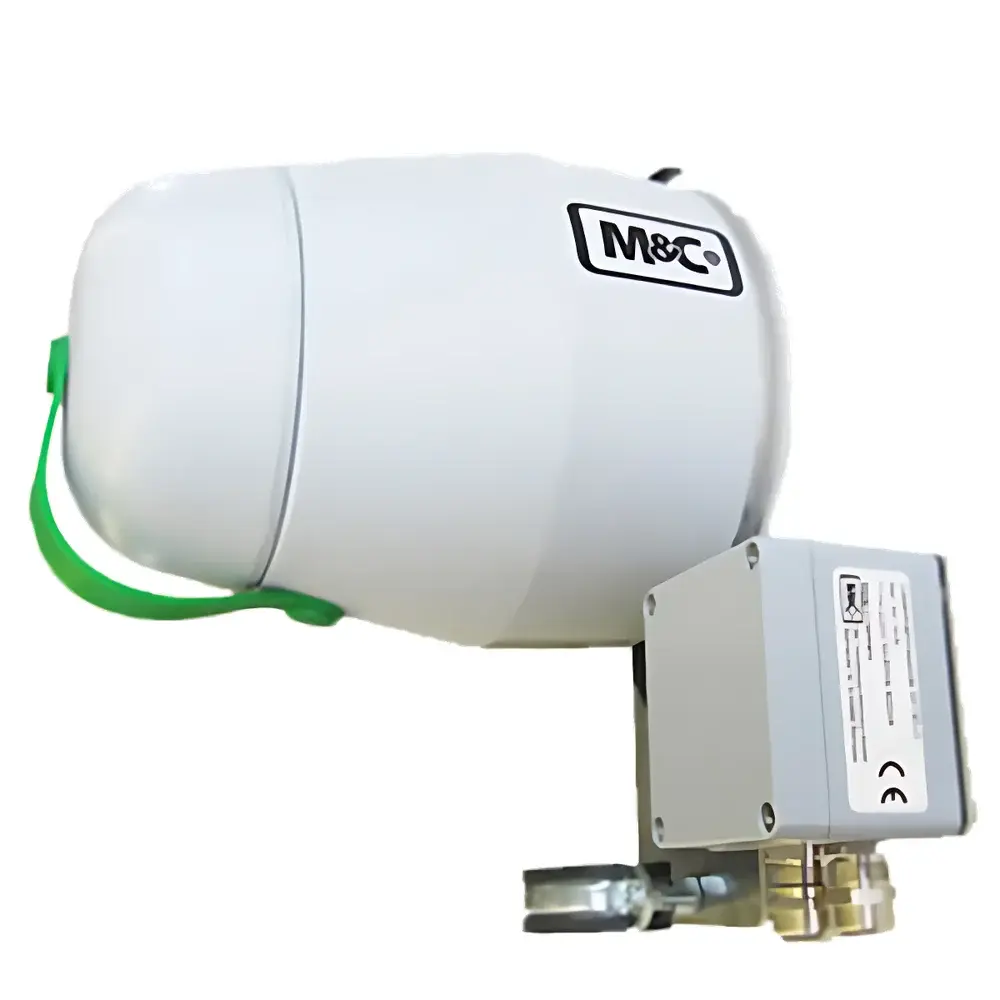
ONUEE SP180-H M&C Sampling Probe
| Brand | ONUEE |
|---|---|
| Origin | Germany |
| Model | SP180-H |
| Heating Temperature | 180 °C (self-regulating) |
| Filter Material | SS316 housing with 2 µm ceramic filter element |
| Optional Filter Materials | Available on request |
| Flange | DN65, PN6 |
| Sample Probe Tube | Stainless steel SP210/SS (optional, max. 600 °C) |
| Calibration Gas Port | Integrated per EN 14181 |
| Power Supply | 110–240 V AC, no voltage conversion required |
| Low-Temperature Monitoring | Bimetallic thermal switch (normally open below 160 °C) |
| Enclosure Protection | IP65-rated protective shroud |
| Maintenance | Tool-free filter replacement |
Overview
The ONUEE SP180-H M&C Sampling Probe is a high-integrity, heated extractive sampling device engineered for continuous, representative gas sampling in demanding industrial and environmental monitoring applications. Designed in accordance with the functional and performance requirements of EN 14181 (Quality Assurance of Automated Measuring Systems for Emissions), the SP180-H operates on the principle of hot-wet sampling—maintaining the entire sample path above the dew point of the process gas to prevent condensation, particle loss, and analyte adsorption. Its self-regulating heating system ensures stable thermal control at 180 °C without external temperature controllers or feedback loops, minimizing failure points and eliminating calibration drift associated with PID-based systems. The probe’s compact, modular architecture supports seamless integration into CEMS (Continuous Emission Monitoring Systems), stack-mounted analyzers, and portable emission testing platforms, particularly where particulate-laden, corrosive, or high-moisture flue gases are encountered.
Key Features
- Self-regulating heater element maintaining precise 180 °C operating temperature across 110–240 V AC input—no voltage converters or external thermostats required
- Tool-free, full-cartridge filter replacement: entire SS316 filter housing—including 2 µm ceramic filter and sealing gasket—extracts as a single unit without disconnecting heated sample lines or dismantling the probe assembly
- Integrated low-temperature safety monitoring via bimetallic thermal switch (normally open below 160 °C), providing fail-safe alarm signaling for process integrity verification
- IP65-rated protective shroud enabling reliable outdoor deployment under rain, dust, and temperature cycling conditions
- DN65/PN6 flange interface compatible with standard stack mounting; optional high-temperature stainless steel sampling tube SP210/SS rated to 600 °C for upstream insertion into extreme thermal zones
- EN 14181-compliant calibration gas port routed directly through the filter matrix, enabling in-situ zero/span verification and back-purge functionality without compromising sample integrity
- Full thermal isolation of filter chamber and probe body to suppress localized cold spots and maintain uniform dew point margin across all wetted surfaces
Sample Compatibility & Compliance
The SP180-H is validated for use with high-dust, high-humidity, and mildly corrosive process streams typical of coal-fired boilers, waste incinerators, cement kilns, and chemical reactors. Its SS316 construction resists chloride-induced stress corrosion cracking, while the ceramic filter element exhibits excellent thermal stability and mechanical retention of sub-micron particulates (including fly ash, soot, and metal oxides). The probe meets structural and functional requirements of EN 14181 (Parts 1–3) for QAL2 (Quality Assurance Level 2) and AST (Annual Surveillance Test) compliance. It supports GLP/GMP-aligned audit trails when integrated with compliant data acquisition systems, and its electrical design conforms to IEC 61000-6-2 (immunity) and IEC 61000-6-4 (emissions). No hazardous area certifications (e.g., ATEX, IECEx) are inherent; optional intrinsically safe variants require factory configuration.
Software & Data Management
As a hardware-level sampling component, the SP180-H does not incorporate embedded firmware or onboard software. However, its low-temperature alarm contact (dry relay output) is designed for direct integration into PLC-based monitoring systems (e.g., Siemens S7, Rockwell ControlLogix) or CEMS supervisory SCADA architectures. When deployed in regulated environments subject to FDA 21 CFR Part 11 or EU Annex 11, the alarm signal may be logged with electronic signatures and time-stamped audit trails via validated third-party DAQ platforms. The probe’s passive design eliminates firmware validation burdens—its performance verification relies solely on physical inspection, temperature mapping (per EN 14181 QAL3), and periodic filter efficiency testing using ISO 12103-1 A2 test dust.
Applications
- Continuous emissions monitoring (CEMS) for SO₂, NOₓ, CO, O₂, and total hydrocarbons in power generation and industrial combustion
- Process gas analysis in petrochemical reformers, fluid catalytic cracking units, and syngas production
- Stack testing and regulatory compliance audits per EPA Method 5, ISO 9096, and VDI 2066
- Hot-wet sampling for mercury speciation (Hg⁰/Hg²⁺) where condensation must be avoided to preserve volatile species distribution
- Research-grade flue gas characterization in pilot-scale carbon capture and storage (CCS) test rigs
FAQ
Does the SP180-H require an external temperature controller?
No. Its self-regulating polymer-based heating element maintains 180 °C inherently; no PID loop, thermocouple feedback, or controller module is needed.
Can the probe be used in explosive atmospheres?
Not in standard configuration. ATEX or IECEx-certified versions require factory modification and documentation—contact ONUEE Technical Support for hazardous area options.
Is the 2 µm ceramic filter replaceable with alternative pore sizes or materials?
Yes. ONUEE offers optional sintered metal, PTFE-coated ceramic, and borosilicate glass filters with pore ratings from 0.5 µm to 5 µm, subject to compatibility assessment with gas chemistry and temperature profile.
How often should the filter be inspected or replaced?
Frequency depends on dust loading; typical intervals range from 72 to 500 hours in coal-fired applications. Visual inspection via cartridge extraction is recommended before each scheduled maintenance cycle.
Does the calibration gas port support automated multi-point calibration sequences?
The port provides physical access for calibration gas injection but does not include solenoid valves or sequencing logic—those functions reside in the connected analyzer or CEMS controller.







