
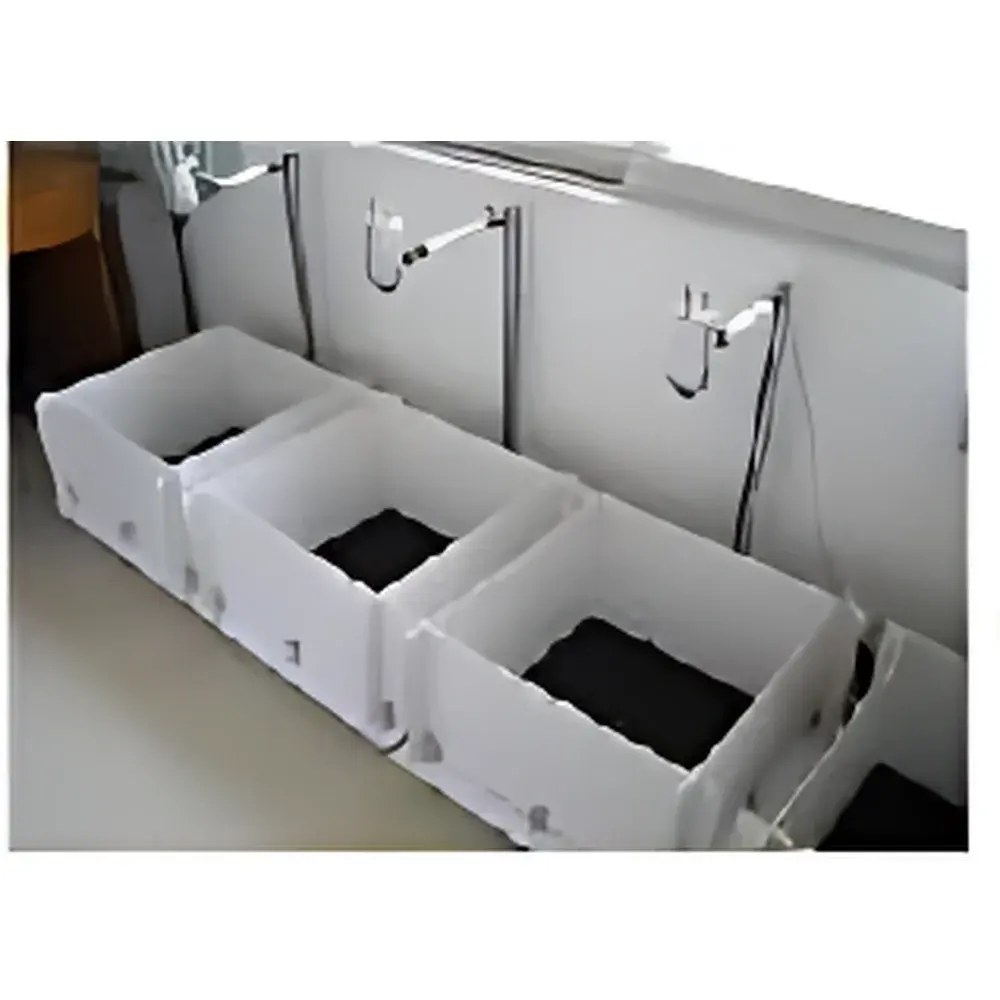
Open Field Test System by EthoVision-Compatible Platform
| Origin | USA |
|---|---|
| Manufacturer Type | Authorized Distributor |
| Origin Category | Imported |
| Model | Open Field Test System |
| Pricing | Available Upon Request |
Overview
The Open Field Test System is a standardized, video-based behavioral phenotyping platform engineered for objective quantification of locomotor activity, exploratory behavior, and anxiety-related responses in rodents (mice and rats) under controlled laboratory conditions. Rooted in the classical open field paradigm—a cornerstone assay in preclinical neuroscience—the system measures spontaneous movement patterns within a symmetrical, unobtrusive arena to infer underlying neurobehavioral states. It operates on computer-vision-based tracking principles: high-resolution cameras capture real-time animal trajectories, which are processed using centroid- and contour-based algorithms to extract spatial-temporal metrics including total distance traveled, time spent in center vs. periphery zones, velocity profiles, immobility bouts, and rearing frequency. The assay leverages ethologically relevant conflict—between thigmotaxis (wall-hugging due to innate aversion to open spaces) and exploratory drive—to generate reproducible indices of anxiety-like behavior, making it indispensable for studies in psychopharmacology, neurodevelopmental disorders, neurodegeneration, and genetic model validation.
Key Features
- Remote-triggered start/stop functionality via encrypted IR or network command—ensuring precise synchronization with experimental protocols and eliminating operator-induced latency.
- Modular arena construction using non-reflective, autoclavable acrylic with standardized 40 × 40 cm or 50 × 50 cm floor dimensions (custom sizes available), compliant with NIH and OECD guidelines for open field testing.
- Industrial-grade hardware architecture: IP65-rated enclosure for lighting control units, EMI-shielded camera mounts, and vibration-dampened base—designed for long-term stability in multi-user core facilities.
- Plug-and-play modularity: Seamless integration of add-on modules—including elevated plus maze, light-dark box, social interaction chambers, and fear conditioning enclosures—via shared software licensing and unified calibration routines (additional module licensing required).
- Native compatibility with LIMS and ELN systems through HL7 v2.x and ASTM E1578-compliant API endpoints—supporting automated metadata ingestion (subject ID, strain, treatment group, timestamp) and audit-trail generation.
Sample Compatibility & Compliance
The system supports C57BL/6, BALB/c, CD-1, Sprague-Dawley, and Wistar strains across age ranges from postnatal day 21 to 18 months. All behavioral protocols adhere to the ARRIVE 2.0 reporting standards and align with IACUC-approved SOPs. Data acquisition workflows meet GLP requirements for traceability: each session generates a digitally signed .csv/.h5 dataset with embedded timestamps, operator ID, calibration logs, and environmental metadata (ambient light lux, room temperature ±0.5°C). Optional FDA 21 CFR Part 11-compliant electronic signature and role-based access control are available via validated software extension.
Software & Data Management
The proprietary analysis suite (v5.3+) provides over 42 configurable behavioral parameters—including zone transition counts, path tortuosity (fractal dimension), thigmotaxis ratio (perimeter distance / total distance), and velocity histogram binning. Raw video is stored losslessly in FFV1-encoded AVI format; analytical outputs export to Excel, MATLAB (.mat), or Python-compatible HDF5. Built-in batch processing enables cross-session normalization (e.g., z-scoring against vehicle-control cohorts) and longitudinal trend visualization. Audit trails record all parameter edits, user logins, and data exports—fully compliant with ISO/IEC 17025 clause 7.7 and EU Annex 11 expectations for analytical instrument qualification.
Applications
- Preclinical evaluation of anxiolytic/anxiogenic compounds (e.g., benzodiazepines, SSRIs, CRF antagonists) in dose-response and chronic dosing paradigms.
- Phenotypic screening of transgenic, knockout, or CRISPR-edited rodent models for autism spectrum disorder, depression, PTSD, and Huntington’s disease.
- Neurotoxicity assessment following exposure to environmental agents (e.g., organophosphates, heavy metals) or nanomaterials.
- Validation of non-pharmacological interventions—including environmental enrichment, exercise regimens, and vagus nerve stimulation—on baseline locomotion and anxiety indices.
- Multi-assay battery integration: synchronized deployment with rotarod, Morris water maze, and prepulse inhibition platforms for comprehensive CNS profiling.
FAQ
What arena dimensions are supported out-of-the-box?
Standard configurations include 40 × 40 cm and 50 × 50 cm square arenas; circular variants (diameter 90 cm) and custom geometries are available upon engineering review.
Does the system support real-time tracking during acquisition?
Yes—live centroid overlay and zone occupancy heatmaps render at ≤30 fps on standard GPU-accelerated workstations; latency remains below 120 ms end-to-end.
Can raw video be exported for third-party analysis (e.g., DeepLabCut)?
Absolutely—uncompressed AVI and time-synchronized frame-accurate .txt trajectory files are generated automatically per session.
Is validation documentation provided for GLP-regulated studies?
Yes—IQ/OQ/PQ protocols, calibration certificates, and software verification reports (per GAMP5) are included with enterprise licenses.
How is lighting uniformity ensured across sessions?
Integrated LED ring illuminators deliver ±5% lux homogeneity (measured at arena floor); programmable intensity (50–500 lux) and spectral profile (5000K CCT) are logged per trial.



