
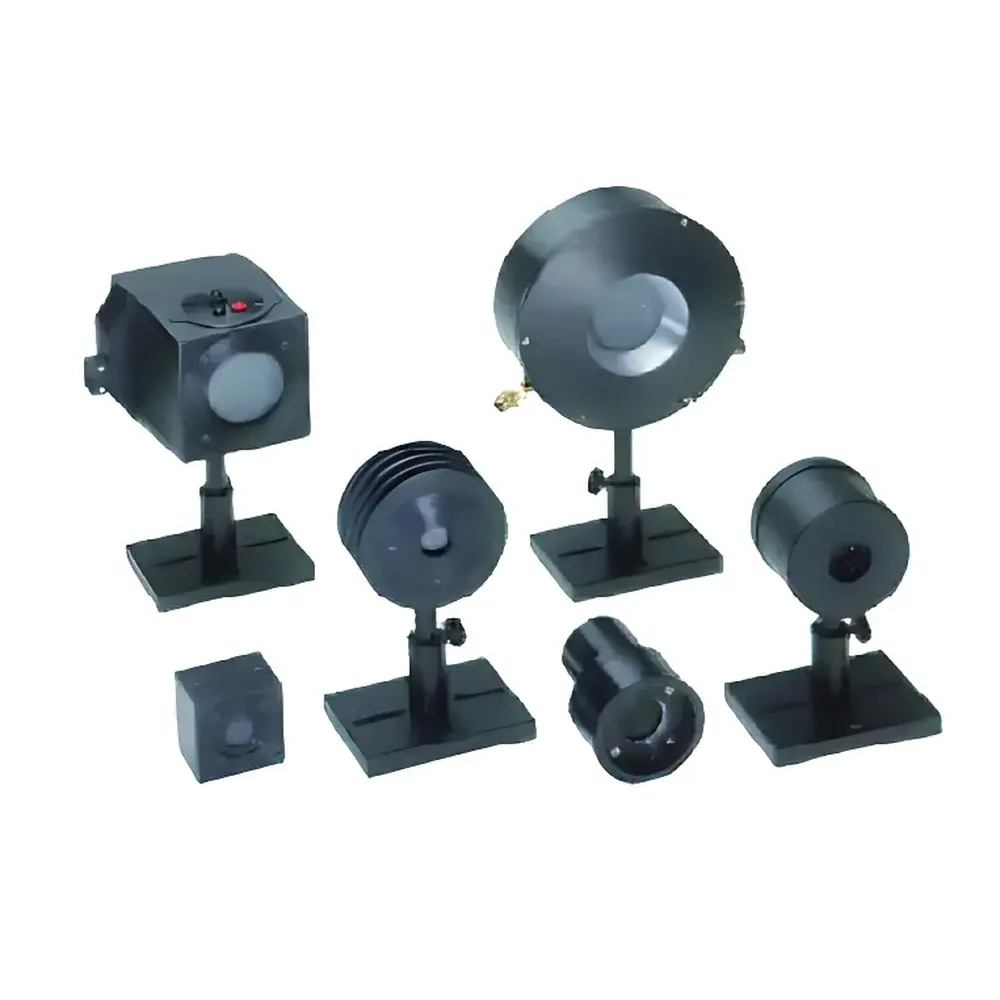
Ophir PD300 Laser Power Sensor
| Brand | Ophir |
|---|---|
| Origin | France |
| Sensor Type | Photodiode-based |
| Max Continuous Power | 3 W (with built-in attenuator) |
| Power Range | 10 pW – 3 W |
| Wavelength Range | 190–1100 nm |
| Linearity | ±0.5% (up to 2 mW), ±1% (with attenuator, up to 3 W) |
| Damage Threshold | 10 W/cm² (CW), 0.1 J/cm² (pulsed, 10 ns) |
| Output Signal | Analog voltage (1 V per 1 W typical) |
| Connector | BNC |
Overview
The Ophir PD300 is a high-precision, photodiode-based laser power sensor engineered for accurate and repeatable measurement of continuous-wave (CW) and low-repetition-rate pulsed laser output in the ultraviolet to near-infrared spectrum (190–1100 nm). Unlike thermal sensors that rely on temperature differentials across thermopile junctions, the PD300 employs a calibrated silicon photodiode with integrated neutral-density attenuation to extend its dynamic range while preserving linearity and minimizing saturation effects. Its design follows fundamental principles of photovoltaic detection—where incident photons generate electron-hole pairs proportional to optical power—making it ideal for applications requiring fast response (<1 µs rise time), high sensitivity (down to 10 pW), and minimal signal drift. The sensor is not intended for high-energy pulse measurement (e.g., Q-switched or ultrafast lasers); for such use cases, Ophir’s thermal or pyroelectric sensors are recommended. All PD300 units ship with NIST-traceable calibration documentation, ensuring metrological integrity for ISO/IEC 17025-compliant laboratories.
Key Features
- Wide dynamic range: 10 pW to 3 W, enabled by dual-mode operation—direct photodiode mode (≤2 mW) and attenuated mode (up to 3 W) via removable ND filter
- High linearity: ±0.5% from 100 pW to 2 mW; ±1% across full 3 W range with attenuator—verified per Ophir’s internal linearity protocol aligned with ISO 11554 Annex D
- Spectral uniformity: Optimized anti-reflection coating ensures flat spectral responsivity (±2%) across 190–1100 nm, critical for broadband or multi-wavelength laser systems
- Low noise & high stability: RMS noise < 10 pW (1 Hz bandwidth); zero-drift < 0.1% per hour at stable ambient conditions (23 ±1 °C)
- Robust mechanical architecture: Aluminum housing with SMA-threaded aperture (10 mm clear aperture), IP52-rated ingress protection, and strain-relieved BNC output cable
- Compliance-ready interface: Analog voltage output (1 V/W nominal) compatible with Ophir StarLite, Juno, and Vega meters—supporting real-time logging, averaging, and statistical analysis
Sample Compatibility & Compliance
The PD300 is validated for collimated or gently focused CW beams with diameters between 0.5 mm and 8 mm. It accommodates Gaussian, top-hat, and multimode spatial profiles without correction factors due to its uniform quantum efficiency distribution across the active area. Beam positioning tolerance is ±1.5 mm from center without introducing >0.3% reading deviation. For regulatory compliance, the sensor meets IEC 61340-5-1 (ESD control), RoHS 2015/863/EU, and CE marking requirements. While not intrinsically certified for hazardous locations, its passive design and lack of active electronics in the sensing head enable safe integration into Class 1 laser safety enclosures per IEC 60825-1:2014. Calibration certificates include uncertainty budgets compliant with GUM (JCGM 100:2008) and reference traceability to NIST SRM 2213.
Software & Data Management
When paired with Ophir’s StarLab v3.x software (Windows/macOS), the PD300 supports automated data acquisition, real-time trend plotting, pass/fail thresholding, and CSV/TXT export with metadata stamping (timestamp, serial number, calibration date, wavelength setting). Audit trails record all user-initiated configuration changes—including zeroing events and range switching—meeting FDA 21 CFR Part 11 requirements when deployed with electronic signature-enabled workstations. Raw analog outputs can also be acquired via third-party DAQ systems (e.g., National Instruments USB-6211) using provided voltage-to-power conversion coefficients. Firmware updates preserve calibration constants; no field recalibration is required unless physical damage or exposure beyond specified damage thresholds occurs.
Applications
- Laser diode characterization during R&D and production testing—especially for telecom (1310/1550 nm), biomedical (405/635 nm), and industrial pumping sources
- Optical power stabilization feedback loops in OEM laser modules, where sub-millisecond response enables closed-loop PID control
- Calibration transfer between primary standards (e.g., cryogenic radiometers) and secondary lab instruments under ISO/IEC 17025 accreditation scopes
- Education and training labs requiring affordable, robust, and pedagogically transparent power measurement tools
- QC/QA verification of fiber-coupled laser delivery systems prior to medical device validation (per IEC 60601-2-22)
FAQ
Can the PD300 measure pulsed lasers?
Yes—but only quasi-CW or low-repetition-rate pulses (≤1 Hz, pulse width ≥100 ns). It is not suitable for measuring pulse energy or peak power of nanosecond or femtosecond lasers.
Is the built-in attenuator user-replaceable?
Yes—the ND filter is mechanically retained and can be removed or replaced using Ophir P/N 7Z01551; replacement requires recalibration to maintain stated accuracy.
Does ambient temperature affect readings?
No significant drift is observed between 15–35 °C due to internal temperature compensation circuitry; however, extended operation >40 °C may require thermal stabilization per Ophir Technical Note TN-104.
How often should the PD300 be recalibrated?
Annually is recommended for ISO/IEC 17025 environments; biannually suffices for non-regulated R&D use—subject to usage intensity and exposure history.
Can it be used with non-Ophir meters?
Yes—any meter accepting 0–1 V analog input with ≥10 kΩ input impedance and known scaling factor (1 V/W) can interpret the signal, though advanced features (auto-range, diagnostics) require native Ophir hardware.




