
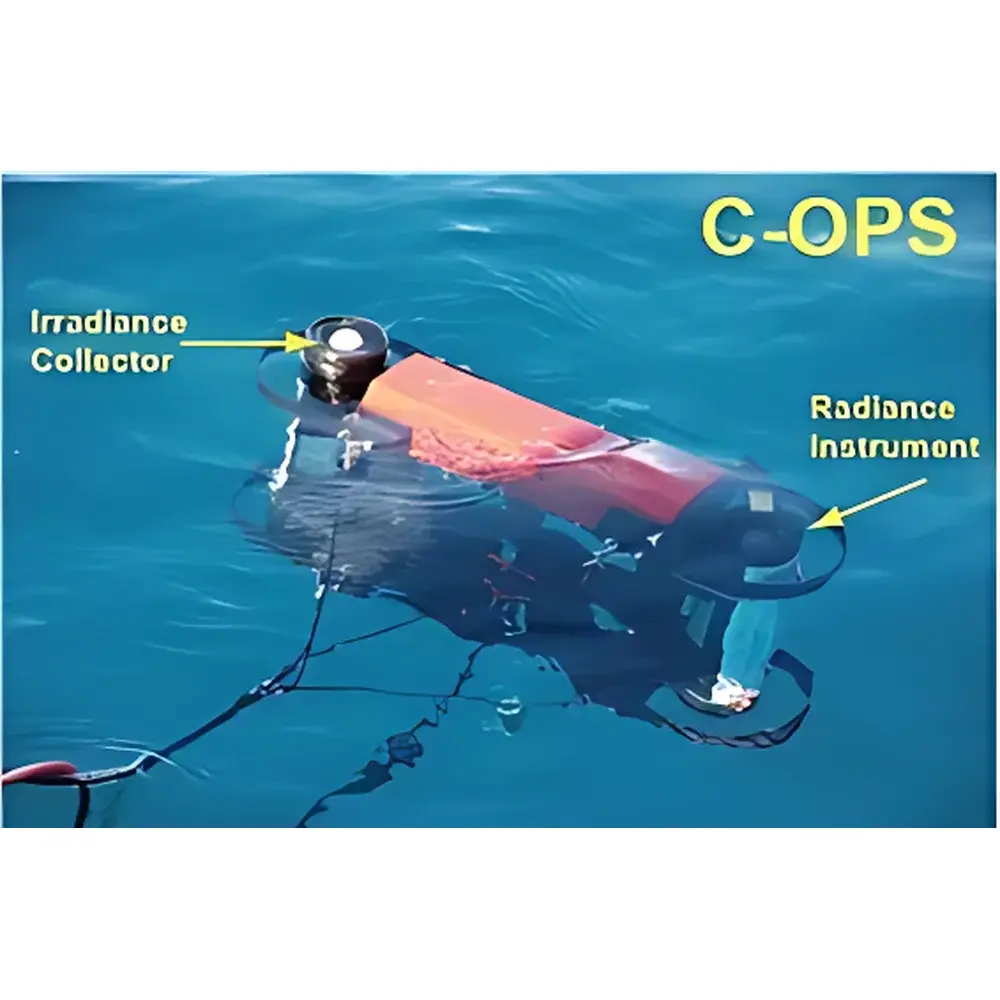
C-OPS Portable Optical Profiling System
| Origin | USA |
|---|---|
| Manufacturer Type | Authorized Distributor |
| Origin Category | Imported |
| Model | C-OPS |
| Pricing | Available Upon Request |
Overview
The C-OPS Portable Optical Profiling System is a high-precision, free-fall marine radiometric profiling instrument engineered for in situ vertical measurements of underwater spectral radiance and irradiance. Developed in collaboration with NASA and manufactured by Biospherical Instruments, Inc., the system implements a robust Cuette-style deployment architecture—eliminating ship shadow artifacts, platform-induced turbulence, and motion-induced sampling bias common in traditional towed or winch-deployed optical sensors. At its core lies the patented MicroRadiometer™ technology: miniaturized, self-contained photodetector modules integrating 24-bit ADCs, programmable gain electrostatic amplifiers, on-board temperature compensation, and synchronized multi-channel acquisition. Each C-OPS configuration houses up to 19 spectrally distinct MicroRadiometers (250–1650 nm), mounted on a pressure-compensated, buoyancy-tuned frame enabling depth-dependent descent velocity control—from 30 cm/s at depths exceeding 10 m. The system operates to 300 m water depth, supports real-time RS485/RS232 telemetry at 115.2 kbaud, and delivers synchronized, time-stamped spectral data at up to 15 Hz across all channels—meeting the stringent temporal and spatial resolution requirements of satellite ocean color validation (e.g., VIIRS, OLCI, PACE), bio-optical model parameterization, and coastal water quality monitoring under GLP-aligned field protocols.
Key Features
- Free-fall profiling architecture with adaptive buoyancy: air-filled bladders compress with depth, reducing net buoyancy and increasing descent rate—enabling <1 cm vertical resolution and consistent sampling geometry across turbid nearshore and oligotrophic open-ocean environments.
- 19-channel MicroRadiometer array: Si, InGaAs, and GaAsP photodetectors with 10 nm FWHM interference filters; 24-bit bipolar ADC; 4–125 Hz programmable sampling; dynamic range >9 decades; NEΔL (radiance) as low as 6.8×10⁻⁷ μW·cm⁻²·nm⁻¹·sr⁻¹ @ 780 nm.
- Optically characterized sensors: underwater-calibrated radiance detectors (7° half-angle FOV); cosine-corrected irradiance sensors with ±3% error up to 60° zenith angle per ASTM E308 and ISO 9060:2018 Class A specifications.
- Integrated auxiliary sensing: simultaneous measurement of temperature, pressure, pitch, and roll—critical for correcting angular response errors and georeferencing profiles in dynamic sea states.
- Deckbox Master Controller: 7.5 V DC powered, provides regulated power and protocol translation for distributed sensors; auto-compensates for cable length up to 150 m; features built-in sensor enumeration diagnostics and microSD data logging (1 GB standard).
Sample Compatibility & Compliance
The C-OPS system is validated for use across the full spectrum of marine optical environments—from highly scattering estuarine waters (TSS > 100 mg/L) to ultra-clear subtropical gyres (Kd(490) < 0.03 m⁻¹). Its compact form factor (7 cm diameter, ~3 kg dry weight), manual deployability, and absence of mechanical tethering eliminate flow distortion and vibration coupling that compromise data fidelity in pump-through or fixed-frame systems. All optical calibrations are traceable to NIST standards via Biospherical’s ISO/IEC 17025-accredited calibration laboratory. System firmware and data acquisition software support audit trails, electronic signatures, and metadata embedding compliant with FDA 21 CFR Part 11 and ISO/IEC 17025 documentation requirements. Sensor housings meet IP68 and MIL-STD-810G environmental durability specifications.
Software & Data Management
C-OPS operation is managed through Biospherical’s proprietary Ocean Optics Software Suite (v5.2+), a Windows-based application supporting real-time visualization, sensor configuration, BioShade/BioGPS synchronization, and automated dark-signal compensation. Raw binary data streams are converted into calibrated physical units (μW·cm⁻²·nm⁻¹·sr⁻¹, μW·cm⁻²·nm⁻¹) using factory-provided spectral response functions and temperature-dependent gain coefficients. The software exports ASCII and NetCDF4 files compliant with IOCCG (International Ocean Colour Coordinating Group) metadata conventions and supports direct ingestion into SeaDAS, OCSSW, and MATLAB-based inversion pipelines. Deckbox firmware enables remote firmware updates, configurable averaging windows, and fail-safe power cycling—ensuring operational continuity during extended deployments aboard research vessels or autonomous platforms.
Applications
- Satellite ocean color vicarious calibration and validation (e.g., NASA PACE, ESA Sentinel-3 OLCI, NOAA JPSS VIIRS)
- Development and refinement of inherent optical property (IOP) inversion algorithms (e.g., QAA, GSM, GARSTEC)
- Long-term ecological research (LTER) site monitoring of CDOM, chlorophyll-a, and suspended sediment dynamics
- Regulatory compliance reporting for EPA NPDES permits and EU WFD (Water Framework Directive) status assessment
- Underwater light field characterization for benthic habitat modeling and coral reef photobiology studies
FAQ
What depth ranges does the C-OPS support, and how is pressure tolerance achieved?
Standard C-OPS configurations operate to 125 m; optional titanium-housed variants extend rated depth to 300 m. Pressure integrity is maintained via epoxy-sealed, double-O-ring aluminum housings and elastomeric buoyancy modules designed to maintain structural stability across hydrostatic gradients.
How does C-OPS mitigate ship shadow and surface reflection artifacts?
By deploying via free-fall—decoupled from vessel motion—and integrating the T-MAST mast (NASA-developed, 3 m max height) for above-deck surface reference measurements, C-OPS eliminates both hull shadow contamination and wave-glitter effects that degrade irradiance ratio accuracy.
Is the system compatible with existing data infrastructure and interoperability standards?
Yes. Output formats adhere to CF-1.8 and IOCCG metadata schemas; time synchronization uses GPS-derived UTC timestamps via BioGPS; data streams conform to MODBUS RTU over RS485 for integration with SCADA and observatory network gateways.
Can C-OPS be deployed from small boats or unmanned platforms?
Absolutely. Its lightweight design (<3 kg), battery-powered Deckbox, and manual launch capability enable operation from RIBs, kayaks, and AUV docking stations. Optional C-HOIST motorized winch supports repeatable recovery in sea states up to Beaufort 4.
What regulatory frameworks does the C-OPS software support for auditable data handling?
Firmware and acquisition software include role-based access control, electronic signature workflows, immutable audit logs, and 21 CFR Part 11-compliant electronic records—validated for use in GLP and GMP-regulated environmental monitoring programs.
Related Products







