
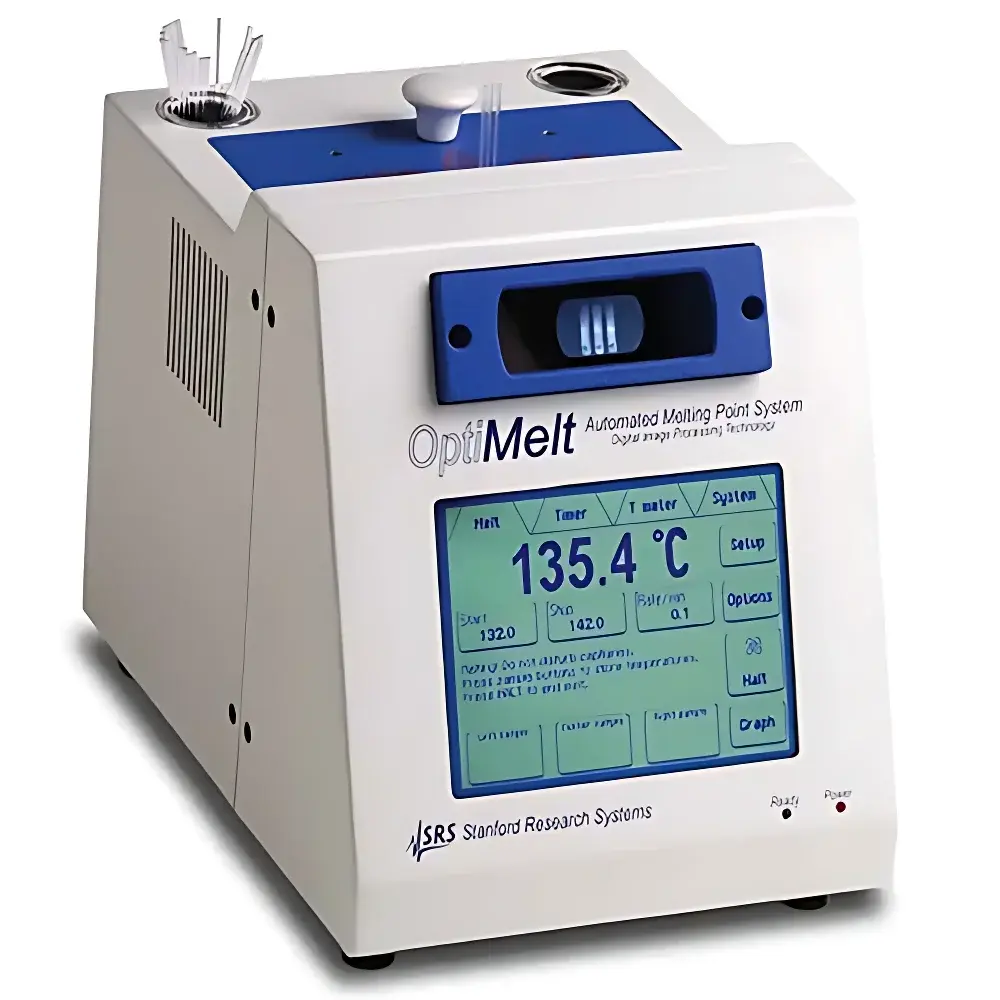
Optimelt MPA100 Automated Melting Point Apparatus
| Brand | Stanford |
|---|---|
| Origin | USA |
| Model | MPA100 |
| Temperature Range | +10 °C to 400 °C |
| Heating Rate | 0.1–20 °C/min |
| Temperature Repeatability | ±0.1 °C |
| Temperature Accuracy | ±0.3 °C (@ ~100 °C), ±0.5 °C (@ ~250 °C), ±0.8 °C (@ ~400 °C) |
| Capillary Outer Diameter | 1.4–2.0 mm |
| Temperature Resolution | 0.1 °C |
| Power Supply | AC 90–264 V |
| Weight | 4.1 kg |
| Operating Ambient | 0–40 °C |
| Interface | USB, RS-232 |
| Software | MeltView (Windows-compatible) |
Overview
The Optimelt MPA100 Automated Melting Point Apparatus is a precision thermal analysis instrument engineered for reliable, high-reproducibility determination of solid-phase transition temperatures in pharmaceuticals, organic chemicals, polymers, and reference standards. It operates on the principle of real-time optical detection—combining high-resolution digital imaging with photometric analysis of light absorption and reflection changes during sample melting. As the sample in a standard capillary undergoes phase transition, its optical transmittance and reflectance shift abruptly; the MPA100’s integrated CMOS imaging sensor captures these changes continuously at configurable frame rates, enabling precise endpoint detection without subjective visual interpretation. Designed for compliance-critical environments, the system features a platinum RTD (Resistance Temperature Detector) sensor calibrated traceably to NIST standards, delivering temperature resolution of 0.1 °C across its full operating range (+10 °C to 400 °C). Its aluminum heating block architecture ensures uniform thermal distribution and rapid thermal response, supporting both regulatory-grade validation and routine QC throughput.
Key Features
- Integrated 1.3-megapixel digital camera with real-time video capture and automatic image logging for post-analysis review and audit trail generation
- Touchscreen-enabled LCD interface (7-inch, capacitive) allowing standalone operation—no PC required for method setup, measurement execution, or result display
- Programmable heating rate from 0.1 °C/min to 20 °C/min in 0.1 °C/min increments, with pre-set ramp profiles for USP & EP-compliant methods
- Automatic endpoint recognition via dynamic optical threshold analysis—eliminates observer bias and inter-operator variability
- On-instrument annotation capability: up to six user-defined temperature markers per run (e.g., onset, clear point, inflection)
- GLP-compliant data handling: stores up to 24 customizable test methods and retains 8 complete melting reports with timestamps, operator ID, and calibration history
- Dual thermal zones: independent control of heating block and ambient-sensing thermistor for improved stability and reduced drift
- RS-232 serial port compatible with ESC/P protocol printers; USB 2.0 interface for direct connection to Windows-based systems running MeltView software
Sample Compatibility & Compliance
The MPA100 accepts standard glass capillaries with outer diameters of 1.4–2.0 mm and lengths up to 100 mm. It supports both single- and multi-sample sequential analysis using manually loaded capillaries. The instrument meets key pharmacopeial requirements including United States Pharmacopeia USP <741>, European Pharmacopoeia Ph. Eur. 2.2.14, and Japanese Pharmacopoeia JP 6.06. Its temperature accuracy profile—±0.3 °C at ~100 °C, ±0.5 °C at ~250 °C, and ±0.8 °C at ~400 °C—is validated per ISO/IEC 17025 guidelines and documented in the factory calibration certificate. All firmware and software modules comply with FDA 21 CFR Part 11 requirements for electronic records and signatures when used with MeltView’s audit-trail-enabled configuration. Data integrity is reinforced by password-protected method editing, immutable report generation, and automatic timestamping of every calibration event and measurement cycle.
Software & Data Management
MeltView software (v3.2+, Windows 10/11 compatible) provides comprehensive instrument control, data visualization, and reporting functionality. It enables synchronized video playback with overlaid temperature curves, differential melting curve derivation (dT/dt), and automated calculation of onset, midpoint, and offset temperatures. Reports export in PDF/A-1a and CSV formats, embedding raw image frames, metadata (operator, date/time, method ID), and calibration status. The software supports network deployment in shared-lab environments and integrates with LIMS via ODBC-compliant database exports. All data files are digitally signed and checksum-verified to ensure non-repudiation—a requirement for GMP/GLP audits. Instrument firmware updates are delivered via signed binary packages with SHA-256 verification.
Applications
- Pharmaceutical quality control: identity testing and purity assessment of active pharmaceutical ingredients (APIs) and excipients per ICH Q5 and Q6A guidelines
- Chemical synthesis validation: monitoring reaction progress and verifying intermediate crystallinity
- Polymorph screening: differentiating solid-state forms based on distinct melting endotherms
- Educational laboratories: teaching thermal transitions and analytical method validation principles
- Reference material certification: supporting NIST-traceable calibration and inter-laboratory comparison studies
- Regulatory submissions: generating compliant datasets for ANDA, NDA, and MA dossier packages
FAQ
Does the MPA100 support dual-capillary simultaneous measurement?
No—the MPA100 is configured for single-capillary analysis per run. Sequential measurements are supported via manual capillary exchange between cycles.
Can the instrument be calibrated using certified reference standards other than those supplied by Stanford?
Yes. Users may input custom calibration points using any NIST-traceable melting standards (e.g., indium, tin, bismuth); calibration coefficients are stored per sensor and persist through power cycles.
Is MeltView software validated for 21 CFR Part 11 compliance?
Yes—when deployed with enabled audit trail, electronic signature, and role-based access controls, MeltView meets all substantive requirements of 21 CFR Part 11 for closed systems.
What is the typical cooling time from 350 °C to 50 °C?
Approximately 10 minutes under ambient conditions (23 °C, no forced air), consistent with the thermal mass and passive dissipation design of the aluminum heating block.
How is temperature uniformity across the heating block verified?
Each unit undergoes spatial mapping using a 9-point thermocouple array during final QA; uniformity is specified as ≤ ±0.3 °C across the capillary seating zone at 200 °C.



