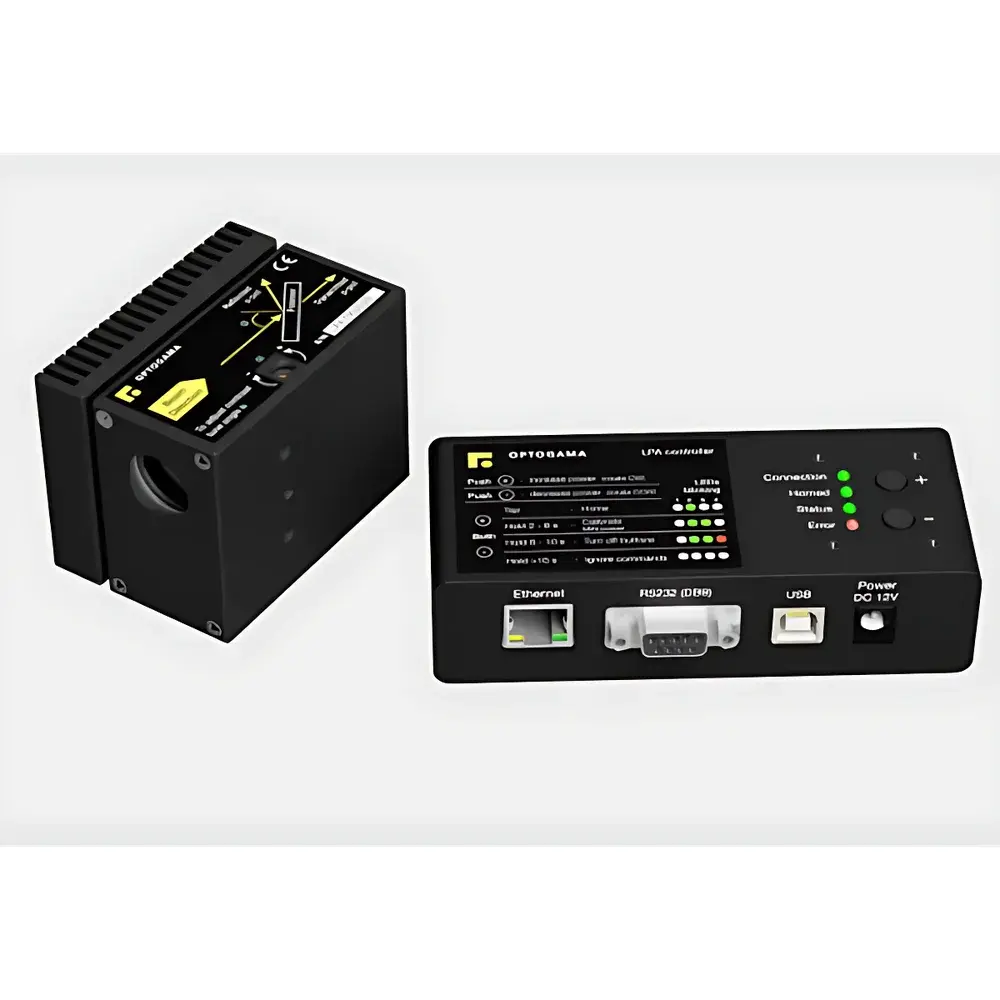
Optogama LPA Series Motorized Variable Laser Power Attenuator
| Brand | Optogama |
|---|---|
| Origin | Lithuania |
| Type | Motorized Variable Optical Attenuator |
| Design Wavelength | 1064 nm (customizable from 240 nm to 2000 nm) |
| Clear Aperture | 18 mm |
| Attenuation Range | 0.1–98% |
| Laser-Induced Damage Threshold (LIDT) | 10 J/cm² (10 ns pulse @ 1064 nm) |
| Switching Time (Closed ↔ Open) | 0.1 s |
| Resolution | < 0.1% |
| Dimensions | 76 × 52 × 58 mm |
| Compliance | RoHS, CE |
Overview
The Optogama LPA Series Motorized Variable Laser Power Attenuator is an engineered optical component designed for precise, repeatable, and stable attenuation of continuous-wave (CW) and pulsed laser beams across ultraviolet (UV), visible (VIS), and near-infrared (NIR) spectral regions—from 240 nm to 2000 nm. Unlike passive or manually adjusted attenuators, the LPA employs a closed-loop motorized actuation system coupled with a proprietary optical architecture based on rotating waveplate-polarizer configurations. This design enables deterministic control of transmitted intensity without altering beam pointing, divergence, or polarization state—critical for interferometric setups, cavity locking, pump-probe experiments, and laser safety interlocks. The device operates on the principle of polarization-dependent transmission: incident light passes through a high-LIDT zero-order waveplate followed by a broadband polarizing beam splitter; motor-driven angular repositioning of the waveplate modulates the polarization ellipse, thereby controlling the fraction of light transmitted through the analyzer. All optical surfaces feature ion-beam-sputtered dielectric coatings optimized for high damage resistance and minimal group delay dispersion.
Key Features
- High laser-induced damage threshold (LIDT) of ≥10 J/cm² at 1064 nm (10 ns pulse width), validated per ISO 21254-1, enabling safe integration into high-power industrial and scientific laser systems up to several watts (CW) or multi-millijoule (pulsed).
- Compact industrial housing (76 × 52 × 58 mm) with robust aluminum alloy chassis and precision-machined kinematic mounts—designed for OEM integration into vacuum-compatible or vibration-sensitive optical tables.
- Motorized attenuation with <0.1% resolution and repeatability better than ±0.3% over 10⁴ cycles, verified under accelerated life testing per IEC 60068-2-64.
- Dual-beam rejection architecture: a dedicated secondary beam dump channel directs reflected and scattered light away from the main output window, eliminating thermal lensing, mechanical stress, and stray-light feedback within the enclosure.
- Broadband optical design supporting customizable wavelength optimization—standard models cover 1064 nm, with optional factory calibration for 240–2000 nm range including 355 nm, 532 nm, 780 nm, 1550 nm, and 1950 nm.
Sample Compatibility & Compliance
The LPA series is compatible with TEM₀₀ and multimode Gaussian beams up to 12 mm diameter (within clear aperture limit), and maintains polarization extinction ratio >100:1 across its full attenuation range. It supports both free-space collimated input and fiber-coupled configurations via optional FC/APC or SMA adapters. All units comply with CE marking requirements for electromagnetic compatibility (EN 61326-1) and low-voltage directive (2014/35/EU). Coating specifications meet MIL-C-48497A for environmental durability, and packaging adheres to ISTA 3A transport standards. For regulated environments—including ISO 13485-certified medical laser systems or FDA 21 CFR Part 11–governed analytical instrumentation—the LPA can be supplied with full traceable calibration certificates (NIST-traceable reference detectors) and audit-ready documentation packages upon request.
Software & Data Management
The LPA integrates seamlessly with standard laboratory control ecosystems via USB 2.0 (virtual COM port) and RS-232 interfaces. Optogama provides native drivers for LabVIEW™ (2015+), MATLAB® (Instrument Control Toolbox), Python (PySerial + custom API), and EPICS IOC support for synchrotron and large-scale facility deployment. Firmware supports SCPI command syntax and includes built-in non-volatile memory for user-defined attenuation presets (up to 16 profiles), real-time position feedback, and error logging with timestamped event records. Optional firmware upgrade enables synchronization with external TTL triggers (<10 µs jitter) for time-resolved attenuation sequencing in pump-probe or LIBS applications. All software packages include digital signature verification and are distributed under a perpetual commercial license with no runtime royalties.
Applications
- Laser power stabilization in ultrafast amplifier chains (e.g., Ti:sapphire regenerative amplifiers, Yb-fiber CPA systems)
- Intensity calibration and dynamic range extension in photodetector linearity testing (per ISO 13694)
- Precision exposure control in laser micromachining, thin-film ablation, and additive manufacturing processes
- Beam conditioning for quantum optics experiments requiring shot-noise-limited intensity control (e.g., squeezed light generation, homodyne detection)
- Automated test equipment (ATE) for photonic integrated circuit (PIC) wafer-level characterization
- Regulatory-compliant laser safety interlocks in Class 4 laser enclosures per IEC 60825-1 Ed.3
FAQ
What is the maximum average power this attenuator can handle?
The LPA is rated for up to 5 W average power at 1064 nm with forced-air cooling; derating applies above 1550 nm due to coating absorption—consult the thermal management appendix in the technical datasheet.
Can the LPA be used with femtosecond pulses?
Yes—when configured with chirped mirror-compatible coatings and operated below 100 fs pulse duration, group delay dispersion (GDD) remains <±5 fs² across the 1064 nm band; GDD maps are available upon request.
Is remote firmware update supported?
Yes—field-upgradable firmware is delivered as signed binary images via USB; updates preserve all user calibration offsets and do not require optical recalibration.
Does the device support analog voltage control?
Analog 0–10 V input is available as an optional interface module (LPA-AV), providing direct intensity mapping with <0.5% linearity error over full scale.
How is calibration traceability maintained?
Each unit ships with a certificate of conformance referencing NIST-traceable power meter calibrations performed at three wavelengths (e.g., 532/1064/1550 nm); uncertainty budgets follow GUM (JCGM 100:2008) methodology.
Related Products