
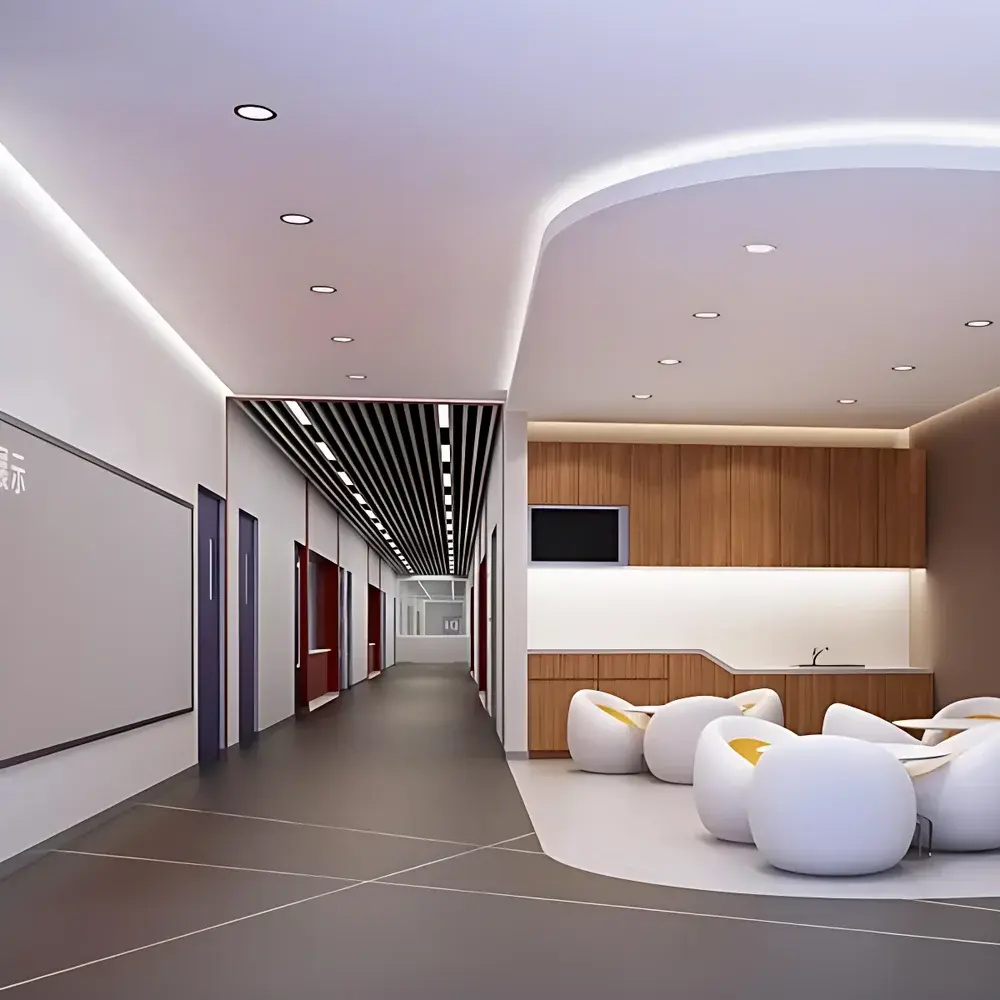
OPTON Comprehensive Laboratory Construction Solution
No specifications available.
Overview
The OPTON Comprehensive Laboratory Construction Solution is not a single instrument, but a turnkey engineering service framework designed specifically for advanced electron microscopy (EM) laboratories. It addresses the stringent environmental, infrastructural, and operational prerequisites required for stable, high-resolution imaging with transmission electron microscopes (TEM), scanning electron microscopes (SEM), and associated analytical platforms such as EDS, EBSD, and in-situ stages. Unlike conventional lab fit-outs, this solution integrates electromagnetic interference (EMI) shielding, ultra-low vibration floor systems, temperature- and humidity-stabilized HVAC with HEPA/ULPA filtration, acoustic damping, and power conditioning — all engineered to meet ISO 14644-1 Class 5–7 cleanroom specifications and ASTM E1930 (vibration criteria for electron microscopes). The design philosophy centers on preserving instrument performance over time: mitigating long-term degradation from ambient thermal drift, ground-borne vibration, stray magnetic fields (>0.1 µT RMS), and airborne particulates (<0.1 µm), thereby ensuring reproducible nanoscale characterization across years of operation.
Key Features
- EM-Specific Vibration Mitigation: Structural isolation via floating slab foundations compliant with VC-E/VC-F criteria per ANSI/ISO 20816-1, validated through on-site laser Doppler vibrometry prior to microscope installation.
- Electromagnetic Shielding: Continuous copper or mu-metal enclosures achieving ≥80 dB attenuation from 1 kHz to 1 GHz, verified per IEEE Std 299.1–2018 for TEM/SEM rooms.
- Environmental Stability: Dual-stage HVAC with ±0.3°C temperature control (20–25°C range), ±2% RH stability (30–50% range), and air change rates ≥15 ACH, incorporating redundant chillers and desiccant dehumidification.
- Power Integrity: Dedicated 3-phase supply with active harmonic filtering, voltage regulation ±0.5%, and transient suppression meeting IEC 61000-4-5 Level 4 — critical for detector electronics and high-voltage gun stability.
- Human-Centric Spatial Design: Ergonomic workflow zoning (sample prep → EM operation → data analysis), circadian lighting (3500–5000 K tunable white), and non-reflective, low-VOC finishes aligned with ISO 14644-8 material compatibility standards.
- Future-Proof Infrastructure: Pre-installed conduits for cryo-EM liquid nitrogen lines, fiber-optic data trunking for 10 GbE camera integration, and modular wall systems enabling reconfiguration without structural modification.
Sample Compatibility & Compliance
This construction solution does not process physical samples; rather, it establishes the foundational environment enabling reliable sample analysis across diverse EM modalities. It supports biological cryo-samples (vitrified grids), beam-sensitive polymers, metallic alloys, geological thin sections, and semiconductor wafers — all requiring sub-nanometer positional stability and minimal charging artifacts. The facility design conforms to key international standards including ISO/IEC 17025 (for accredited EM labs), GLP Annex 11 (data integrity in regulated environments), and FDA 21 CFR Part 11 (where digital image metadata workflows are implemented). All materials used in clean zones comply with SEMI F57 (outgassing limits) and IEST-RP-CC003.4 (particulate shedding thresholds).
Software & Data Management
While no proprietary software is bundled, the infrastructure embeds robust IT readiness: structured cabling certified to ISO/IEC 11801 Class EA, rack-mounted UPS with SNMP monitoring, and VLAN segmentation for instrument control networks (separate from institutional IT). Integration pathways exist for Thermo Fisher Velox, JEOL Stream, or Zeiss ZEN EM editions — supporting DICOM-EM metadata tagging, audit-trail-enabled acquisition logs, and secure TLS 1.3 encrypted transfer to central LIMS or ELN systems. Optional add-ons include time-synchronized NTP servers for cross-instrument experiment correlation and environmental sensor APIs feeding real-time temp/vib/RH data into instrument acquisition software for automated parameter adjustment.
Applications
The OPTON Comprehensive Laboratory Construction Solution serves core applications demanding metrological-grade EM performance: high-resolution structural biology (single-particle cryo-EM), failure analysis in advanced node semiconductors (sub-2 nm feature imaging), in-situ catalysis studies under controlled gas environments, quantitative mineral phase mapping in geosciences, and correlative light-electron microscopy (CLEM) workflows requiring precise spatial registration across modalities. Its design enables longitudinal studies where instrument calibration stability must be maintained over multi-year projects — essential for NIH R01 grants, EU Horizon scale-ups, and industrial R&D programs subject to ISO 9001 internal audits.
FAQ
Is this solution compatible with both TEM and SEM installations?
Yes — the vibration, EMI, and environmental specifications are tailored to the most demanding requirements of high-end TEM (e.g., Titan Krios) and field-emission SEM (e.g., Merlin Compact), with modular adjustments per instrument footprint and utility load.
Does OPTON provide commissioning validation reports?
Yes — third-party certified test reports (vibration spectra, magnetic field maps, particle counts, HVAC performance curves) are delivered upon handover, traceable to NIST-calibrated instrumentation.
Can existing laboratory spaces be retrofitted?
Yes — feasibility assessment includes structural load analysis, utility capacity review, and EMI baseline surveys; retrofit scope ranges from partial zone upgrades (e.g., EM room shell only) to full brownfield redevelopment.
What is the typical project timeline from design to commissioning?
For a 120 m² dedicated EM suite: 8–10 weeks design development, 16–20 weeks construction and MEP installation, 4 weeks system commissioning and validation — total ~6 months excluding permitting.
Are sustainability certifications (e.g., LEED, BREEAM) supported?
Yes — energy recovery ventilators, low-GWP refrigerants, and recycled-content structural materials can be specified to achieve LEED Silver+ or equivalent national green building standards.





