
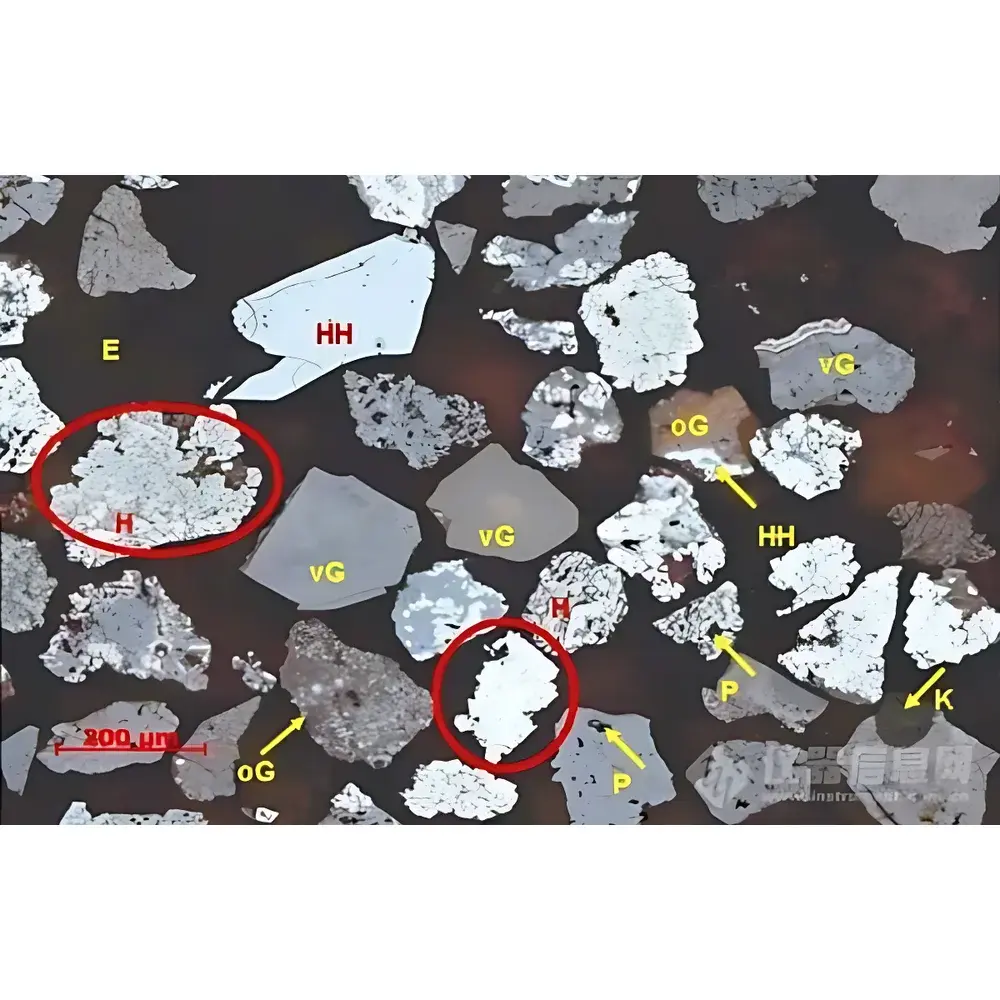
OPTON OIA Fully Automated Optical Mineralogical Analysis System
| Brand | OPTON |
|---|---|
| Model | OIA |
| Origin | Beijing, China |
| Type | Domestic |
| Price | USD 350,000 (approx.) |
| Core Technology | Reflected-light Polarized Optical Microscopy + AI-powered Image Recognition & Quantitative Phase Analysis |
Overview
The OPTON OIA Fully Automated Optical Mineralogical Analysis System is an industrial-grade, high-throughput optical mineral analyzer engineered for quantitative phase identification and microstructural characterization of iron-bearing ores, sinter, pellets, and coke in ferrous metallurgy. Unlike electron microscopy–based systems, the OIA leverages reflected-light polarized optical microscopy—compliant with ASTM E883 (Standard Guide for Reflected-Light Photomicrography) and ISO 16700 (Microanalysis — Quantitative analysis by energy-dispersive X-ray spectrometry — General principles) — to deliver rapid, non-destructive, and cost-efficient mineralogical assessment. Its core measurement principle relies on differential reflectance, birefringence, extinction angle, and interference color under cross-polarized illumination, enabling robust discrimination among hematite (H), pseudohematite (H), hydrohematite (HH), goethite variants (glassy oG, ochreous vG), kaolinite (K), porosity (P), and epoxy-impregnated matrix (E). Designed for continuous operation in QC/QA labs and R&D centers of integrated steelworks, the system bridges the gap between classical petrographic analysis and modern digital mineralogy—without requiring ultra-high vacuum, conductive coating, or spectral calibration.
Key Features
- Fully automated stage scanning with 10×–100× objective turret, motorized focus, and precision XYZ positioning (±0.2 µm repeatability)
- Integrated dual-illumination path: bright-field, dark-field, and cross-polarized reflected light with calibrated retardation plates
- AI-accelerated mineral classification engine trained on >12,000 validated ore thin-section images, supporting ≥28 predefined iron-bearing mineral phases
- Real-time quantification of modal abundance (% area), particle size distribution (PSD), liberation degree, texture index (e.g., pore connectivity, grain boundary continuity), and intergrowth morphology
- Automated report generation compliant with GLP documentation standards, including audit trail, user authentication, and timestamped raw image archiving
- Modular hardware architecture compatible with optional integration of microhardness indentation or UV fluorescence modules
Sample Compatibility & Compliance
The OIA accepts standard 25 mm × 45 mm polished thin sections (epoxy-impregnated, carbon-coated optional) and bulk drill-core chips mounted in resin blocks. It is validated for use with magnetite, hematite, limonite, siderite, goethite, lepidocrocite, and clay-associated gangue minerals (e.g., kaolinite, quartz, feldspar). All analytical workflows adhere to ASTM D3407 (Standard Test Method for Determination of Mineral Content of Coal and Coke), ISO 13909-4 (Hard Coal and Coke — Mechanical Sampling — Part 4: Coal — Methods of Determination of Particle Size Distribution), and internal QA protocols aligned with ISO/IEC 17025:2017. Data integrity meets FDA 21 CFR Part 11 requirements for electronic records and signatures when deployed with enabled audit logging and role-based access control.
Software & Data Management
The OIA Control Suite v4.2 is a Windows-based application featuring a dual-mode interface: “Expert Mode” for method development (custom threshold tuning, phase library expansion, multi-layer segmentation) and “Routine Mode” for push-button analysis. All image data are stored in vendor-neutral TIFF+XML metadata format; quantitative outputs export to CSV, Excel, and PDF with embedded traceability (sample ID, operator, instrument serial, acquisition date/time, calibration log ID). The software supports batch processing of up to 96 sections per run and integrates via OPC UA into MES/ERP systems (e.g., SAP QM, Siemens Opcenter). Database structure complies with IEC 62443-3-3 for industrial cybersecurity baseline requirements.
Applications
- Iron ore resource evaluation: Differentiation of hematite polymorphs (dense vs. porous pseudohematite), goethite hydration states, and liberation efficiency estimation prior to grinding
- Sinter and pellet microstructure–property correlation: Quantification of bonding phases (e.g., SFCA, dicalcium silicate), pore network topology, and reactivity index prediction
- Coke optical texture analysis: Classification of anisotropic domains (mosaic, flow, fibrous), inertinite content, and thermal maturity assessment per ISO 7404-5
- Process optimization feedback loop: Correlation of mineralogical parameters (e.g., hematite crystallinity index, goethite dehydration ratio) with blast furnace permeability, reducibility, and slag viscosity models
- Supplier qualification and blend optimization: Statistical comparison of multi-source ore batches using multivariate mineralogical fingerprints
FAQ
Does the OIA require sample coating or vacuum operation?
No. As a reflected-light optical system, it analyzes uncoated, ambient-air-stable polished sections without vacuum or conductive sputtering.
How does OIA compare to SEM-EDS for iron oxide phase identification?
OIA provides faster throughput (>200 fields/hour vs. ~20 fields/hour for point-by-point EDS mapping) and superior contrast for crystallographic variants (e.g., pseudohematite vs. hematite) but does not yield elemental composition. It is complementary—not competitive—with SEM-EDS.
Can users expand the built-in mineral library?
Yes. Trained users may import validated reference images, define new phase masks, and assign custom optical property thresholds via the Library Manager module.
Is remote diagnostics and software update supported?
Yes. With customer consent and firewall-compliant configuration, OPTON engineers can perform secure remote maintenance and version-controlled firmware updates.
What is the typical validation timeline for method transfer to a new lab?
Using the included IQ/OQ/PQ protocol package, full installation qualification and performance verification typically require 5–7 working days, including staff training and first-run certification.





