
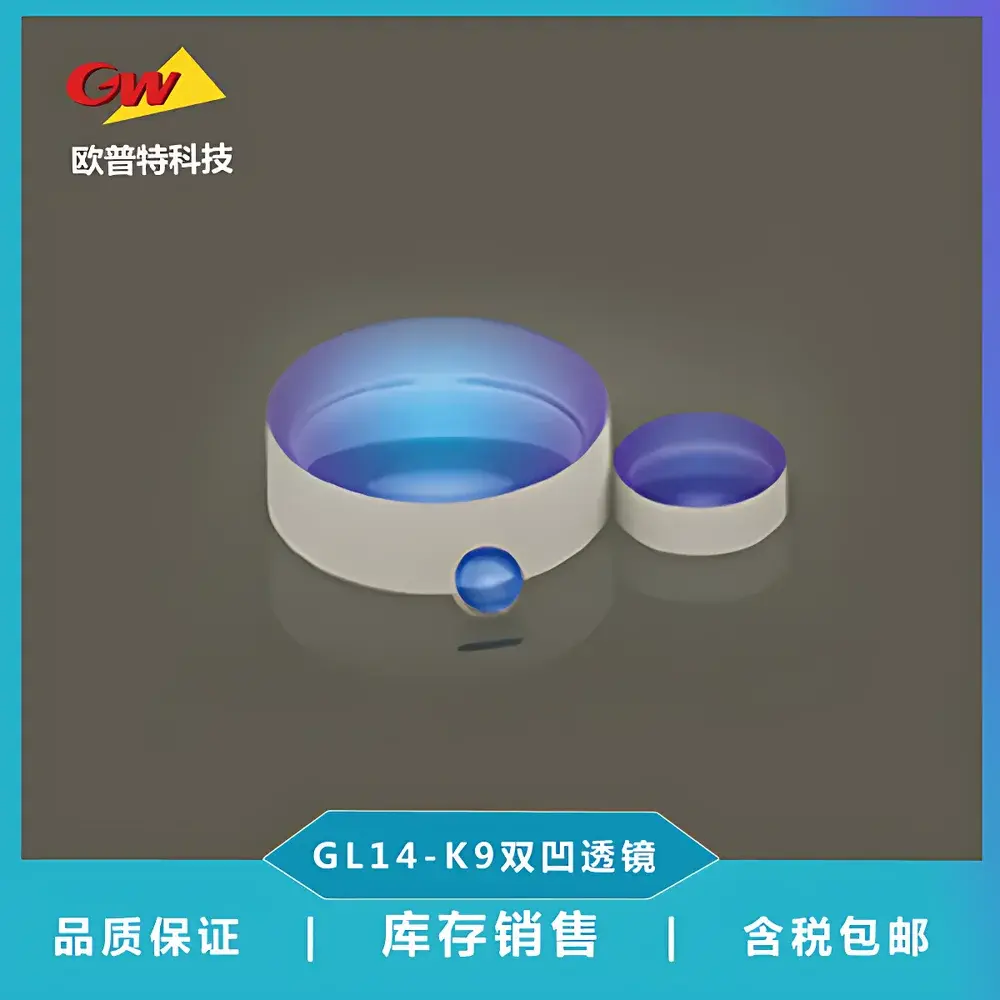
Optoprecision GL14 Biconcave Lens – VIS/NIR/SWIR Broadband Anti-Reflective Coated
| Origin | Beijing, China |
|---|---|
| Manufacturer Type | Authorized Distributor |
| Origin Category | Domestic (China) |
| Model | GL14 |
| Component Category | Optical Element |
| Coating Options | Uncoated |
Overview
The Optoprecision GL14 Biconcave Lens is a precision-engineered optical component fabricated from homogeneously annealed K9 borosilicate crown glass—a material widely specified in metrology-grade optical systems for its excellent transmission across the visible (VIS), near-infrared (NIR), and short-wave infrared (SWIR) spectral regions. As a symmetric biconcave lens (R₁ = −R₂), it introduces negative focal power and is routinely deployed in beam expansion, optical path length adjustment, divergence control, and collimation correction within laser cavities, interferometers, and imaging relay systems. Its design wavelength is optimized at 587.6 nm (d-line), ensuring minimal chromatic aberration under standard illumination conditions. The lens conforms to ISO 10110-3 surface form tolerances (λ/4 @ 632.8 nm) and maintains tight mechanical specifications—including diameter tolerance (+0.0/−0.1 mm), center thickness tolerance (±0.2 mm), and centration error ≤3 arcmin—enabling high reproducibility in alignment-sensitive setups.
Key Features
- Symmetric biconcave geometry with matched radii of curvature (R₁ = −R₂), enabling predictable negative focal behavior and simplified system modeling.
- Fabricated from certified, fine-annealed K9 optical glass (Schott N-BK7 equivalent), offering low bubble/inclusion content (ISO 10110-7 Class 3–4), high homogeneity (Δn ≤ 5 × 10⁻⁶), and consistent refractive index dispersion.
- Available in three broadband anti-reflective coating variants: VIS (400–700 nm, Rₐᵥg < 0.5% per surface), NIR (650–1050 nm, Rₐᵥg < 0.4% per surface), and SWIR (1000–1650 nm, Rₐᵥg 5 J/cm² @ 1064 nm, 10 ns).
- Controlled edge treatment: 0.2 mm × 45° chamfer (per ISO 10110-12) minimizes chipping during mounting and reduces stray light generation.
- Surface quality rated at 3–4 scratch-dig (MIL-PRF-13830B), suitable for applications requiring moderate scatter control without demanding ultra-low roughness requirements.
- Standardized mechanical interfaces compatible with industry-standard lens mounts (e.g., Thorlabs SM-series, Newport RMS-threaded cells), referenced in the Optoprecision Mounting Guide (p.100).
Sample Compatibility & Compliance
The GL14 series supports integration into both free-space and fiber-coupled architectures operating from 400 nm through 1650 nm. Its K9 substrate exhibits negligible absorption in this range, with transmission exceeding 99.2% per surface (uncoated) and >99.8% per surface (AR-coated) under normal incidence. All coated variants comply with ISO 9211-4 for coating adhesion (tape test pass), humidity resistance (95% RH, 40°C, 24 h), and thermal cycling stability (−40°C to +70°C, 5 cycles). The lenses are supplied without proprietary serialization but support traceability via batch-lot labeling per ISO 9001:2015 manufacturing protocols. While not individually certified to MIL-STD-810 or ECSS-Q-ST-70-02C, they meet baseline environmental robustness criteria for laboratory and OEM instrument integration under controlled ambient conditions.
Software & Data Management
No embedded firmware or driver software is associated with the GL14 lens, as it is a passive optical element. However, full technical documentation—including Zemax-compatible .ZMX files, raytrace-ready STEP/IGES models, and coating spectral reflectance/transmittance datasets (CSV format)—is provided upon request for optical design validation. All dimensional and performance data adhere to ASME Y14.5 geometric dimensioning and tolerancing conventions. For regulated environments (e.g., FDA-regulated analytical instrumentation or aerospace subsystems), lens lot records—including substrate certification, coating process logs, and interferometric surface verification reports—can be furnished under NDA to support GLP/GMP audit readiness and configuration management.
Applications
- Beam expansion and collimation in HeNe, diode-pumped solid-state (DPSS), and fiber laser systems.
- Negative focal correction in multi-element objectives, telecentric lenses, and anamorphic beam shaping assemblies.
- Optical cavity mode control in tunable external-cavity diode lasers (ECDLs) and VCSEL-based sensing modules.
- Reference optics in Fourier-transform infrared (FTIR) spectrometers and hyperspectral imaging calibration paths.
- Low-cost achromatic pair elements when combined with BK7-plano-convex or SF10 double-convex counterparts.
- Alignment fiducials and null optics in interferometric surface metrology (e.g., Fizeau and Twyman-Green configurations).
FAQ
What is the maximum permissible incident angle for optimal AR coating performance?
For VIS and NIR coatings, angular sensitivity remains within ±0.5% reflectance deviation up to 15° AOI; SWIR coatings maintain specification up to 10° AOI due to extended wavelength phase-matching constraints.
Can GL14 lenses be cleaned using standard optical solvents?
Yes—acetone, isopropanol, or spectroscopic-grade methanol may be used with lint-free wipes (e.g., Texwipe TX609); avoid ultrasonic cleaning unless explicitly validated for coated K9 substrates.
Is custom diameter or focal length available?
Standard GL14 offerings span Ø2–50 mm and EFL −2 to −50 mm; non-standard geometries are available under OEM agreement with minimum order quantities and extended lead times.
Do you provide interferometric test reports for individual lenses?
Interferometric surface verification (Zygo GPI or equivalent) is performed on statistical sampling per lot; full-unit certification incurs additional QA surcharge and must be specified at time of order.
Are these lenses suitable for vacuum or space-qualified environments?
While K9 exhibits low outgassing (CNEL < 1.0 × 10⁻¹⁰ g/(cm²·s)), AR coatings are not inherently space-qualified; mission-critical deployment requires separate outgassing validation per ECSS-Q-ST-70-02C and radiation hardness testing.




