
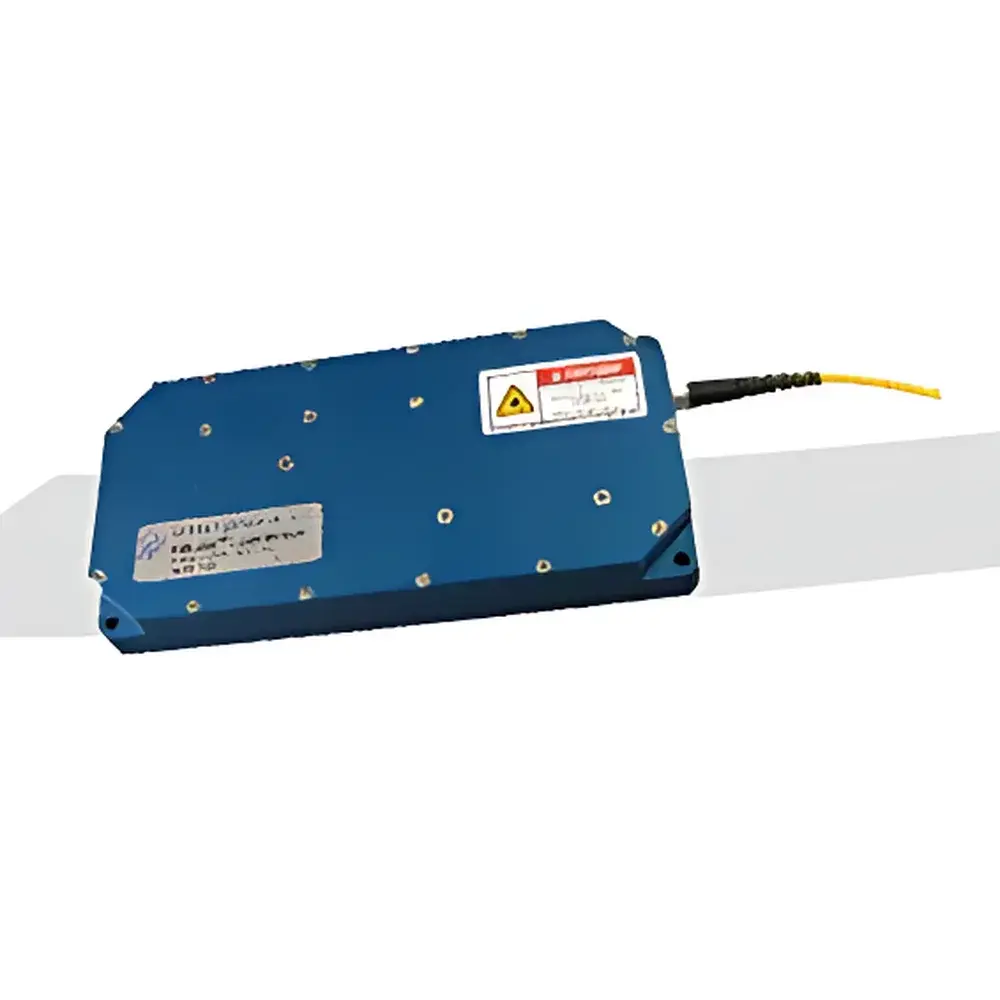
Orbits Lightwave OL-ETH Eternal™ & SlowLight™ Narrow-Linewidth Fiber Laser
| Brand | Orbits Lightwave |
|---|---|
| Origin | USA |
| Model | OL-ETH |
| Core Technology | Semiconductor-based All-Fiber Virtual Ring Cavity Laser |
| Output Power | Up to 350 mW (oscillator-only), scalable to 500 mW |
| Linewidth | <1 Hz (Lorentzian, white-noise-limited) |
| OSNR | >90 dBc (50 pm RBW, at 180 mW) |
| SMSR | >75 dBc (3 MHz RBW) |
| RIN | −175 dBc/Hz @ 100 MHz (at 100 mW) |
| Frequency Stability | <0.25 MHz/°C |
| Polarization Extinction Ratio | >23 dB |
| Wavelength Options | 1530–1565 nm & 1047–1080 nm |
| Tuning | PZT (1–60 GHz), Thermal (0–160 GHz) |
| Absolute Wavelength Accuracy | ±0.02 nm |
| Beam Quality | M² < 1.05 |
| Power Stability | ±0.1% RMS |
| Operating Temperature | 10–55 °C |
| Power Consumption | 5–30 W |
Overview
The Orbits Lightwave OL-ETH is a high-performance, all-fiber narrow-linewidth laser system engineered for applications demanding ultra-low phase noise, exceptional frequency stability, and robust environmental immunity. Built upon the proprietary Eternal™ and SlowLight™ technologies, the OL-ETH employs a monolithic, passively stabilized virtual ring cavity architecture—eliminating physical loop closure while enabling true traveling-wave oscillation in a compact linear footprint. This design fundamentally suppresses spatial hole burning and thermal transients, resulting in intrinsic linewidths below 1 Hz (Lorentzian, white-noise-limited) and sub-200 Hz integrated linewidth over 1–10 ms measurement windows. The SlowLight™-enhanced gain medium reduces group velocity by two orders of magnitude, directly suppressing both amplitude modulation (AM) and frequency modulation (FM) noise—achieving record-low relative intensity noise (RIN) of −175 dBc/Hz at 100 MHz and frequency noise spectral density below 1 Hz/√Hz at 100 kHz. Unlike conventional distributed feedback (DFB) or external cavity diode lasers (ECDLs), the OL-ETH delivers metrology-grade coherence without active electronic locking or complex vacuum or temperature-controlled enclosures.
Key Features
- All-fiber virtual ring cavity with monolithic SlowLight™ gain fiber—no free-space optics or alignment-sensitive components
- Stablelase™ hermetic packaging: vibration- and shock-insensitive (<0.1 g RMS sensitivity), qualified to MIL-STD-810G for field-deployable operation
- Passive thermal compensation combined with low-thermal-coefficient cavity design: frequency drift <0.25 MHz/°C across 10–55 °C ambient range
- High-power oscillator output: up to 350 mW fundamental power from single-mode polarization-maintaining (PM) fiber; optional amplification to 500 mW available
- Exceptional spectral purity: optical signal-to-noise ratio (OSNR) >90 dBc (50 pm resolution bandwidth), side-mode suppression ratio (SMSR) >75 dBc (3 MHz RBW)
- Low-noise, wideband tuning: PZT actuation (1–60 GHz) and thermal tuning (0–160 GHz) with hysteresis <0.5% of full scale
- Factory-calibrated absolute wavelength accuracy: ±0.02 nm (traceable to NIST SRM 1535a), supported by integrated wavemeter option
- M² 23 dB polarization extinction ratio (PER) via Panda-type PM fiber delivery
Sample Compatibility & Compliance
The OL-ETH is designed for integration into OEM subsystems and turnkey instrumentation platforms used in regulated environments. Its optical output conforms to IEC 60825-1:2014 Class 3B laser safety requirements, with interlock-ready TTL-compatible enable/disable signaling and integrated photodiode monitoring. Firmware supports configurable safety thresholds and fault logging compliant with ISO 13849-1 PL e / SIL 2 functional safety architecture. For laboratory and industrial deployment, the system meets CE marking requirements (EMC Directive 2014/30/EU, Low Voltage Directive 2014/35/EU) and RoHS 3 (2015/863/EU) material restrictions. While not pre-certified for FDA 21 CFR Part 11, the embedded control firmware provides audit-trail-capable parameter logging (timestamped, user-ID-tagged, immutable), supporting GLP/GMP-aligned validation protocols when deployed in analytical or medical device test systems.
Software & Data Management
Control is implemented via dual-interface architecture: a USB-C CDC ACM serial interface for low-latency command-and-control (SCPI-compliant syntax), and an optional Ethernet TCP/IP interface supporting IEEE 1588-2008 Precision Time Protocol (PTP) synchronization. The Orbits Control Suite (v4.x) provides cross-platform GUI (Windows/macOS/Linux) with real-time spectrum visualization, automated linewidth measurement (Hanning-windowed FFT, 100 kHz–100 MHz span), and long-term drift trending (24+ hour logged datasets). All configuration parameters—including PZT voltage maps, thermal setpoints, and power calibration curves—are stored in non-volatile memory with SHA-256 checksum integrity verification. Export formats include CSV (time-series), HDF5 (multi-dimensional metadata-rich), and SDF (Spectral Data Format v2.1) for interoperability with MATLAB, Python (SciPy/Labber), and LabVIEW-based DAQ ecosystems.
Applications
- Fiber-optic acoustic sensing (DAS) for perimeter security, seabed monitoring, and pipeline leak detection—leveraging multi-kilometer coherence length and sub-Hz linewidth for strain resolution <1 nε/√Hz
- Cohesive LIDAR systems requiring heterodyne detection fidelity: coherent Doppler wind LIDAR, vibrometry, and long-range target identification
- Seed sources for high-energy pulsed fiber amplifiers (e.g., chirped-pulse amplification systems), where amplified spontaneous emission (ASE) suppression and temporal contrast depend critically on oscillator spectral purity
- Coherent optical communications (100G–800G DP-QPSK/16-QAM) requiring stable local oscillator (LO) references with phase noise <−100 dBc/Hz @ 100 kHz offset
- Rf photonics and microwave photonics: low-phase-noise optical carriers for photonic-assisted RF generation, analog optical links, and photonic ADC clock distribution
- High-resolution spectroscopy: cavity-enhanced absorption spectroscopy (CEAS), photoacoustic gas sensing, and molecular fingerprinting in the C-band and Yb-band
- Optical metrology: interferometric displacement sensing, gravitational wave detector prototype testing, and optical clock stabilization loops
FAQ
What distinguishes the OL-ETH’s “virtual ring” architecture from conventional fiber lasers?
The virtual ring eliminates physical loop closure using counter-propagating mode coupling in SlowLight™ fiber—enabling unidirectional traveling-wave oscillation without isolators or polarization controllers. This yields superior mode stability and eliminates spatial hole burning-induced power fluctuations.
Is the OL-ETH suitable for airborne or mobile platform integration?
Yes. The Stablelase™ mechanical design passes random vibration (5–500 Hz, 0.04 g²/Hz PSD) and shock (30 g, 11 ms half-sine) per MIL-STD-810G Method 516.6, with no performance degradation observed under sustained 2g acceleration.
Can multiple OL-ETH units be phase-locked for array applications?
Yes. The system includes a low-jitter (<1 ps RMS) 10 MHz reference input/output port and supports external phase-lock loops (PLL) using standard RF synthesizers. Dual-unit coherence measurements confirm phase stability <1 rad over 1 s at 1550 nm.
Does the laser support continuous wavelength tuning over its full band?
Yes—both PZT and thermal actuators provide continuous, mode-hop-free tuning across the entire 1530–1565 nm or 1047–1080 nm bands, verified by high-finesse scanning Fabry–Pérot interferometer trace.
What documentation is provided for regulatory validation in pharmaceutical or aerospace QA/QC environments?
A complete Design History File (DHF)-aligned package is available upon request, including Factory Acceptance Test (FAT) reports, traceable calibration certificates (NIST-traceable wavemeter and power meter), failure modes and effects analysis (FMEA), and software verification protocol (SVP) summary.





