
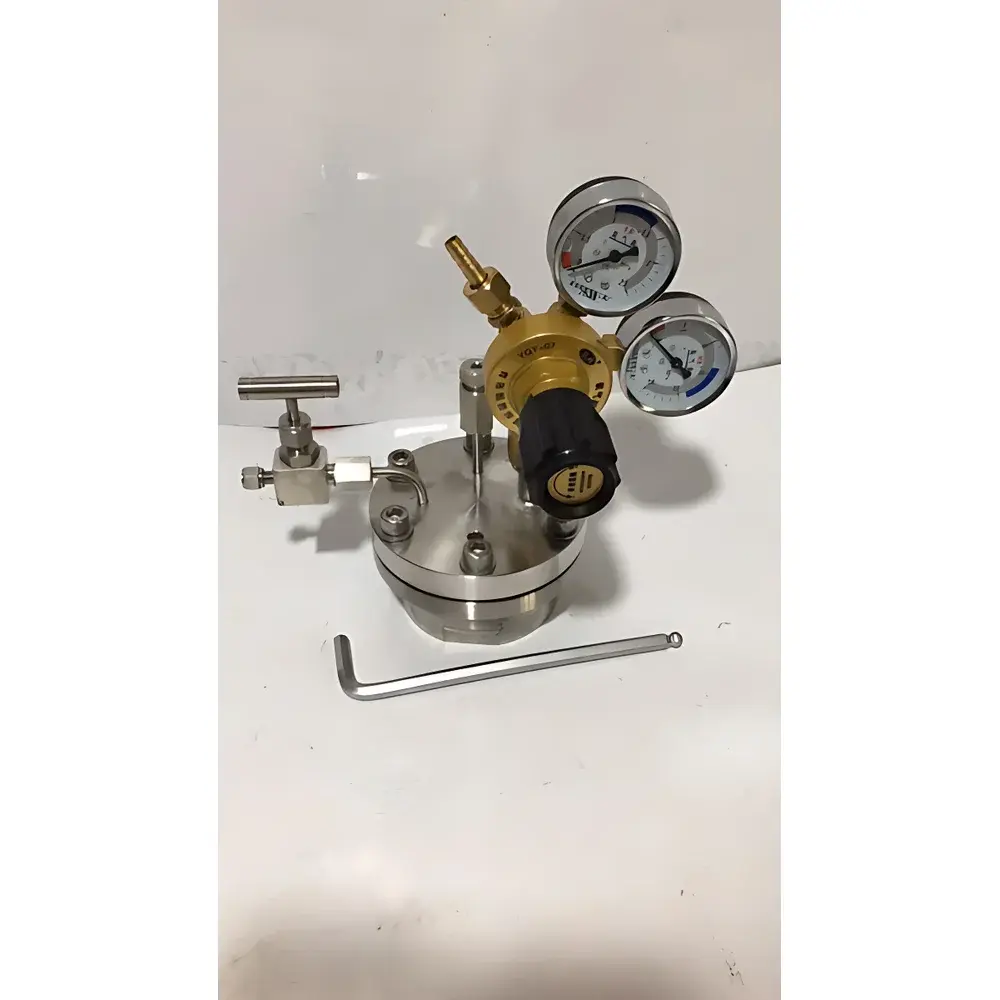
Organic Gas-Compatible Reaction Vessel PFM2 by Zhengxin Instrument Factory
| Brand | Zhengxin Instrument Factory |
|---|---|
| Origin | Jiangsu, China |
| Manufacturer Type | Authorized Distributor |
| Country of Origin | China |
| Model | PFM2 |
| Price | USD 420 (FOB Jiangsu) |
| Usable Volume | Small-scale (≤500 mL) |
| Construction Material | 316 Stainless Steel |
| Operating Pressure | Low-pressure (up to 0.6 MPa gauge) |
| Vacuum Capability | ≤ −0.098 MPa (absolute) |
| Design Standard | ASME BPVC Section VIII Div. 1 compliant for low-pressure service |
Overview
The PFM2 Organic Gas-Compatible Reaction Vessel is a compact, pressure-rated laboratory reactor engineered for controlled gas–liquid and gas–solid reactions involving volatile or reactive organic vapors—such as methane, ethylene, hydrogen sulfide, formaldehyde, or chlorinated hydrocarbons—under inert, reducing, or mildly pressurized atmospheres. Designed in accordance with ASME Boiler and Pressure Vessel Code Section VIII Division 1 for low-pressure service, the vessel employs a robust 316 stainless steel construction to resist corrosion from acidic condensates, halogenated intermediates, and oxidizing byproducts commonly encountered in organic synthesis, catalytic hydrogenation, and photochemical degradation studies. Its sealed, gastight architecture integrates standardized ISO-KF (QF) or NW25 vacuum flanges, enabling direct coupling to mass flow controllers, gas scrubbers, online FTIR cells, or cold traps—eliminating dead-volume leaks and ensuring stoichiometric gas dosing integrity. Unlike generic glass reactors, the PFM2 maintains mechanical stability during repeated thermal cycling (−20 °C to +180 °C) and accommodates optional magnetic drive stirrers with PTFE-coated impellers for homogeneous mixing without shaft leakage.
Key Features
- 316 stainless steel wetted parts with electropolished interior finish (Ra ≤ 0.4 µm) to minimize surface adsorption and facilitate residue-free cleaning between organic batches
- Double-sealed, clamp-type lid with helical groove gasket channel and dual O-ring configuration (Viton® FKM primary + EPDM secondary) rated for continuous operation up to 0.6 MPa(g) and vacuum down to 2 kPa(abs)
- Standardized 1/4″ NPT and M12×1.0 threaded ports for integration with pressure transducers, thermocouple wells (Type K), and gas inlet/outlet manifolds
- Modular design supporting optional accessories: jacketed heating/cooling mantle (±0.5 °C control), reflux condenser with dry-ice trap, and explosion-proof spark-resistant stirrer motor (ATEX Zone 2 compliant)
- Traceable material certification (MTR EN 10204 3.1) supplied with each unit; vessel serial number engraved on body and lid for audit-ready equipment identification
Sample Compatibility & Compliance
The PFM2 is validated for use with Class I organic solvents (e.g., THF, DMF, dichloromethane, toluene) and reactive gases including H₂, CO, NH₃, Cl₂ (diluted), and SO₂ at concentrations below occupational exposure limits (OSHA PEL). It conforms to ISO 14001 environmental handling protocols and supports GLP-compliant recordkeeping when paired with calibrated pressure and temperature loggers. While not certified for high-hazard exothermic reactions (e.g., nitration, azide chemistry), it meets ASTM E2877-22 criteria for low-energy gas-phase reaction screening and is routinely employed in academic and industrial R&D labs conducting catalyst evaluation, polymerization kinetics, and VOC abatement testing under controlled ventilation hoods.
Software & Data Management
The PFM2 operates as a standalone hardware platform with no embedded firmware or proprietary software. All process parameters—including real-time pressure (0–1.0 MPa, ±0.5% FS), temperature (−50 to +200 °C, ±0.3 °C), and stir speed (0–600 rpm)—are monitored via external third-party controllers (e.g., Eurotherm 2408, Omega CN7500) compatible with Modbus RTU or 4–20 mA analog outputs. Raw sensor data may be archived in CSV or TDMS format using LabVIEW, MATLAB, or Python-based acquisition scripts. For regulated environments, users may implement 21 CFR Part 11–compliant electronic signatures and audit trails through validated SCADA systems interfaced via RS485 or Ethernet/IP.
Applications
- Catalytic hydrogenation of unsaturated organics (alkenes, nitroarenes) under sub-atmospheric H₂ partial pressures
- In situ generation and trapping of unstable intermediates (e.g., diazonium salts, carbocations) using controlled gas sparging
- Gas–liquid phase-transfer catalysis with quaternary ammonium halides in biphasic systems
- Accelerated aging studies of polymer films exposed to ozone or NOₓ mixtures at elevated humidity
- Calibration verification of portable VOC sensors using certified gas standards delivered via dynamic dilution
FAQ
Is the PFM2 suitable for reactions involving chlorine gas (Cl₂)?
Yes—when operated at ≤10% v/v Cl₂ in nitrogen carrier gas and maintained below 50 °C, provided Viton® seals are inspected after every 5 cycles and replaced per manufacturer’s service schedule.
Can the vessel be sterilized using autoclaving?
No. Autoclaving exceeds its pressure–temperature rating. Sterilization must be performed via ethanol rinse followed by vacuum-drying or gas-phase hydrogen peroxide (H₂O₂) treatment at ambient temperature.
Does the PFM2 include pressure relief protection?
A rupture disc (set point: 0.8 MPa) is available as an optional accessory; it is not pre-installed but strongly recommended for all applications exceeding 0.4 MPa(g) operating pressure.
What documentation is provided upon shipment?
Each unit ships with ASME U-1 Manufacturer’s Data Report, material test reports (MTRs), dimensional drawings (PDF & STEP), and a calibration certificate for the integrated pressure port (traceable to NIST).



