
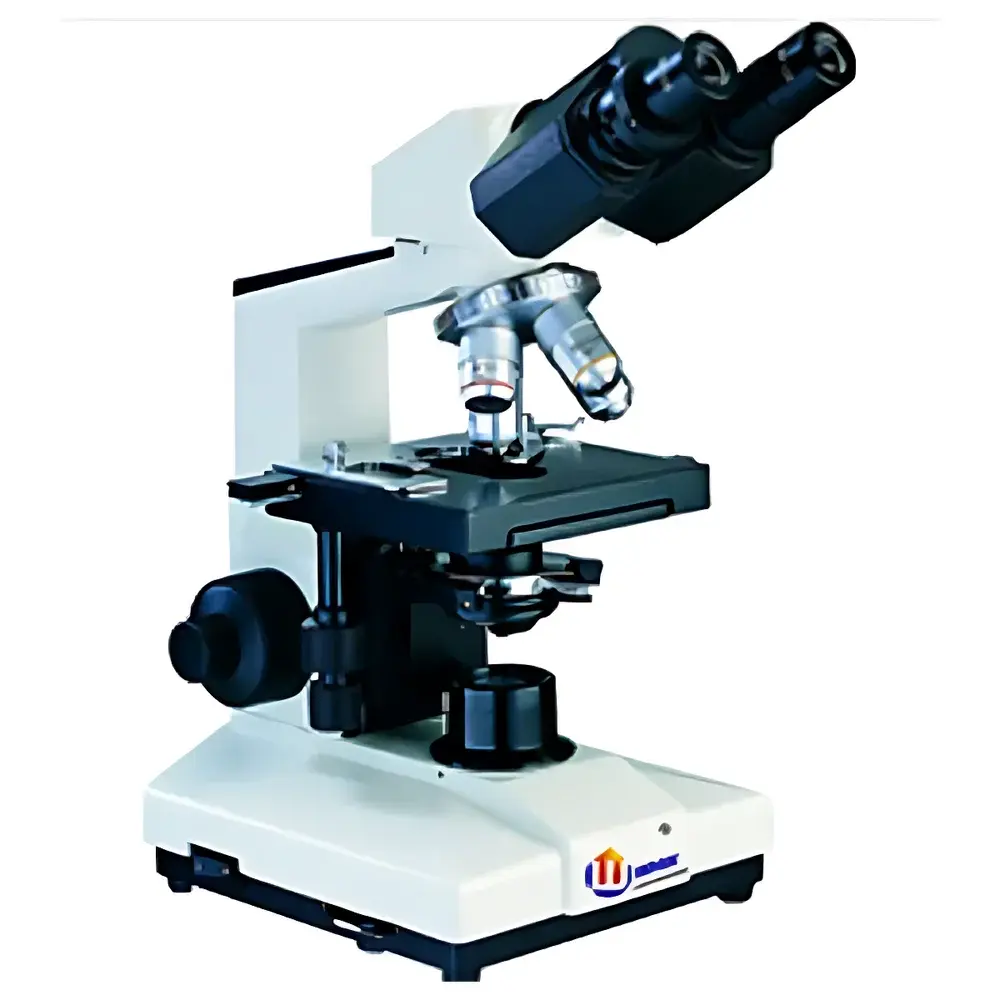
YANRUN BI-16 Biological Inverted Microscope
| Brand | YANRUN |
|---|---|
| Origin | Shanghai, China |
| Manufacturer Type | Direct Manufacturer |
| Product Category | Domestic (China-Made) |
| Model | BI-16 Biological Inverted Microscope |
| Instrument Type | Inverted Microscope |
| Eyepiece Configuration | Binocular |
| Magnification Range | 40×–1600× |
| Eyepieces | Wide-Field WF10× (Φ18 mm), WF16× (Φ11 mm) |
| Achromatic Objectives | 4×/0.10, 10×/0.25, 40×/0.65 (spring-loaded), 100×/1.25 (spring-loaded, oil immersion) |
| Nosepiece | Four-position, outward-facing ball-bearing centering turret |
| Stage | Dual-layer mechanical stage (135 mm × 125 mm) |
| Condenser | Abbe condenser, N.A. 1.25, vertically adjustable |
| Filters | Blue filter, ground glass |
| Illuminator | 6 V / 20 W halogen lamp with brightness control |
| Focusing Mechanism | Coaxial coarse/fine focus |
| fine focus graduation | 2 µm |
| Optional Configurations | Phase contrast (PH-I/PH-II turret, PHP objectives), LED illumination (9 V/500 mA adapters), polarizing system (360° rotatable polarizer, slide-in analyzer), infinity-corrected optical pathway, USB/VIDEO camera eyepiece |
Overview
The YANRUN BI-16 Biological Inverted Microscope is an entry-level yet robust inverted microscope engineered for routine cell culture observation, live-cell monitoring, and basic histological evaluation in academic teaching labs, quality control environments, and small-scale biotechnology facilities. Unlike upright microscopes, its inverted configuration positions the objective lenses beneath the specimen stage and the light source above—enabling direct observation of adherent cells in standard Petri dishes, multi-well plates, and flasks without specimen inversion or mounting. The optical architecture employs a finite-conjugate achromatic lens system optimized for high contrast and minimal chromatic aberration across the visible spectrum (400–700 nm). Designed for stability under continuous operation, the BI-16 features a rigid cast-aluminum base, vibration-damped stage assembly, and thermally stable halogen illumination—ensuring consistent intensity and color temperature during extended imaging sessions.
Key Features
- Binocular viewing head inclined at 30°, with interpupillary adjustment (55–75 mm) and diopter compensation for both eyepieces.
- Two precision focusing variants: BI-16A (coaxial coarse/fine focus) and BI-16B (coaxial focus with upper-limit lock, tension-adjustable coarse knob, and 2 µm fine-focus graduation).
- Four-position objective turret with ball-bearing internal centering for repeatable alignment and minimal parfocality drift.
- Dual-layer mechanical stage offering 75 mm × 35 mm travel range, calibrated X/Y verniers, and low-profile design compatible with standard tissue culture vessels.
- Abbe condenser (N.A. 1.25) with rack-and-pinion height adjustment, integrated iris diaphragm, and centering screws for Köhler illumination optimization.
- Halogen illumination system (6 V / 20 W) with continuously variable brightness control and heat-absorbing filter to minimize thermal load on live specimens.
- Modular upgrade path supporting phase contrast, polarization, darkfield, and digital imaging via standardized C-mount or trinocular port options.
Sample Compatibility & Compliance
The BI-16 accommodates common life science sample formats including 35 mm and 60 mm Petri dishes, T-25/T-75 flasks, 6–96-well plates, and glass-bottom dishes (thickness ≤ 1.2 mm). Its working distance clearance (≥ 3 mm at 10×, ≥ 0.5 mm at 100× oil) permits unobstructed access for micromanipulation tools and environmental chambers. While not certified for ISO 13485 or FDA 21 CFR Part 11 compliance out-of-the-box, the instrument’s mechanical reproducibility, documented calibration traceability (via included stage micrometer), and stable illumination output support GLP-aligned documentation workflows. All optical components meet ISO 10934-1 standards for achromatic correction, and the halogen lamp complies with IEC 60825-1 for Class 1 laser safety when used with optional camera attachments.
Software & Data Management
The BI-16 supports third-party digital imaging through USB 2.0 or analog VIDEO output ports. Compatible software includes open-source platforms (e.g., ImageJ/Fiji with appropriate drivers) and commercial packages (Olympus cellSens Lite, Zeiss ZEN Lite) when paired with C-mount-adapted CMOS cameras (e.g., AmScope MU1403, Thorlabs DCU223M). Metadata capture—including magnification, objective ID, exposure time, and timestamp—is retained in TIFF or AVI containers. For audit-ready environments, users may implement external logging protocols using time-stamped image directories and manual logbooks aligned with ISO/IEC 17025 clause 7.5.2 (control of technical records).
Applications
- Monitoring confluence and morphology of adherent mammalian cell lines (e.g., HeLa, NIH/3T3, CHO-K1) in routine passage workflows.
- Qualitative assessment of microbial contamination in suspension cultures and biofilm formation assays.
- Basic hematology: unstained or Wright-Giemsa stained blood smears and bone marrow aspirates.
- Botanical studies: root tip mitosis staging, pollen grain viability testing, and fungal hyphae observation.
- Teaching laboratories: introduction to microscopy principles, resolution limits, depth of field, and Köhler illumination setup.
- QC release testing of sterile packaging integrity via visual inspection of particulates in clear vials or bags.
FAQ
Is the BI-16 suitable for oil immersion imaging?
Yes—the 100×/1.25 NA spring-loaded objective is designed for immersion oil (Type A, n = 1.515) and achieves theoretical resolution down to ~0.25 µm at 550 nm wavelength.
Can it be upgraded to phase contrast without replacing the main optical train?
Yes—phase contrast capability is added via optional PH-I or PH-II turret condensers, matched PHP-series objectives, and centering telescopes; no modification to the base microscope body is required.
What is the maximum recommended working duration per session?
Continuous operation up to 8 hours is supported by the thermally managed halogen housing; for >4-hour sessions, periodic 5-minute lamp cooldown intervals are advised to extend filament life.
Does the BI-16 support DIC or fluorescence?
No—DIC requires Nomarski prisms and strain-free optics not present in the standard configuration; fluorescence necessitates epi-illumination, barrier filters, and high-N.A. objectives outside this model’s design scope.
Are replacement parts and service manuals available internationally?
Yes—YANRUN provides English-language technical documentation, exploded-view diagrams, and spare part kits (e.g., bulbs, fuses, stage clips) with lead times under 12 business days to EEA and North American distribution partners.




