
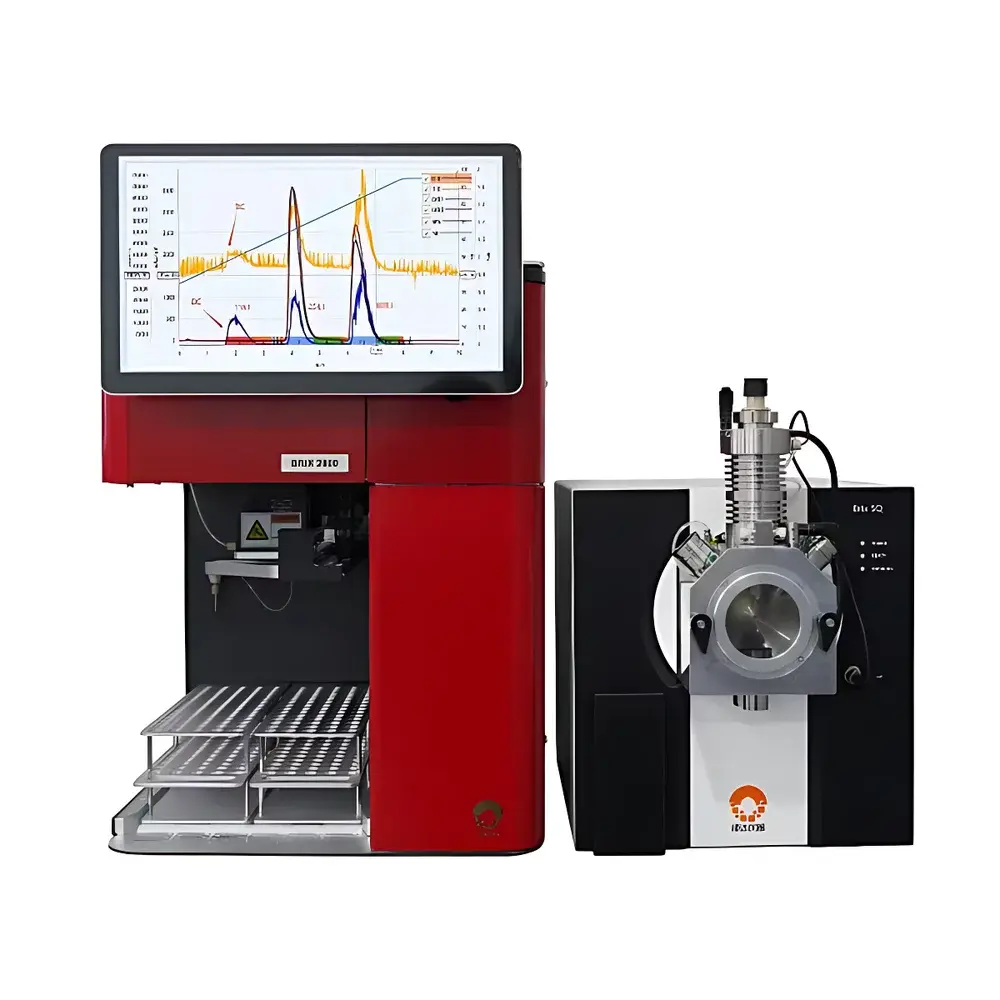
Orienda Brix-SQ Mass-Directed Preparative Liquid Chromatography System
| Brand | Orienda |
|---|---|
| Origin | Beijing, China |
| Manufacturer Type | Authorized Distributor |
| Country of Origin | China |
| Model | Brix-SQ |
| Pricing | Available Upon Request |
Overview
The Orienda Brix-SQ Mass-Directed Preparative Liquid Chromatography System is an integrated, benchtop-scale purification platform engineered for synthetic and natural product chemists requiring rapid, selective isolation of target compounds based on real-time mass spectral detection. Unlike conventional preparative HPLC systems that rely solely on UV-triggered fraction collection, the Brix-SQ employs a robust, low-maintenance electrospray ionization (ESI) mass spectrometer coupled directly to a high-pressure preparative LC flow path. This architecture enables true mass-directed fractionation—where collection is triggered automatically upon detection of ions matching user-defined m/z values. The system operates on a “set-and-collect” principle: users input one or more target molecular weights (e.g., [M+H]⁺ or [M−Na]⁻), and the instrument autonomously initiates fraction collection only when the corresponding ion signal exceeds a configurable intensity threshold. This eliminates reliance on retention time alignment or reference standards, significantly reducing method development time and improving reproducibility across diverse compound classes.
Key Features
- Mass-triggered fraction collection with configurable m/z windows and intensity thresholds
- Dedicated passive flow splitter with mechanical multi-position adjustment—no electronic actuation, no consumables, no software dependency
- Integrated solid-phase sample introduction interface: accepts crushed TLC plates, dried reaction mixtures, or powdered crude extracts without dissolution or pre-filtration
- Optimized flow-path design minimizing carryover and column fouling—especially critical for high-concentration, viscous, or particulate-laden samples common in synthetic chemistry workflows
- Stable mass axis calibration: temperature-compensated quadrupole optics ensure long-term m/z accuracy without daily tuning or ambient temperature recalibration
- Rapid ESI source cleaning via tool-free access; no replacement electrodes, gaskets, or capillaries required during routine maintenance
- Active split valve option available for precise, stable flow division between MS detector and collection path—supports delay time compensation and scalable integration with larger-diameter preparative columns (e.g., 20–50 mm i.d.)
Sample Compatibility & Compliance
The Brix-SQ accommodates a broad range of sample formats—including neat solids, lyophilized residues, silica gel scrapings from TLC, and crude reaction supernatants—without mandatory filtration or solvent exchange. Its low-dead-volume interface and pressure-tolerant ESI source tolerate moderate particulate load and variable solvent strength (10–100% aqueous/organic gradients). While not certified for GMP production environments, the system supports GLP-aligned documentation practices: all collection events are timestamped and logged with associated m/z, intensity, and retention time metadata. Raw data files adhere to open mzML format, enabling traceability and third-party validation. System operation complies with IEC 61010-1 safety standards for laboratory equipment; ESI voltage and gas controls conform to EN 61326-1 for electromagnetic compatibility.
Software & Data Management
The Brix-SQ runs on a lightweight, Windows-based control application designed for minimal training overhead. No scripting or advanced chromatography knowledge is required. Users define targets via intuitive m/z entry fields; method templates—including polarity mode, fragmentor voltage, and dwell time—are preconfigured for common compound categories (e.g., small-molecule pharmaceuticals, alkaloids, flavonoids). All acquisition and collection logs are stored in structured SQLite databases with export to CSV or Excel. Audit trails record operator ID, method version, and parameter changes—supporting basic 21 CFR Part 11 readiness when deployed with network-authenticated login and write-protected storage. Data integrity is preserved through automatic file checksum generation and session-level backup snapshots.
Applications
- Synthetic organic chemistry: rapid purification of parallel synthesis outputs, Suzuki couplings, amide bond formations, and heterocyclic scaffolds
- Natural products isolation: targeted recovery of bioactive constituents from plant extracts, fungal broths, or marine-derived samples
- Medicinal chemistry support: iterative purification of hit-to-lead compounds without prior analytical method transfer
- Fine chemical and polymer additive purification: removal of catalyst residues, unreacted monomers, or regioisomeric impurities
- Academic research labs: accessible mass-directed purification for undergraduate and graduate teaching laboratories where cost, simplicity, and reliability are prioritized over ultra-high resolution
FAQ
Does the Brix-SQ require continuous software control to operate the passive splitter?
No—the mechanical splitter is manually set prior to run and remains fixed throughout the separation. No driver, firmware, or real-time communication is involved.
Can the system handle samples loaded directly from TLC plates without extraction?
Yes. The solid-sample interface allows direct insertion of silica- or C18-coated plate fragments into the injection chamber; on-column elution initiates upon mobile phase contact.
Is mass calibration traceable to NIST standards?
The factory calibration uses perfluorotributylamine (PFTBA) and is documented in the system certificate; users may perform verification checks using sodium formate or cesium iodide.
What is the maximum recommended flow rate for the ESI source when interfaced with 20 mm i.d. columns?
For optimal ion transmission and signal stability, the recommended total flow is ≤20 mL/min; active splitting enables diversion of ≥95% of flow to waste or collector while maintaining 0.2–0.5 mL/min to the MS.
Are raw mass spectra saved in vendor-neutral format?
Yes—acquired centroided spectra are exported in standard mzML 1.1.0 format, compatible with OpenMS, Skyline, and ProteoWizard tools.




