
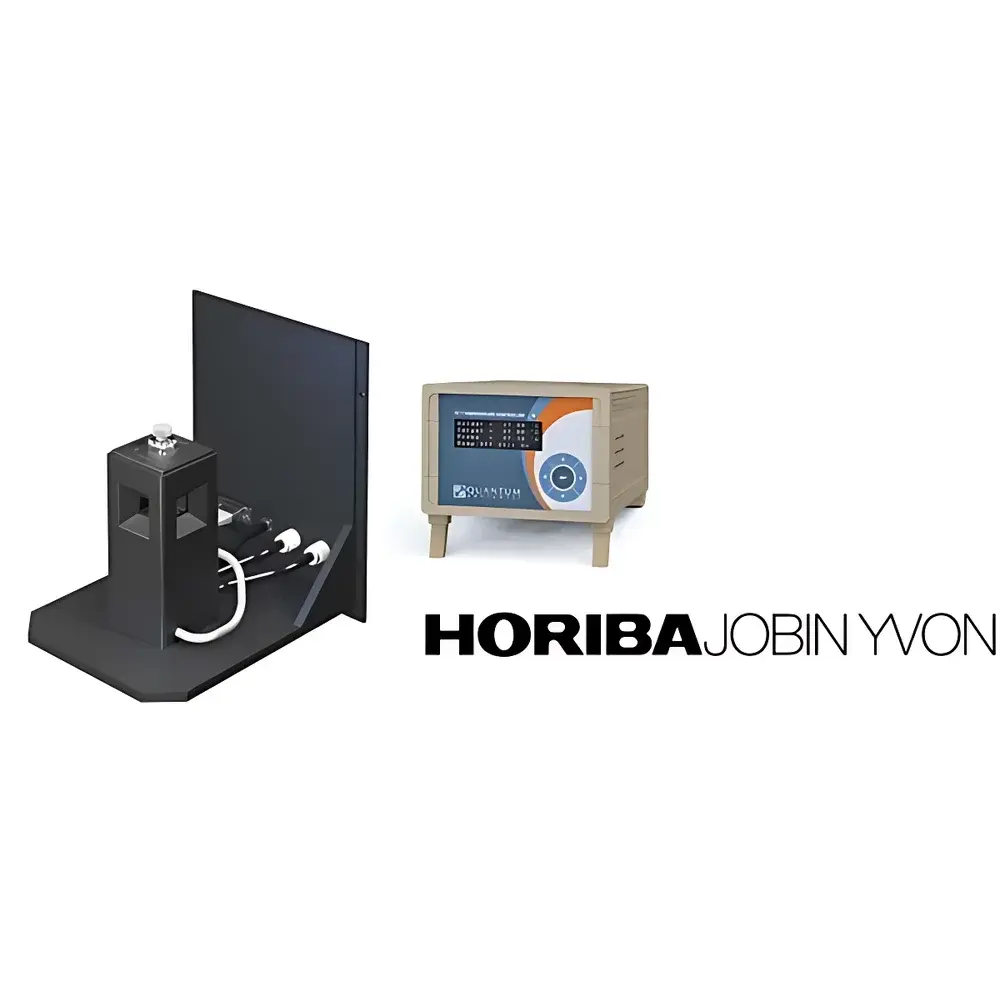
Orient KOJI Luma40 Magnetic Stirring Electronic Temperature-Controlled Sample Holder
| Brand | Orient KOJI |
|---|---|
| Origin | USA |
| Manufacturer Type | Authorized Distributor |
| Import Status | Imported |
| Model | Luma 40 |
| Price Range | USD 6,800 – 13,600 |
| Temperature Range | −40 °C to +105 °C |
| Temperature Accuracy | ±0.2 °C (0 °C to +80 °C) |
| Temperature Precision | ±0.01 °C |
| Temperature Reproducibility | < ±0.05 °C |
| Optical Port Dimensions | 12 mm (H) × 10 mm (W) |
| Compatible Probes | Horiba Series 400 & Series 500 |
| Standard Cuvette O.D. | 12.5 mm × 12.5 mm |
| Cuvette Z-Height Options | 8.5 mm or 15 mm (specify at order) |
| Dry Gas Purge | Yes |
| Stirring | Variable-speed magnetic stirring |
Overview
The Orient KOJI Luma40 Magnetic Stirring Electronic Temperature-Controlled Sample Holder is a precision-engineered accessory designed for integration with high-sensitivity steady-state and time-resolved fluorescence spectrometers—including the Horiba FluoroMax-4 and FluoroLog-3 platforms. It operates on the principle of Peltier-based thermoelectric cooling and heating, enabling rapid, bidirectional thermal control across an exceptionally wide range (−40 °C to +105 °C) while maintaining sub-millidegree stability. Unlike passive temperature blocks or water-jacketed cells, the Luma40 employs active feedback regulation via a NIST-traceable platinum resistance thermometer (Pt100), delivering real-time closed-loop control with ±0.01 °C precision and better than ±0.05 °C reproducibility over repeated thermal cycles. Its four orthogonal optical ports—each precisely dimensioned at 12 mm (height) × 10 mm (width)—are optimized for minimal beam deviation and maximum light throughput in front-face, right-angle, and back-scattering configurations. The unit supports standard 12.5 mm square cuvettes with selectable Z-heights (8.5 mm or 15 mm), ensuring compatibility with both conventional and micro-volume sample geometries common in photophysical characterization.
Key Features
- Peltier-driven thermoelectric control enabling continuous operation from cryogenic (−40 °C) to near-boiling (+105 °C) temperatures
- NIST-traceable Pt100 sensor with digital PID feedback loop for ±0.01 °C temperature precision and < ±0.05 °C cycle-to-cycle reproducibility
- Variable-speed magnetic stirring (0–1200 rpm) with programmable ramp profiles, minimizing convection artifacts and ensuring homogeneous sample distribution during kinetic or equilibrium measurements
- Dry gas purge port compatible with nitrogen or argon lines, enabling oxygen-sensitive experiments (e.g., triplet state lifetime studies, phosphorescence, or photoinduced electron transfer)
- Modular mechanical interface engineered for direct mounting onto Horiba FluoroMax-4 and FluoroLog-3 sample compartments without optical realignment
- Thermally isolated stainless-steel housing with low-thermal-mass design to reduce thermal lag and improve response time (< 90 s to stabilize within ±0.1 °C across full range)
Sample Compatibility & Compliance
The Luma40 accommodates standard 12.5 mm × 12.5 mm outer-diameter quartz or fused-silica cuvettes with either 8.5 mm or 15 mm optical path height—configurations selected at time of order to match instrument-specific beam height requirements. It accepts Horiba Series 400 and Series 500 temperature probe assemblies for independent verification and validation. All thermal calibration data are traceable to NIST Standard Reference Materials (SRMs), supporting compliance with ISO/IEC 17025 laboratory accreditation requirements. The device’s electronic architecture conforms to IEC 61000-6-3 (EMC emission limits) and IEC 61010-1 (safety for laboratory equipment). While not FDA-cleared as a medical device, its performance documentation and audit-ready calibration logs support GLP and GMP-aligned workflows where temperature-controlled spectroscopic assay validation is required.
Software & Data Management
The Luma40 communicates via RS-232 or USB virtual COM port to Horiba FluorEssence™ or DeltaHub™ software environments. Temperature setpoints, stirring speed, and dry gas flow status are fully scriptable via ASCII command protocol, enabling synchronization with acquisition triggers (e.g., start heating upon excitation pulse, pause stirring during photon counting intervals). Full thermal history—including timestamped temperature, setpoint error, and stir speed—is logged internally and exportable as CSV for post-experiment correlation with fluorescence decay or spectral shift data. Audit trail functionality includes user ID tagging, parameter change logging, and tamper-evident timestamps compliant with 21 CFR Part 11 when deployed with validated software configurations.
Applications
- Temperature-dependent fluorescence quantum yield determination across phase transitions (e.g., polymer coil-to-globule, lipid bilayer melting)
- Activation energy profiling of non-radiative decay pathways using Arrhenius analysis of lifetime or intensity vs. temperature
- Stabilization of transient intermediates (e.g., exciplexes, charge-transfer states) under controlled thermal gradients
- High-fidelity phosphorescence measurements requiring inert, low-temperature environments with mechanical homogeneity
- Method development for pharmaceutical solid-state characterization (polymorph screening, amorphous content assessment) via temperature-resolved emission spectroscopy
- Calibration validation of reference standards (e.g., quinine sulfate, fluorescein) across extended thermal ranges per USP guidelines
FAQ
Is the Luma40 compatible with non-Horiba spectrofluorometers?
Yes—mechanical and electrical interfaces can be adapted for custom integration with other platforms (e.g., Edinburgh Instruments FS5, PTI QuantaMaster) using third-party mounting brackets and serial command mapping; contact technical support for interface specifications.
What is the recommended maintenance schedule for long-term thermal accuracy?
Annual recalibration against NIST-traceable reference standards is advised; users should retain calibration certificates for ISO/IEC 17025 audits. No consumables or routine part replacement is required under normal operating conditions.
Can the dry gas purge be operated independently of temperature control?
Yes—the purge solenoid valve is software-controllable and may be activated before, during, or after thermal ramping to prevent condensation or oxidation without interrupting temperature stabilization.
Does the Luma40 support gradient temperature programming (e.g., linear ramps or step profiles)?
Yes—up to 10 user-defined segments (ramp rate, dwell time, target temperature) can be programmed directly via FluorEssence™ or through ASCII command scripting.
What cuvette materials are validated for use at −40 °C?
Only UV-grade fused silica (e.g., Hellma Suprasil® or Starna Quartz) is certified for sustained operation below 0 °C; standard quartz cuvettes may exhibit microfracture risk under repeated thermal cycling below −20 °C.



