
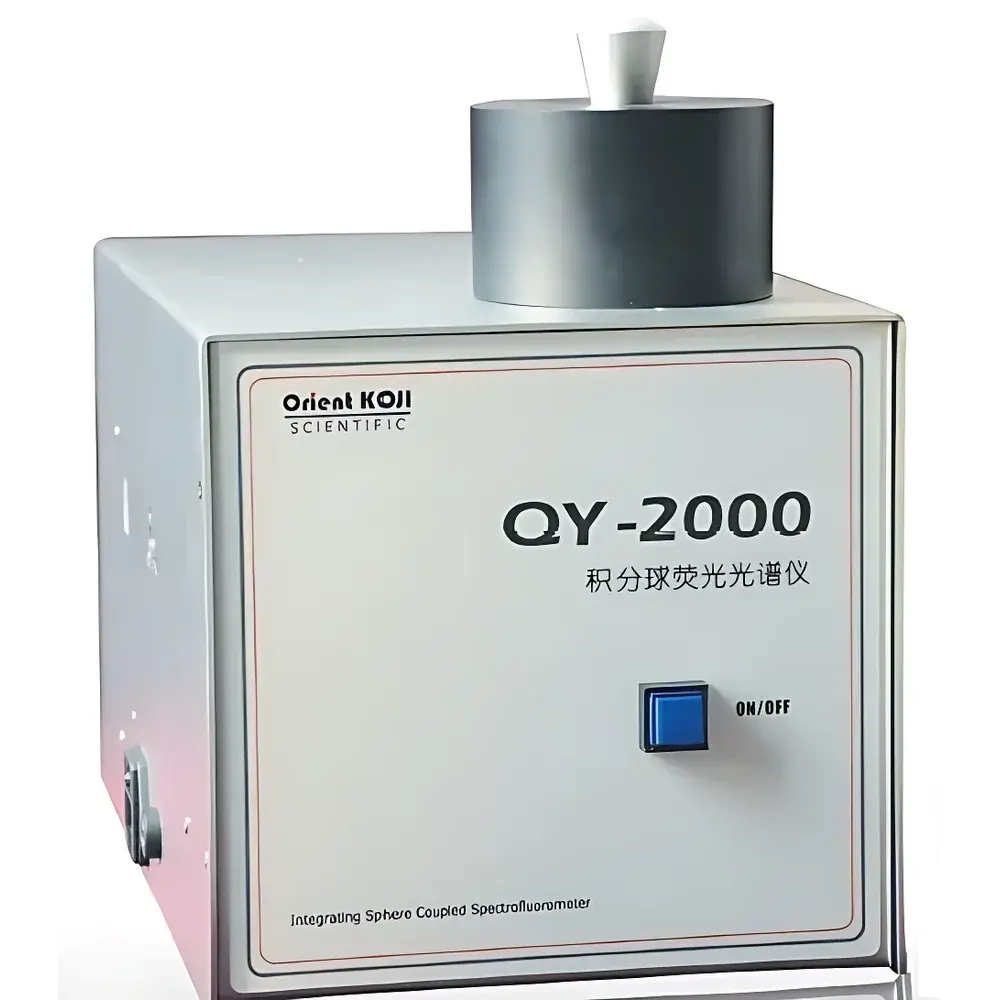
Orient KOJI QY-2000 Integrating Sphere Fluorescence Spectrometer
| Brand | Orient KOJI |
|---|---|
| Origin | Tianjin, China |
| Manufacturer Type | Authorized Distributor |
| Origin Category | Domestic (China) |
| Model | QY-2000 |
| Price Range | USD 28,000–42,000 |
| Dispersion Unit | Grating + Bandpass Filters |
| Instrument Type | Steady-State Fluorescence Spectrometer |
| Slit/Spectral Bandwidth | CCD Detector (Fixed Optical Resolution) |
| Resolution | 1.2 nm |
| Sensitivity | >500:1 (S/N) |
| Wavelength Accuracy | ±0.2 nm |
| Excitation Sources | Tunable Xenon Lamp + Selectable LEDs (254 nm, 395 nm, 450 nm, 460 nm) |
| Detection Range | 250–850 nm |
| Integrating Sphere | PTFE-coated interior, <1% port loss, sample port diameter <8 mm |
| Dynamic Range | 7000:1 |
| PLQY Reproducibility | ±1% (mean deviation) |
Overview
The Orient KOJI QY-2000 Integrating Sphere Fluorescence Spectrometer is a purpose-engineered steady-state molecular fluorescence measurement system designed for absolute and relative photoluminescence quantum yield (PLQY) quantification of solid-state luminescent materials. It operates on the fundamental principle of comparative photon flux measurement using a calibrated integrating sphere coupled with a high-stability xenon excitation source and selectable monochromatic LED exciters. Unlike conventional fluorometers relying on reference standards for relative intensity calibration, the QY-2000 enables traceable, standard-free absolute quantum efficiency determination—critical for R&D validation, material certification, and process control in LED phosphor development, display technology, and lighting-grade phosphor manufacturing. Its optical architecture complies with ISO 11664-7:2023 (CIE S 025/E:2015) guidelines for quantum yield measurement in solid samples, ensuring metrological consistency across laboratories.
Key Features
- Integrated 150 mm PTFE-coated integrating sphere with <1% port loss and <8 mm sample aperture, optimized for diffuse reflectance and total emission collection from powders, pellets, and thin films.
- Dual-excitation capability: High-intensity tunable xenon lamp (200–900 nm) plus four pre-aligned, temperature-stabilized LED sources (254 nm, 395 nm, 450 nm, 460 nm) for wavelength-specific excitation without realignment.
- Back-thinned CCD detector with 250–850 nm spectral response and built-in second-order suppression filters to eliminate harmonic artifacts during UV excitation.
- Optical resolution of 1.2 nm (FWHM) at 546.1 nm, enabling precise peak deconvolution for multi-component phosphor blends and host–activator systems.
- Wavelength accuracy ±0.2 nm (NIST-traceable calibration), essential for CIE 1931 chromaticity coordinate calculation and correlated color temperature (CCT) derivation.
- Dynamic range of 7000:1 and signal-to-noise ratio >500:1 (at 1 s integration), supporting low-yield measurements (e.g., deep-red or NIR-emitting phosphors) without gain saturation.
Sample Compatibility & Compliance
The QY-2000 accommodates powdered phosphors (LED, trichromatic, UV-conversion), OLED emissive layers, quantum dot composites, and functionalized paper substrates (e.g., fluorescent whitening agent screening). Sample handling is compatible with standard quartz or borosilicate sample cups (diameter ≤7 mm). The system meets ASTM E1318-22 requirements for solid-state luminescence instrumentation and supports GLP-compliant workflows through audit-trail-enabled software logging. All quantum yield calculations adhere to the “direct method” per IUPAC Technical Report (Pure Appl. Chem. 2021, 93, 1217–1232), eliminating reliance on certified reference standards for absolute PLQY determination.
Software & Data Management
The proprietary QYSoft v4.2 platform provides automated PLQY computation—including external quantum yield (EQE), internal quantum yield (IQE), excitation absorption fraction, CIE x,y chromaticity, CCT, CRI (Ra), and color purity—based on raw sphere-coupled spectra. Data export supports CSV, ASCII, and JCAMP-DX formats for third-party analysis (e.g., MATLAB, Origin, Igor Pro). Software features full 21 CFR Part 11 compliance mode with electronic signatures, role-based access control, and immutable audit trails for regulated environments (e.g., FDA-regulated lighting device qualification). Batch processing and template-driven measurement protocols ensure inter-operator reproducibility.
Applications
- Quantitative evaluation of LED phosphor batches for luminous efficacy, thermal quenching resistance, and batch-to-batch consistency.
- Development and optimization of narrow-band red-emitting nitride phosphors (e.g., K₂SiF₆:Mn⁴⁺) and green-emitting β-SiAlON:Eu²⁺ under variable-temperature excitation (RT–300 °C).
- Photostability assessment of organic-inorganic hybrid emitters via time-resolved PL decay integration within fixed-interval spectral acquisition.
- Rapid screening of fluorescent whitening agents (FWAs) in hygiene products (e.g., tissue paper, detergents) using 365 nm excitation and quantitative FWA concentration correlation.
- Reflectance spectroscopy (240–850 nm) for bandgap estimation and absorption edge analysis of semiconductor phosphor hosts.
FAQ
Does the QY-2000 require certified reference standards for absolute quantum yield measurement?
No—it implements the direct photon-flux comparison method using the integrating sphere’s dual-spectrum acquisition (excitation-only vs. excitation + emission), eliminating dependence on NIST-traceable reference standards.
Can the system measure temperature-dependent quantum yield?
Yes—optional cryo- or thermo-stage integration (−10 °C to 300 °C) enables in situ PLQY mapping with synchronized thermal control and spectral acquisition.
Is the instrument compatible with external excitation sources such as lasers or synchrotron beamlines?
Yes—the front-panel fiber-optic coupling port accepts SMA-905 connectors and supports OEM adapters for Hitachi F-7000/F-7100 and Horiba FluoroMax series light guides.
What spectral calibration services are available?
Factory NIST-traceable wavelength and radiometric calibration certificates are included; annual recalibration service is offered with ISO/IEC 17025-accredited documentation.
How is data integrity ensured in regulated environments?
QYSoft v4.2 includes 21 CFR Part 11-compliant user authentication, electronic signature capture, and immutable audit logs covering all parameter changes, measurement events, and report generation.





