
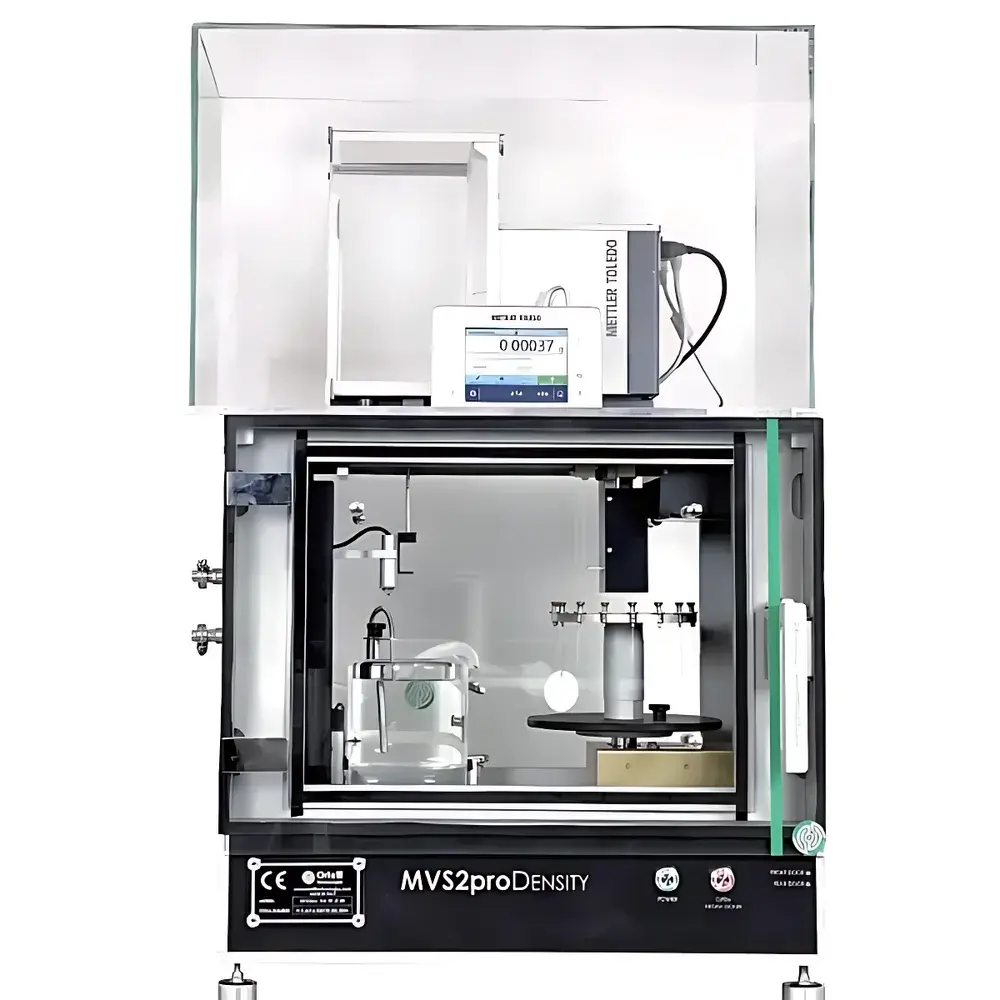
Ortelli MVS2pro Automated Density Balance
| Brand | Ortelli |
|---|---|
| Origin | Italy |
| Model | MVS2pro |
| Instrument Type | Buoyancy-Based Density Analyzer |
| Configuration | Benchtop Laboratory System |
| Sample Type | Solids (films, rods, granules) |
| Density Range | 0–2 g/cm³ |
| Temperature Control Range | 10–40 °C (standard test temp: 23 °C) |
| Cycle Time | ~3–5 min per sample |
| Auto-sampler Capacity | 16-position robotic arm |
| Compliance | ISO 1183-1, ISO 9001 |
Overview
The Ortelli MVS2pro Automated Density Balance is a precision benchtop instrument engineered for the rapid, operator-independent determination of solid material density using the hydrostatic weighing principle—commonly referred to as buoyancy-based density measurement. Rooted in Archimedes’ principle, the system measures the weight difference of a sample in air and immersed in a calibrated reference fluid (typically distilled water or ethanol), enabling calculation of true density with high reproducibility. Designed specifically for polymer laboratories, quality control departments, and materials R&D facilities, the MVS2pro replaces manual immersion techniques and legacy density gradient column methods—both of which suffer from subjectivity, thermal drift, and poor throughput. Its fully automated architecture integrates mechanical handling, thermal stabilization, and digital data acquisition into a single workflow compliant with ISO 1183-1:2019 (Plastics — Methods for determining the density of non-cellular plastics) and aligned with ISO 9001 quality management system requirements.
Key Features
- Fully automated 16-position robotic sample handler for unattended batch processing—eliminating manual placement, timing variability, and operator-induced bias.
- Integrated Peltier-controlled thermostatic bath with Pt100 high-accuracy temperature sensor, maintaining setpoint stability within ±0.1 °C across the 10–40 °C operating range; default calibration and testing performed at 23.0 °C per ISO recommendations.
- Dual-load-cell measurement module optimized for high-resolution mass differentiation (air vs. immersed states), supporting densities from 0.001 to 2.000 g/cm³ with repeatability ≤ ±0.001 g/cm³ under controlled conditions.
- Modular fluid chamber design compatible with multiple immersion media—including deionized water, ethanol, and custom-density calibration fluids—to accommodate samples with varying wettability or chemical sensitivity.
- Intuitive touchscreen interface with guided workflow navigation, real-time status monitoring, and on-device result validation (e.g., buoyancy force consistency checks, temperature deviation alerts).
Sample Compatibility & Compliance
The MVS2pro accommodates geometrically diverse solid specimens without requiring custom fixtures: standard formats include injection-molded plaques (ISO 527), extruded rods (ASTM D1238 melt index specimens), granules (≤10 mm diameter), and machined cylinders. Surface porosity, minor curvature, or low surface energy (e.g., fluoropolymers) are mitigated via optional surfactant-doped immersion fluids and vacuum-assisted degassing protocols. All measurement procedures adhere to ISO 1183-1 clauses governing sample conditioning, immersion time, meniscus correction, and air buoyancy compensation. The system’s firmware and audit trail functionality support GLP-compliant environments and are structured to meet documentation requirements under FDA 21 CFR Part 11 when paired with validated software configuration.
Software & Data Management
The embedded control software provides full method definition, calibration logging (mass, temperature, fluid density), and raw-data export in CSV and XML formats. Each measurement record includes timestamp, operator ID (optional), environmental metadata (ambient temperature/humidity), and full traceability of all intermediate values (air mass, immersed mass, fluid temperature, calculated density). Optional PC-based software extends capabilities to statistical process control (SPC) charting, multi-instrument fleet monitoring, and integration with LIMS platforms via OPC UA or RESTful API. All electronic records maintain immutable audit trails with user-action timestamps, satisfying ISO/IEC 17025 clause 7.5.2 and supporting internal QA audits.
Applications
The MVS2pro serves critical roles across polymer manufacturing and regulatory testing: quantifying crystallinity in polyethylene (PE) and polypropylene (PP) grades via density correlation; verifying resin lot conformity against ASTM D1505 and ISO 1183 specifications; supporting failure analysis of molded parts exhibiting dimensional instability; and enabling comparative density profiling during copolymer development (e.g., ethylene-propylene rubber blends). It is also routinely deployed for density verification of glass microspheres, sintered metal powders, ceramic substrates, and composite preforms where gravimetric accuracy directly correlates with porosity and structural integrity.
FAQ
What standards does the MVS2pro comply with?
It conforms to ISO 1183-1:2019 for solid plastics and supports methodologies referenced in ASTM D1505, ISO 2812-1, and USP for density-related pharmaceutical excipient characterization.
Can the system measure porous or hydrophobic materials?
Yes—when used with vacuum-assisted immersion and low-surface-tension fluids (e.g., ethanol + 0.1% Triton X-100), the MVS2pro achieves reliable wetting for PTFE, silicone elastomers, and open-cell foams.
Is temperature calibration traceable to national standards?
The integrated Pt100 sensor is factory-calibrated against NIST-traceable references; end-user verification is supported via external certified thermometers per ISO/IEC 17025 calibration protocols.
How is data integrity ensured during long unattended runs?
Each measurement triggers automatic checksum generation, file-level encryption, and dual-storage redundancy (on-device flash + optional network share), with tamper-evident log files compliant with 21 CFR Part 11 Annex 11 expectations.
What maintenance is required for sustained accuracy?
Annual verification of load cell linearity, fluid density recalibration using certified reference standards (e.g., SRM 1921b), and mechanical arm lubrication per Ortelli’s scheduled maintenance protocol—documented in the included service logbook.



