
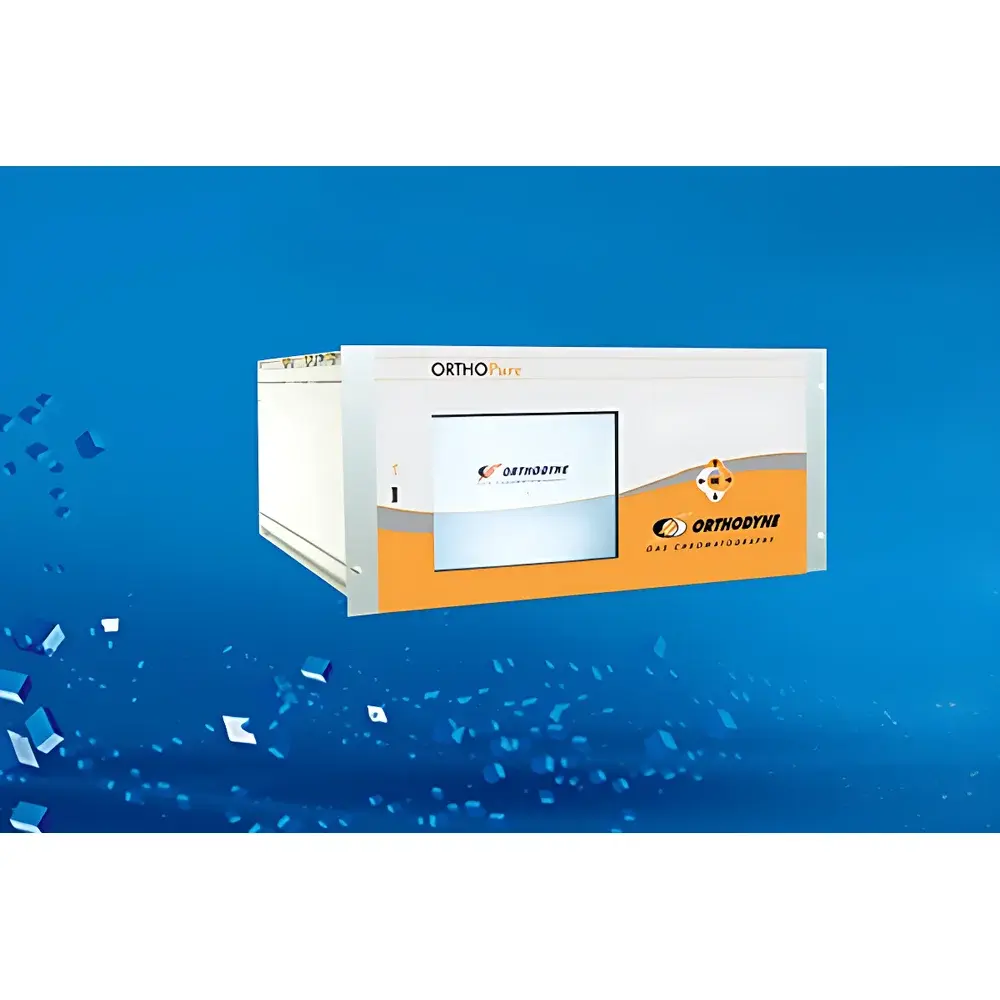
ORTHOPure HDID-ppt-ppb-ppm Helium Ionization Detector Gas Chromatograph
| Brand | SDL (Sailong) |
|---|---|
| Model | HDID |
| Origin | Belgium |
| Manufacturer | SDL |
| Instrument Type | High-Sensitivity Trace Impurity Analyzer for Ultra-High-Purity (UHP) Gases |
| Detection Principle | Pulsed Discharge Helium Ionization Detection (PDHID) |
| Measurement Range | ppt to ppm (v/v) |
| Target Gases | He, Ar, H₂, N₂, O₂, CO₂, Kr, Xe |
| Detectable Impurities | Ne, H₂, Ar, O₂, N₂, Kr, CH₄, CO, CO₂, Xe, and other permanent gases and light hydrocarbons |
| Compliance | Designed for ISO 8573-1 Class 1 compressed gas purity verification, ASTM D7622, and semiconductor-grade gas certification workflows |
Overview
The ORTHOPure HDID-ppt-ppb-ppm is a high-performance, laboratory-grade gas chromatograph engineered specifically for the quantitative analysis of trace-level impurities in ultra-high-purity (UHP) carrier and process gases. Built upon the proven physics of pulsed discharge helium ionization detection (PDHID), this instrument delivers exceptional sensitivity, stability, and selectivity for permanent gases and light hydrocarbons without requiring radioactive sources or hydrogen combustion. Unlike conventional thermal conductivity (TCD) or flame ionization (FID) detectors, the PDHID operates by generating a stable, low-power helium plasma that ionizes analyte molecules with near-universal response—yet maintains baseline stability across multi-hour runs. The system is optimized for routine compliance testing in semiconductor fabrication facilities, specialty gas production labs, and high-purity cryogenic gas supply chains where detection limits in the low-part-per-trillion (ppt) range are mandated for gases such as helium, argon, nitrogen, oxygen, hydrogen, carbon dioxide, krypton, and xenon.
Key Features
- True ppt-level detection capability for Ne, H₂, O₂, N₂, CH₄, CO, CO₂, Kr, and Xe in UHP matrix gases—validated per IEC 61540 and ASTM D7622 protocols
- Modular, field-upgradable column oven with ±0.1 °C temperature uniformity and ramp rates up to 40 °C/min for rapid method optimization
- Dual-channel GC architecture supporting simultaneous analysis of two independent gas streams or parallel calibration/analysis workflows
- Integrated electronic pressure control (EPC) with 0.001 psi resolution for reproducible retention time alignment across >1,000 injections
- Stainless-steel, electropolished flow path compliant with SEMI F57 and CGA G-13 standards for minimal surface adsorption and memory effects
- Self-diagnostic firmware with real-time detector voltage monitoring, plasma stability logging, and automated baseline drift compensation
Sample Compatibility & Compliance
The ORTHOPure HDID accepts standard 1/8″ or 1/4″ stainless-steel gas cylinders equipped with CGA-580, CGA-330, or ISO 8573-compliant sampling interfaces. It supports direct injection of pressurized gas samples ranging from 10 kPa to 1,000 kPa, with optional heated sample lines (up to 150 °C) for moisture-sensitive or condensable impurity analysis. All hardware components—including valves, fittings, and detector housing—meet ASME B31.3 process piping requirements and are certified for use in Class 1, Division 1 hazardous locations (per UL 61010-1). The system is preconfigured for GLP/GMP environments: audit trail logging, user access levels (admin/operator/analyst), electronic signatures, and full 21 CFR Part 11 compliance via optional software module.
Software & Data Management
Controlled via ORTHOSoft v5.2—a validated, Windows-based chromatography data system (CDS)—the HDID platform provides method editor, sequence scheduler, peak integration engine, and report generator modules. Raw data files (.ORF) are stored in vendor-neutral HDF5 format with embedded metadata (instrument ID, operator, timestamp, calibration status). Software supports automated calibration curve generation using certified multi-component gas standards (NIST-traceable), linear/non-linear regression fitting, and uncertainty propagation per ISO/IEC 17025 Annex A. Export options include CSV, PDF, XML, and LIMS-ready HL7 ADT/ORM messages. Remote diagnostics and firmware updates are supported over TLS 1.2-secured Ethernet or optional cellular gateway.
Applications
- Verification of ISO 8573-1 Class 1–3 purity grades for helium, argon, nitrogen, and hydrogen used in EUV lithography tools
- Final-release testing of bulk cryogenic gases supplied to pharmaceutical inhaler manufacturing (USP , Ph. Eur. 2.2.48)
- Monitoring of purge gas purity in hydrogen fuel cell stack qualification per SAE J2719
- Trace hydrocarbon speciation (CH₄, C₂H₆, C₂H₄) in semiconductor-grade silane and ammonia delivery systems
- Leak detection validation in vacuum chamber purging loops using neon tracer gas at sub-ppb sensitivity
- Quality assurance of recycled noble gases (Kr, Xe) recovered from medical imaging equipment
FAQ
What detection principle does the HDID employ, and how does it differ from traditional HID?
It uses pulsed discharge helium ionization detection (PDHID), which eliminates radioactive tritium sources while achieving comparable or superior sensitivity to conventional HID—especially for neon and hydrogen in helium matrices.
Is the system compatible with existing laboratory LIMS infrastructure?
Yes—ORTHOSoft supports ASTM E1578-compliant LIMS integration via ODBC, RESTful API, and configurable HL7 message templates.
Can the HDID quantify water vapor or HF in corrosive gas streams?
Not natively; water and HF require dedicated moisture sensors or FTIR coupling. However, the system supports external pre-concentration traps for sub-ppb H₂O analysis when paired with optional chilled mirror dew point interface.
Does the instrument require annual recalibration by the manufacturer?
No—users may perform full performance verification using NIST SRM 1676a and internal diagnostic routines. Factory calibration certificates are provided with each unit and remain valid for 12 months under documented operating conditions.
What is the typical maintenance interval for the PDHID source?
Under continuous operation at ≤100 ppm total impurity load, the helium plasma source requires cleaning every 6–9 months; replacement parts are field-swappable with no alignment tools needed.




