OTC-Auto In-situ Community Photosynthesis and Respiration Monitoring System
| Origin | Beijing |
|---|---|
| Manufacturer Type | Authorized Distributor |
| Origin Category | Domestic (China) |
| Model | OTC-Auto |
| Price | USD 42,000 (FOB Beijing) |
Overview
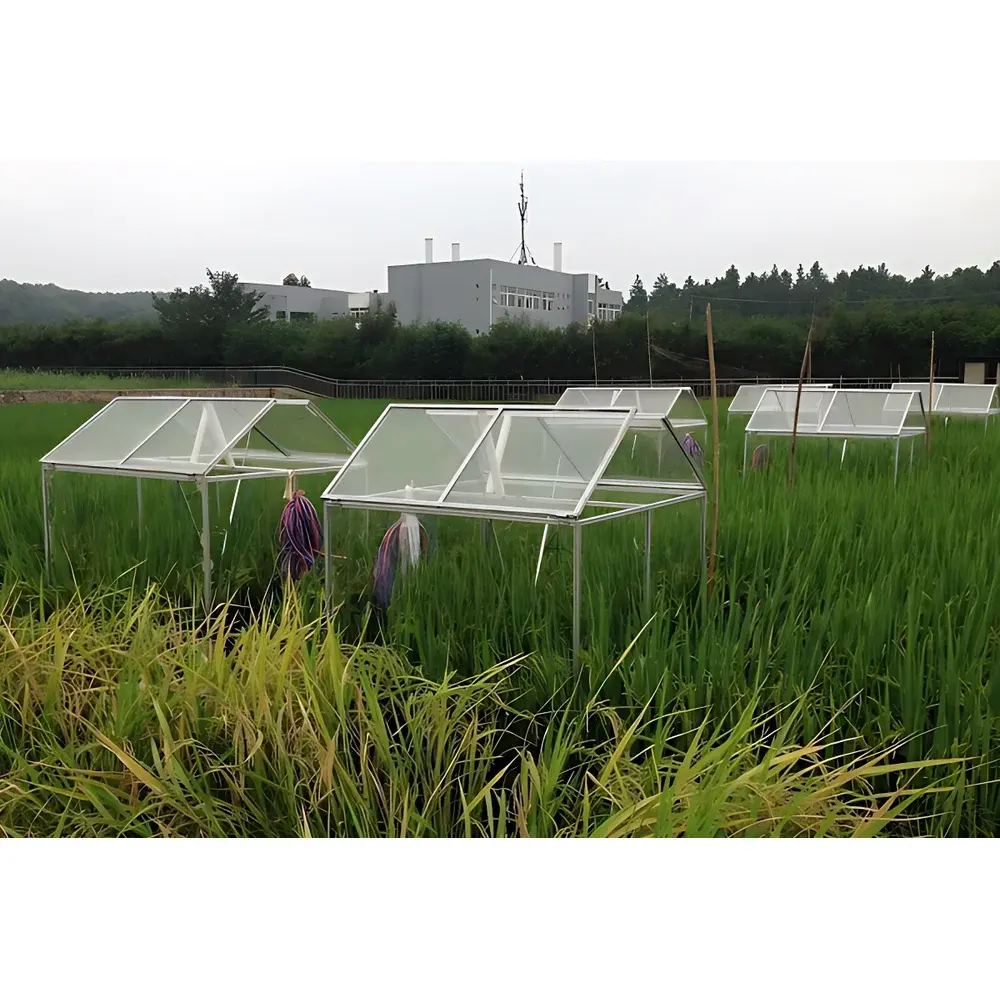
The OTC-Auto In-situ Community Photosynthesis and Respiration Monitoring System is an engineered field-deployable ecosystem flux measurement platform designed for continuous, non-invasive quantification of net CO2 and H2O exchange at the plant community or micro-ecosystem scale. Based on the open-top chamber (OTC) methodology—compliant with ISO 16634-2:2021 (soil respiration) and aligned with USDA ARS and FLUXNET protocol conventions—the system employs diffusion-driven gas sampling combined with high-stability infrared CO2 analysis to eliminate reliance on power-intensive vacuum pumps or complex pneumatic manifolds. Its core architecture integrates a motorized, programmable OTC enclosure, multi-parameter environmental sensing, and modular gas analyzers to support long-term, unattended operation in diverse biomes—including grasslands, wetlands, croplands, tundra, and controlled-environment greenhouses. The system operates on the principle of closed-chamber accumulation kinetics: CO2 concentration change over time (d[CO2]/dt) within the sealed OTC volume, corrected for temperature, pressure, and humidity, yields net ecosystem exchange (NEE) expressed in µmol CO2·m−2·s−1. This enables rigorous partitioning of gross primary production (GPP) and ecosystem respiration (Reco) when deployed in paired configurations (e.g., vegetated vs. bare-soil chambers).
Key Features
- Programmable auto-opening OTC with configurable duty cycles (e.g., 50 min open / 10 min closed), enabling diurnal flux tracking while minimizing chamber-induced microclimate artifacts
- Diffusion-based, pump-free CO2 sampling using calibrated NDIR sensors (0–2000 ppm range, ±1.5% accuracy, 1 ppm resolution) with integrated T/P compensation
- Standard sensor suite: air temperature (−40 to +60 °C, ±0.1 °C), relative humidity (0–100%, ±2% RH), PAR (400–700 nm, ±5% calibration traceable to NIST), soil volumetric water content (0–60% VWC, ±3% VWC), and soil temperature (−40 to +80 °C, ±0.2 °C)
- Modular expansion capability: optional fiber-optic O2 sensors (0–50% O2, ±0.2% accuracy, liquid/gas phase compatible), SCG-N multi-depth soil CO2/O2 gradient probes (patented, ZL 2016 2 0734283.7), and minirhizotron imaging systems for root phenotyping
- Multi-gas analysis compatibility: supports external FTIR-based analyzers for simultaneous CO2, CH4, N2O, and NH3 detection with MDCD values down to 7 ppb (N2O) and 40 ppb (CH4)
- Chlorophyll fluorescence module (optional): measures F0, Fm, Fm′, QY, NPQ, qP, Rfd, and advanced transient kinetics (OJIP) under ambient or actinic light regimes
- Scalable deployment: single-unit, dual-chamber (for soil-vs.-vegetation flux separation), or multi-channel (up to 8 parallel OTCs) configurations
Sample Compatibility & Compliance
The OTC-Auto system accommodates heterogeneous vegetation structures—from low-canopy mosses and grasses to shrub understories and herbaceous crop stands—with customizable OTC dimensions (standard: 64 × 64 × 50 cm; optional sizes available). It complies with internationally recognized ecosystem flux measurement standards, including ASTM D5918-22 (soil carbon dioxide efflux), ISO 16634-2:2021 (soil respiration determination), and FAO guidelines for agricultural GHG inventory reporting. Data acquisition meets GLP principles: all sensor calibrations are logged with timestamps and operator IDs; raw time-series data are stored with metadata (GPS coordinates, chamber ID, protocol version) in CSV/NetCDF format. Optional 21 CFR Part 11-compliant software modules provide electronic signatures, audit trails, and role-based access control for regulated environmental monitoring programs.
Software & Data Management
The bundled Ecolab-OTC v4.2 software provides real-time visualization, automated flux calculation (using linear and polynomial regression of [CO2] vs. time), and batch processing of multi-day datasets. It supports export to common ecological modeling formats (e.g., PEcAn, ED2, LPJ-GUESS) and includes built-in tools for gap-filling, outlier detection, and uncertainty propagation based on sensor error budgets. All raw and processed data are timestamped with UTC synchronization via GPS or NTP. Field units feature onboard SD-card logging (72+ hours at 30-s intervals) and optional LoRaWAN or cellular telemetry for remote diagnostics and alarm notifications (e.g., chamber jam, sensor timeout, power failure).
Applications
- Long-term carbon budget assessment in restored wetlands and degraded grasslands
- Climate manipulation experiments (e.g., warming, drought, CO2 enrichment) using paired OTC arrays
- Phenotypic screening of crop genotypes under field conditions for photosynthetic efficiency and stress resilience
- Soil-microbe-plant interaction studies via concurrent soil CO2 gradient profiling and root imaging
- Validation of satellite-derived GPP products (e.g., MODIS, Sentinel-3) at eddy-covariance tower footprint scales
- Regulatory GHG reporting for agricultural mitigation projects under VCS or Gold Standard methodologies
FAQ
How does the OTC-Auto system differentiate between soil respiration and plant photosynthesis?
It requires dual-chamber deployment: one chamber encloses both soil and vegetation; the second (control) chamber covers bare soil only. Subtracting the bare-soil flux from the vegetated flux yields net canopy assimilation.
Can the system operate autonomously for >30 days without maintenance?
Yes—when powered by a 50-W solar panel + 100-Ah deep-cycle battery, and configured with low-power sensors and 5-min sampling intervals, field endurance exceeds 45 days.
Is the CO2 analyzer factory-calibrated, and what is its recalibration interval?
Each NDIR sensor ships with NIST-traceable calibration certificates; recommended field recalibration every 6 months using certified zero (N2) and span (500 ppm CO2) gases.
Does the system support integration with third-party eddy covariance hardware?
Yes—via analog voltage outputs (0–5 V) and Modbus RTU serial interface, enabling synchronized operation with CSAT3B sonic anemometers or IRGASON systems.
What level of technical support is provided for international users?
Includes remote configuration assistance, annual firmware updates, ISO/IEC 17025-aligned validation documentation, and on-site training (available upon request).