
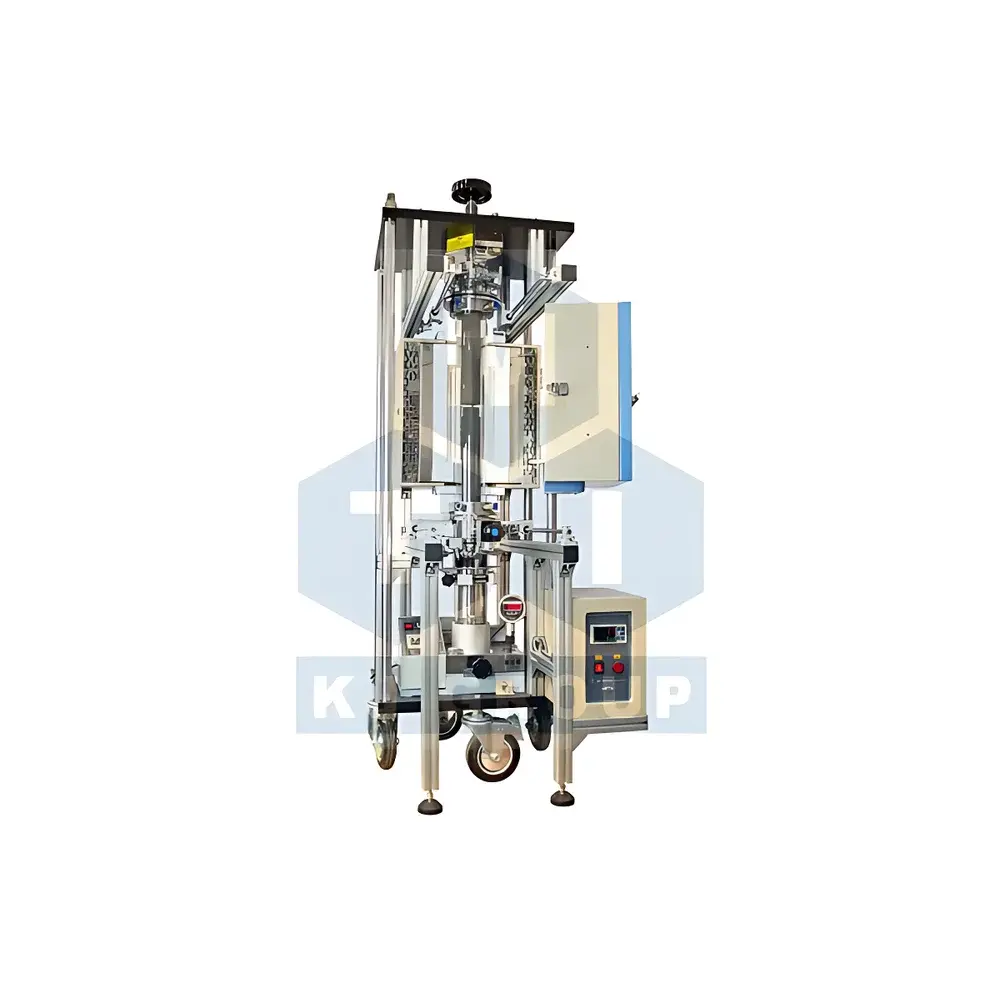
OTF-1200X-VHP4 Vacuum Hot Press Furnace
| Brand | 合肥科晶 |
|---|---|
| Origin | Anhui, China |
| Manufacturer Type | Authorized Distributor |
| Origin Category | Domestically Manufactured |
| Model | OTF-1200X-VHP4 |
| Price Range | ¥50,000–¥100,000 |
| Instrument Type | Tubular Furnace |
| Max Operating Temperature | 1100 °C |
| Temperature Control Accuracy | ±1 °C |
| Max Power | 2.2 kW |
| Heating Rate | Not Specified |
| Heating Method | Resistive (Silicon Carbide Heating Elements) |
| Internal Chamber Dimensions | Ø100 mm × 1200 mm (Quartz Tube), Heating Zone Length:300 mm |
| Maximum Applied Pressure | 6 ton-force (10 MPa gauge) |
| Vacuum Level | 1×10⁻⁵ Torr (with turbomolecular pump), 1×10⁻² Torr (with rotary vane pump) |
| Cooling | Water-cooled KF-25 flanges |
| Programmability | 30-segment PID temperature ramping |
| Input Voltage | 208–240 VAC, 50/60 Hz |
| Net Weight | 365 kg |
| Overall Dimensions | 1050 mm (L) × 750 mm (W) × 1750 mm (H) |
Overview
The OTF-1200X-VHP4 Vacuum Hot Press Furnace is a vertically oriented, open-type tubular furnace system engineered for simultaneous high-temperature thermal processing and uniaxial mechanical compression under controlled vacuum or inert gas atmospheres. It integrates a high-purity fused quartz reaction tube (Ø100 mm × 1200 mm), water-cooled KF-25 vacuum flanges, a precision hydraulic press capable of up to 6 ton-force (10 MPa gauge pressure), and a programmable 30-segment PID temperature controller. Designed for sintering, diffusion bonding, and densification of advanced ceramics, intermetallics, thermoelectric materials, and multilayer substrates, the system operates up to 1100 °C with ±1 °C thermal stability across its 300 mm uniform heating zone. The furnace chamber features an alumina-coated SiC heating element assembly—enhancing radiant efficiency and extending service life—while the integrated pressure actuation mechanism enables in-situ force application via a motor-driven hydraulic cylinder (25 mm bore, 15 mm stroke) directly coupled to tooling inside the evacuated quartz environment.
Key Features
- Vertical open-frame architecture enabling rapid sample loading/unloading and direct access to pressure tooling
- High-vacuum compatibility: base pressure ≤1×10⁻⁵ Torr with optional turbomolecular pumping system; standard mechanical pump achieves ≤1×10⁻² Torr
- Integrated 20-ton electric hydraulic press with digital pressure readout, auto-hold functionality, and programmable pressure ramping profiles
- Fused quartz tube (99.99% purity) with water-cooled end flanges and KF-25 vacuum interfaces ensures thermal isolation and vacuum integrity during pressurized operation
- 30-segment programmable temperature controller supporting complex ramp-soak-cool sequences with real-time data logging capability
- Alumina-coated silicon carbide heating elements deliver uniform axial temperature distribution and improved thermal efficiency over extended operational cycles
- Modular design supports customization of high-temperature tooling—including graphite dies rated for 50 MPa—and optional accessories such as gas mass flow controllers and infrared pyrometry
Sample Compatibility & Compliance
The OTF-1200X-VHP4 accommodates cylindrical and disc-shaped samples up to Ø12.7 mm diameter when using standard graphite dies; custom die geometries (e.g., rectangular, multi-cavity) are available upon specification. Compatible material systems include oxide and non-oxide ceramics (Al₂O₃, SiC, ZrO₂), metal matrix composites, layered perovskites, and thin-film heterostructures requiring interfacial consolidation. The system meets fundamental requirements for ASTM C1161 (flexural strength of advanced ceramics), ISO 14703 (vacuum practice terminology), and general laboratory safety standards per IEC 61010-1. While not pre-certified for GLP/GMP environments, its programmable control architecture, audit-trail-capable software interface (via optional RS485/USB data export), and stable thermal-pressure coupling support validation protocols required for R&D-scale process transfer to production hot-press systems.
Software & Data Management
Temperature and pressure profiles are managed through a front-panel touchscreen controller with onboard memory for ≥100 user-defined programs. Real-time parameter monitoring—including setpoint, actual temperature, applied load, and vacuum level—is displayed simultaneously. Data can be exported via USB flash drive in CSV format for post-processing in MATLAB, Python, or Excel. Optional PC-based software (OTF-PC Suite v3.2+) provides remote control, synchronized multi-channel logging (T, P, V, t), alarm configuration, and electronic signature support compliant with FDA 21 CFR Part 11 Annex 11 principles when deployed with network-authenticated user accounts and encrypted log archives.
Applications
- Densification of nanocrystalline ceramic powders without grain growth
- Diffusion bonding of dissimilar metals (e.g., Cu–Ti, Ni–Al) for microelectronics packaging
- Consolidation of thermoelectric Bi₂Te₃-based pellets with preserved phase homogeneity
- Hot pressing of transparent YAG laser ceramics under oxygen-controlled vacuum
- Multi-layer substrate lamination for MEMS packaging and power electronics
- In-situ observation of creep behavior in refractory alloys under combined thermal-mechanical stress
FAQ
What vacuum pumps are compatible with this system?
A two-stage rotary vane pump achieves ~1×10⁻² Torr; for high-vacuum operation (<1×10⁻⁴ Torr), a turbomolecular pump with appropriate backing line and controller is recommended.
Can the furnace operate under inert gas flow instead of vacuum?
Yes—the quartz tube includes a 1/4″ stainless steel needle valve inlet and KF-25 exhaust port, permitting continuous purge with Ar, N₂, or forming gas at regulated flow rates.
Is the hydraulic pressure applied continuously during thermal cycling?
Yes; pressure is maintained throughout the entire thermal program, including ramp, soak, and cool segments, enabling true isostatic-like consolidation kinetics.
Are pressure calibration certificates included?
Standard units ship with factory-calibrated pressure transducers traceable to NIST standards; full calibration documentation is provided upon request for QA/QC compliance.
What maintenance intervals are recommended for long-term reliability?
Quartz tube inspection every 50 operating hours; water-cooling circuit descaling every 6 months; hydraulic oil replacement annually or after 1000 pressure cycles—whichever occurs first.



