
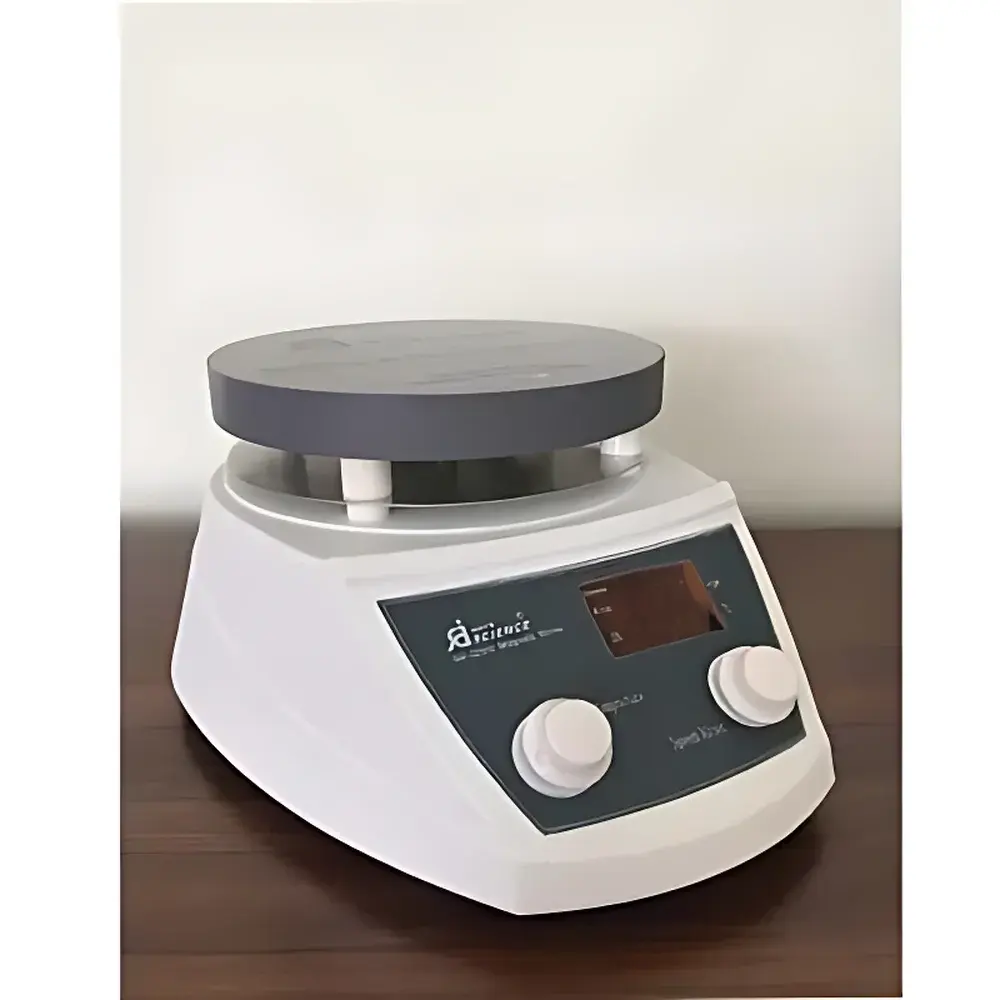
Otisience AM-5250C Magnetic Stirrer with Integrated Heating Plate
| Brand | Otisience |
|---|---|
| Model | AM-5250C |
| Type | Magnetic Stirrer |
| Max. Stirring Volume | 5–10 L |
| Speed Range | 0–1500 rpm |
| Temperature Control Range | Ambient to 300 °C |
| Heating Plate Max. Temp. | 350 °C |
| Control Accuracy | ±1 °C |
| PT100 External Sensor Support | Yes |
| Bidirectional Stirring (Forward/Reverse) | Yes, Adjustable Interval 0.5–3.0 min |
| Heater Diameter | 150 mm |
| Max. Heating Power | 350 W |
| Power Supply | 220 V / 50 Hz |
| Dimensions (W×D×H) | 198 × 225 × 115 mm |
| Weight | 2.4 kg |
Overview
The Otisience AM-5250C Magnetic Stirrer with Integrated Heating Plate is a compact, digitally controlled laboratory instrument engineered for precise temperature-regulated mixing of liquid samples in glass or stainless-steel vessels. It operates on the principle of magnetic coupling—where a rotating permanent magnet beneath a thermally stable ceramic-coated aluminum heating plate induces synchronous rotation of a PTFE- or glass-coated magnetic stir bar immersed in the sample. Unlike hotplate-only units, the AM-5250C integrates closed-loop digital temperature control with real-time speed regulation, enabling simultaneous thermal stabilization and homogeneous agitation across volumes from 5 to 10 liters. Its design meets core operational requirements for applications demanding reproducible thermal profiles under dynamic mixing conditions—including dissolution testing, catalyst screening, polymerization initiation, and buffer equilibration in analytical and preparative workflows.
Key Features
- Digital microprocessor-based control system with dual-display interface showing both setpoint and real-time values for speed (rpm) and plate temperature (°C)
- Ceramic-coated aluminum heating plate rated for continuous operation up to 350 °C, with rapid thermal response and uniform heat distribution across the 150 mm diameter surface
- Stable speed regulation over full 0–1500 rpm range, independent of line voltage fluctuations—ensuring consistent shear input during extended experiments
- Bidirectional stirring mode with programmable forward/reverse alternation intervals (0.5–3.0 minutes), enhancing suspension homogeneity and preventing vortex formation in viscous or particulate-laden media
- Integrated support for external PT100 sensor input, enabling direct sample temperature feedback for improved thermal accuracy beyond surface-heating estimation
- ±1 °C temperature control precision at setpoints between ambient and 300 °C, validated per ASTM E2251-22 guidelines for laboratory hotplate performance verification
- Compact footprint (198 × 225 × 115 mm) and lightweight construction (2.4 kg) optimized for benchtop integration in regulated environments including GLP-compliant laboratories
Sample Compatibility & Compliance
The AM-5250C accommodates standard round-bottom flasks (50 mL–10 L), beakers, and jacketed reactors compatible with magnetic stirring. Its heating plate surface tolerates borosilicate glass, quartz, and stainless-steel containers; however, ferromagnetic vessels are incompatible due to interference with magnetic drive coupling. The unit complies with IEC 61010-1:2010 safety standards for electrical equipment used in laboratory environments and incorporates thermal cut-off protection at 380 °C. While not intrinsically rated for hazardous area use, it supports operation within ISO/IEC 17025-accredited testing facilities when deployed with documented calibration records and maintenance logs.
Software & Data Management
The AM-5250C operates as a standalone instrument without proprietary software dependency. All parameters are configured via front-panel keypad and retained in non-volatile memory after power cycling. For audit-trail compliance in regulated settings (e.g., pharmaceutical QC labs operating under FDA 21 CFR Part 11), users may integrate the unit into broader lab management systems via optional RS-232 or analog 0–10 V output modules (sold separately). Calibration data—including speed verification using traceable tachometers and temperature validation using NIST-traceable PT100 probes—must be recorded manually or imported into electronic lab notebooks (ELNs) per internal SOPs.
Applications
- Controlled-temperature dissolution studies per USP using calibrated vessels and certified stir bars
- Precipitation and crystallization kinetics where nucleation onset correlates with thermal ramp rate and agitation intensity
- Preparation of homogeneous reagent blends for ICP-MS sample introduction or HPLC mobile phase conditioning
- Thermal activation of enzymatic reactions in biochemistry assays requiring strict thermal uniformity during mixing
- Accelerated stability testing of formulations under isothermal agitation conditions aligned with ICH Q1A(R2) guidance
- Extraction protocol development in environmental and food safety labs, particularly for Soxhlet-assisted or reflux-coupled extractions
FAQ
Does the AM-5250C support external temperature probe feedback for closed-loop sample temperature control?
Yes—the unit features a dedicated PT100 input port enabling connection of an external probe placed directly in the sample vessel. This allows the controller to regulate heater output based on actual solution temperature rather than plate surface temperature.
Can the bidirectional stirring function be disabled to operate in unidirectional mode only?
Yes—forward-only operation is selectable via the mode menu; reverse cycling is optional and fully configurable or deactivatable.
Is the heating plate surface chemically resistant to common solvents such as acetone, ethanol, or dilute acids?
The ceramic coating provides resistance to most organic solvents and mild aqueous reagents; however, prolonged exposure to concentrated HF, molten alkalis, or halogenated solvents at elevated temperatures may degrade surface integrity.
What is the recommended calibration frequency for routine GLP use?
Per ISO/IEC 17025:2017 Clause 7.8.2, calibration of speed and temperature functions should occur prior to first use, after any repair affecting performance, and at defined intervals—typically every 6 months for high-utilization instruments or per internal quality schedule.
Does the unit include overload or dry-run protection?
It includes overtemperature cut-off but lacks fluid-level sensing; therefore, operation without liquid load is permissible for short durations (<5 min), though extended dry heating is discouraged to preserve heater longevity.



