
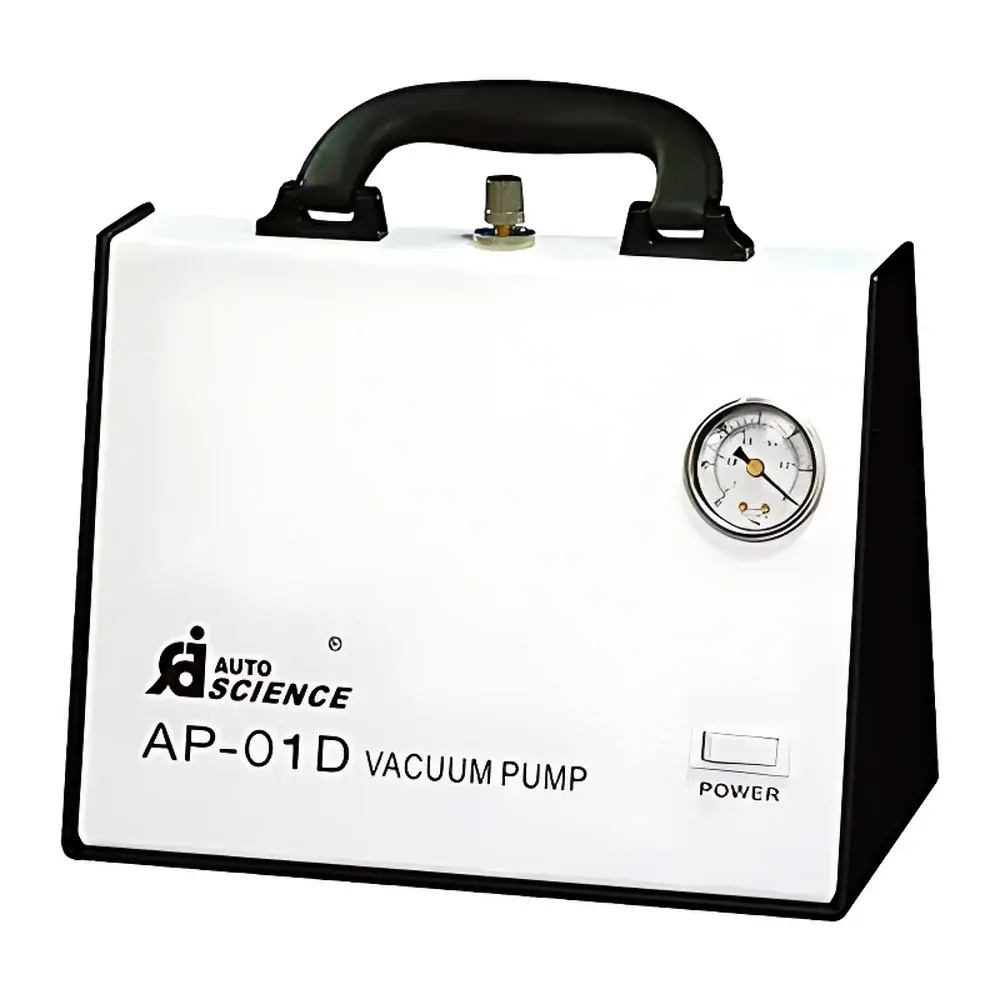
Otisience AP-01D Oil-Free Vacuum & Pressure Pump
| Brand | Otisience |
|---|---|
| Origin | Tianjin, China |
| Model | AP-01D |
| Pump Type | Diaphragm-Type Oil-Free Vacuum/Pressure Pump |
| Ultimate Vacuum | 80 kPa (≈20 psi vacuum) |
| Max Pressure Output | Not Specified |
| Flow Rate | 10 L/min |
| Motor Power | 35 W |
| Dimensions (W×H×D) | 246 × 190 × 135 mm |
| Weight | 3.2 kg |
| Power Supply | AC 220 V / 50 Hz |
| Construction Materials | PPS (Polyphenylene Sulfide) & PTFE (Polytetrafluoroethylene) |
| Compliance | CE-marked design principles |
Overview
The Otisience AP-01D is a compact, diaphragm-driven oil-free vacuum and pressure pump engineered for precision laboratory applications requiring contamination-free gas handling. Unlike rotary vane or piston pumps, the AP-01D operates on a positive displacement principle: an electromechanically actuated elastomeric diaphragm undergoes reciprocating motion within a chemically inert chamber, alternately expanding and compressing the internal volume to evacuate or pressurize connected systems. This mechanism eliminates lubricant migration, rendering the pump suitable for solvent-sensitive protocols—including HPLC mobile phase degassing, filtration under vacuum, solid-phase extraction (SPE), and inert-atmosphere sample preparation. Its ultimate vacuum capability of 80 kPa (approximately 20 psi vacuum) and stable 10 L/min free-air flow rate support rapid air removal from filtration manifolds, solvent reservoirs, and vacuum desiccators without introducing hydrocarbon or particulate contaminants.
Key Features
- True oil-free operation ensures zero risk of lubricant carryover into solvents, samples, or analytical streams—critical for LC-MS compatibility and regulatory compliance.
- Chemically resistant wetted path constructed from polyphenylene sulfide (PPS) housing and PTFE-coated diaphragm, providing long-term stability against common organic solvents (e.g., acetonitrile, methanol, chloroform, ethyl acetate) and mild acids/bases.
- Adjustable vacuum regulation via integrated pressure control valve, enabling fine-tuned suction force for delicate membrane filtration or gentle solvent aspiration.
- Low-noise (<55 dB(A)) and low-power (35 W) operation supports continuous use in shared laboratory environments without thermal overload or electrical strain.
- Compact footprint (246 × 190 × 135 mm) and lightweight design (3.2 kg) facilitate benchtop integration, mobile cart mounting, or placement inside fume hoods and gloveboxes.
- Thermal protection circuitry automatically interrupts motor operation during sustained high-load conditions, resuming function upon cooldown—enhancing operational safety and service life.
Sample Compatibility & Compliance
The AP-01D is validated for use with standard laboratory filtration assemblies (e.g., FB-series filter bottle kits), SPE cartridges, vacuum concentrators, and small-volume drying chambers. Its non-metallic, corrosion-resistant fluid path meets material compatibility requirements outlined in ASTM D471 (elastomer resistance to liquids) and ISO 8573-1 Class 0 air purity standards for oil-free compressed air. While not certified to IEC 61000-6-3 (EMC) or UL 61010-1 as a standalone unit, its design adheres to electromagnetic compatibility best practices for lab-grade instrumentation. The pump supports Good Laboratory Practice (GLP) and current Good Manufacturing Practice (cGMP) workflows when deployed in controlled environments where audit trails for equipment qualification (IQ/OQ/PQ) are maintained per internal SOPs.
Software & Data Management
The AP-01D is a manually operated, analog-control device with no embedded firmware, digital interface, or data logging capability. It features a single-pole single-throw (SPST) power switch and mechanical vacuum adjustment knob—ensuring operational simplicity, minimal failure points, and full traceability through manual log entries. For laboratories implementing 21 CFR Part 11–compliant systems, vacuum application events may be recorded in electronic lab notebooks (ELNs) or LIMS alongside associated sample IDs, operator initials, and timestamped start/stop entries. No driver software, USB connectivity, or remote control functionality is provided or required.
Applications
- HPLC and UHPLC mobile phase filtration and online degassing using DG-series inline degassers or gravity-fed filter assemblies.
- Routine vacuum filtration of aqueous and organic extracts through nylon, PTFE, or PVDF membranes (0.22 µm or 0.45 µm pore size).
- Preparation of solvent blanks and calibration standards under inert atmosphere to prevent oxidation or hydrolysis.
- Supporting ASE (Accelerated Solvent Extraction) and QuEChERS workflows by evacuating collection vials prior to solvent transfer.
- Small-scale vacuum drying of lyophilized fractions, crystallization plates, or microcentrifuge tubes.
- Actuation of pneumatic valves or low-pressure actuators in custom-built lab automation rigs (when configured for pressure mode).
FAQ
Is the AP-01D certified for use in explosion-proof environments?
No. The AP-01D is not intrinsically safe or ATEX-certified. It must be operated outside classified hazardous locations.
Can this pump generate positive pressure as well as vacuum?
Yes—the AP-01D is a dual-mode diaphragm pump capable of both vacuum aspiration and low-pressure air delivery (up to ambient +20 psi gauge), though maximum pressure output is not formally rated.
What maintenance intervals are recommended?
Diaphragm replacement is advised every 12–18 months under continuous daily use; visual inspection of sealing surfaces and cleaning of exhaust ports should occur quarterly.
Does the pump require calibration?
No routine calibration is specified. Vacuum accuracy depends on mechanical integrity of the diaphragm and valve assembly; verification against a calibrated pressure gauge is recommended annually.
Is the AP-01D compatible with corrosive gases such as HCl or Cl₂?
Not recommended. While resistant to liquid organic solvents, prolonged exposure to aggressive acidic or oxidizing gases may degrade the PTFE diaphragm and PPS housing over time.



