
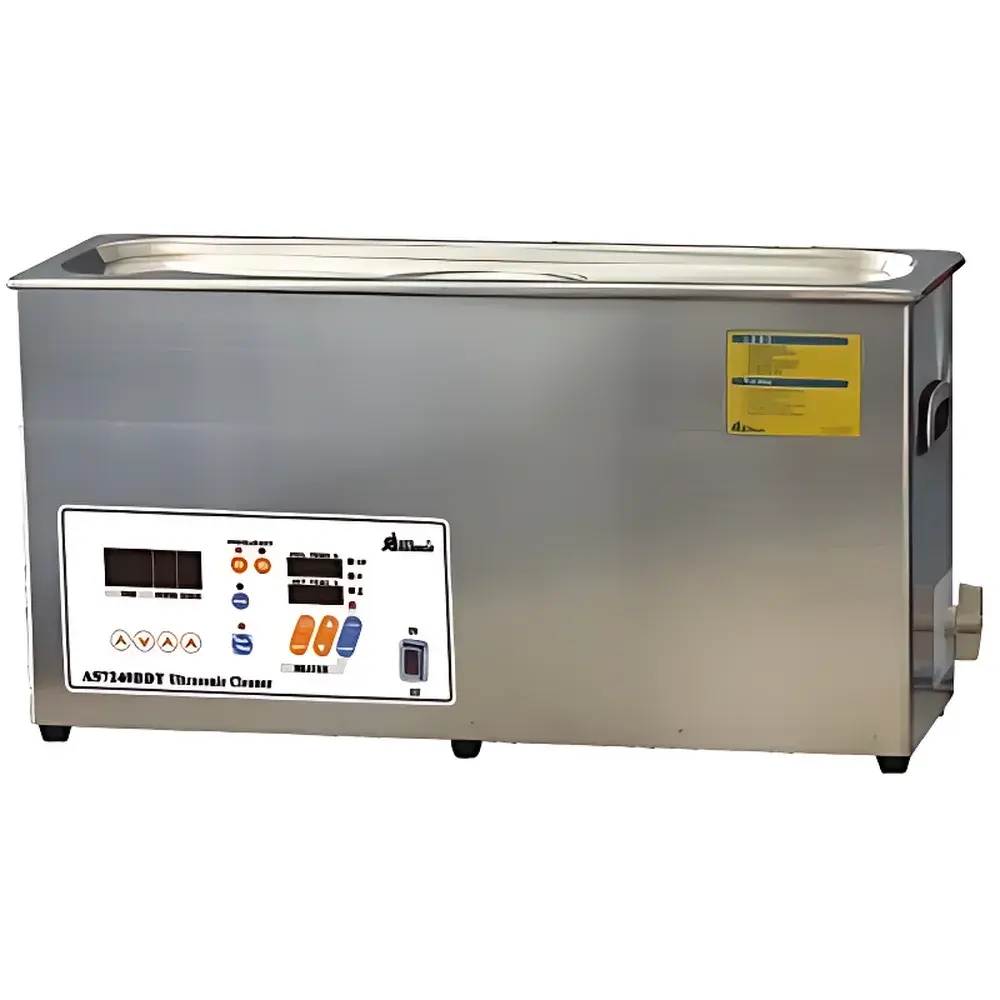
Otisience AS7240BDT Benchtop Ultrasonic Cleaner
| Brand | Otisience |
|---|---|
| Model | AS7240BDT |
| Type | General-purpose ultrasonic cleaner |
| Capacity | 7 L |
| Ultrasonic frequency | 40 kHz / 60 kHz dual-frequency selectable |
| Ultrasonic power | 240 W (adjustable from 1% to 100%) |
| Heating power | 400 W |
| Temperature range | +5 °C to 80 °C above ambient |
| Timer range | 1–999 min |
| Noise-reduction lid | Included |
| Manual drain valve | Yes |
| Tank dimensions (W×L×D) | 470 × 135 × 100 mm |
| External dimensions (W×L×H) | 530 × 160 × 270 mm |
| Construction | Stainless steel tank and housing |
| Degassing mode | Adjustable |
| Accessories | Stainless steel mesh basket and acoustic lid |
Overview
The Otisience AS7240BDT is a precision-engineered benchtop ultrasonic cleaner designed for reproducible, controllable cleaning of laboratory glassware, analytical components, surgical instruments, optical parts, and small mechanical assemblies. It operates on the principle of cavitation—where high-frequency sound waves generate microscopic vacuum bubbles in a liquid medium that collapse violently upon reaching a critical size, producing localized shockwaves and microstreaming. This physical mechanism enables effective removal of particulate contaminants, organic residues, biofilms, and loosely adhered oxides without mechanical abrasion or chemical aggression. The dual-frequency capability (40 kHz and 60 kHz) allows users to optimize cleaning performance based on sample geometry, soil type, and solvent viscosity—making the AS7240BDT suitable for both routine QC/QA workflows and demanding R&D applications across pharmaceutical, biotechnology, materials science, and clinical laboratories.
Key Features
- Dual-frequency operation: Switchable between 40 kHz (high-energy cavitation for robust cleaning of heavily soiled or large-surface-area items) and 60 kHz (finer, more uniform cavitation with reduced noise and enhanced penetration into blind holes, microchannels, and complex geometries).
- Full digital control interface: Precise adjustment of ultrasonic power (1–100% in 1% increments), heating temperature (+5 °C to 80 °C), and timer (1–999 minutes), all displayed on an intuitive LED screen with real-time feedback.
- Integrated degassing function: Programmable degassing cycle optimizes solvent preparation by removing dissolved air prior to cleaning—critical for maximizing cavitation efficiency, especially with high-viscosity or volatile solvents such as isopropanol, ethanol, or aqueous surfactant solutions.
- Stainless steel construction: 304 stainless steel tank and housing ensure long-term corrosion resistance, chemical compatibility with common cleaning agents (including mild alkaline, acidic, and enzymatic formulations), and compliance with ISO 15195 and GLP facility requirements.
- Acoustic noise reduction: Includes a hinged, insulated lid that attenuates operational noise by >15 dB(A), meeting occupational safety guidelines per OSHA 29 CFR 1910.95 and enabling placement in shared lab environments without disruption.
- Thermal stability & safety: PID-controlled heating system maintains setpoint accuracy within ±1.5 °C; over-temperature cutoff and dry-run protection prevent heater damage during low-fluid conditions.
Sample Compatibility & Compliance
The AS7240BDT accommodates a wide range of sample types—including volumetric flasks, HPLC vials, pipette tips, chromatography columns, microscope slides, semiconductor wafers, and dental tools—when placed in the included stainless steel mesh basket. Its 7 L capacity supports batch processing while maintaining consistent energy distribution across the tank volume. The device complies with IEC 61000-6-3 (EMC emissions) and IEC 61000-6-2 (immunity), and its design facilitates audit readiness for ISO/IEC 17025-accredited laboratories. While not certified for sterilization per ISO 17664 or EN 285, it meets preparatory cleaning requirements referenced in USP , ASTM D2603, and CLSI GP26-A4 for pre-sterilization cleaning validation protocols.
Software & Data Management
The AS7240BDT operates via embedded firmware with no external software dependency. All operational parameters are stored in non-volatile memory, ensuring retention after power cycling. For regulated environments, the unit supports manual logbook documentation of cleaning cycles (time, temperature, frequency, power setting), aligning with FDA 21 CFR Part 11 principles when integrated into a broader electronic record system. Optional RS-232 output (available upon request) enables connection to lab information management systems (LIMS) for automated cycle logging and traceability—supporting GMP Annex 11 and ALCOA+ data integrity expectations.
Applications
- Cleaning of HPLC/GC autosampler vials, syringes, and injection ports to prevent carryover and baseline drift.
- Preparation of cell culture flasks and bioreactor components prior to autoclaving or gamma irradiation.
- Removal of polishing compounds and metal fines from precision optics and metrology standards.
- Decontamination of reusable surgical instruments before steam sterilization (per AAMI ST79 guidance).
- Extraction support: sonication-assisted leaching of metals from environmental filters or polymer matrices prior to ICP-MS analysis.
- Surface activation of substrates for thin-film deposition or adhesive bonding in microfabrication labs.
FAQ
Is the AS7240BDT suitable for cleaning delicate MEMS devices or silicon wafers?
Yes—when operated at 60 kHz with low power (20–40%) and low-temperature settings (<40 °C) in deionized water or IPA, it delivers gentle yet effective particle removal without damaging microstructures.
Can this unit be used with flammable solvents?
No. The AS7240BDT is not explosion-proof and lacks intrinsically safe certification. Only aqueous or non-flammable solvents (e.g., ethanol/water mixtures below 40% v/v) should be used, in accordance with NFPA 30 and local fire codes.
Does the unit include calibration documentation?
Factory calibration certificates for temperature and timer accuracy are available upon request and may be included in IQ/OQ documentation packages for GxP installations.
What maintenance is required?
Routine cleaning of the tank interior with mild detergent and periodic inspection of the transducer mounting integrity and drain valve seal—no scheduled recalibration is needed under normal operating conditions.
Is the mesh basket compatible with ultrasonic energy transmission?
Yes—the 304 stainless steel basket is acoustically transparent and designed to minimize shadowing effects, ensuring uniform exposure across all loaded samples.



