
Otisience DG Series Online Degasser
| Brand | Otisience |
|---|---|
| Model | DG Series |
| Type | Online Solvent Degasser for HPLC/UHPLC Systems |
| Flow Rate per Channel | 10 mL/min |
| Max. Operating Pressure per Channel | 5 psi |
| Dimensions (W×L×H) | 86 × 278 × 155 mm |
| Weight | 6 kg |
| Power Supply | 110/220 V, 50/60 Hz |
| Channel Configurations | 2-, 3-, or 4-Channel Parallel Degassing Modules |
| Compliance | Designed for ISO/IEC 17025-compliant laboratories and compatible with GLP/GMP workflows requiring stable mobile phase delivery |
Overview
The Otisience DG Series Online Degasser is an engineered solution for continuous, membrane-based solvent degassing in high-performance liquid chromatography (HPLC), ultra-high-performance liquid chromatography (UHPLC), and related analytical systems. It operates on the principle of vacuum-driven gas permeation through hydrophobic polytetrafluoroethylene (PTFE) membranes—allowing dissolved oxygen, nitrogen, and other volatile gases to diffuse out of the mobile phase under reduced pressure while retaining liquid solvents. This physical separation mechanism ensures stable baseline performance in sensitive detection modalities—including UV-Vis absorbance, fluorescence, electrochemical, and mass spectrometric detection—where dissolved gases cause signal drift, increased noise, bubble formation in pumps or detectors, and compromised retention time reproducibility. The DG Series is designed for seamless integration into existing LC system architectures, supporting both isocratic and gradient elution protocols without flow interruption or backpressure accumulation.
Key Features
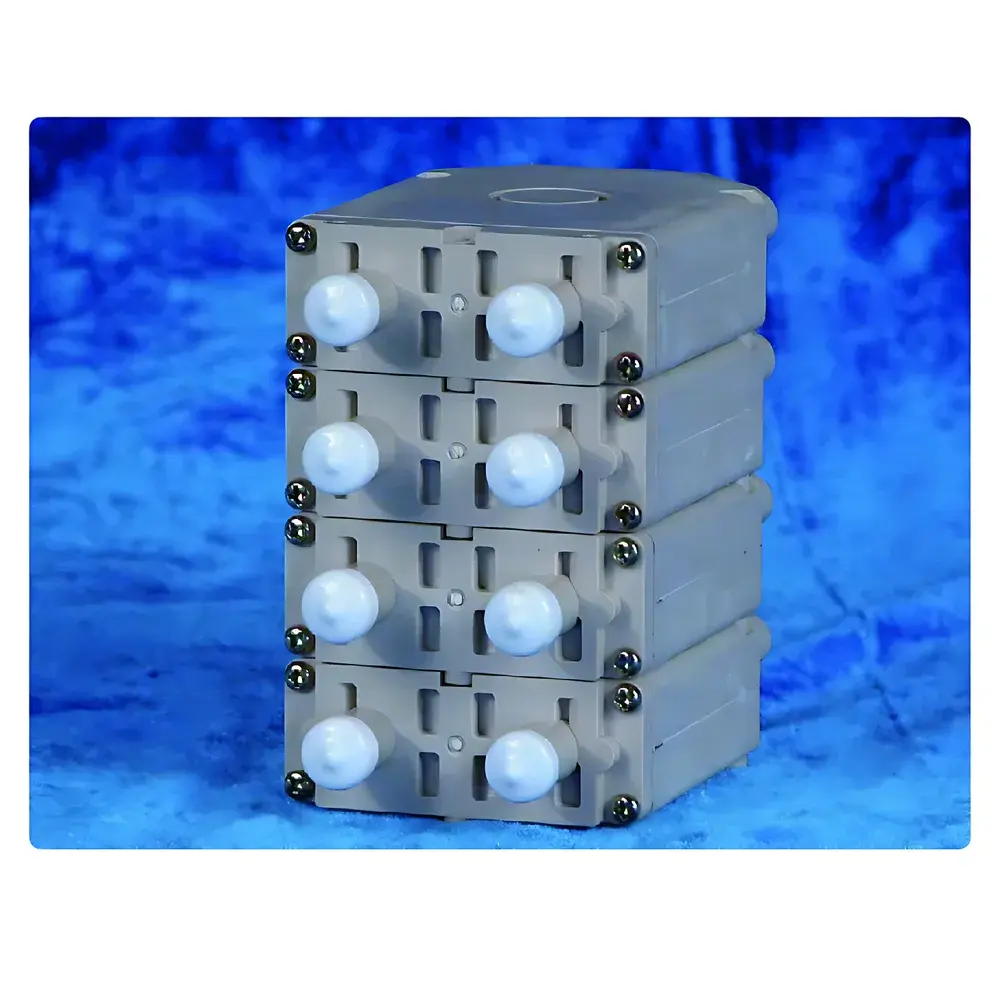
- Vacuum-assisted membrane degassing architecture with individually sealed PTFE capillary modules per channel, ensuring cross-contamination-free operation across multi-solvent lines.
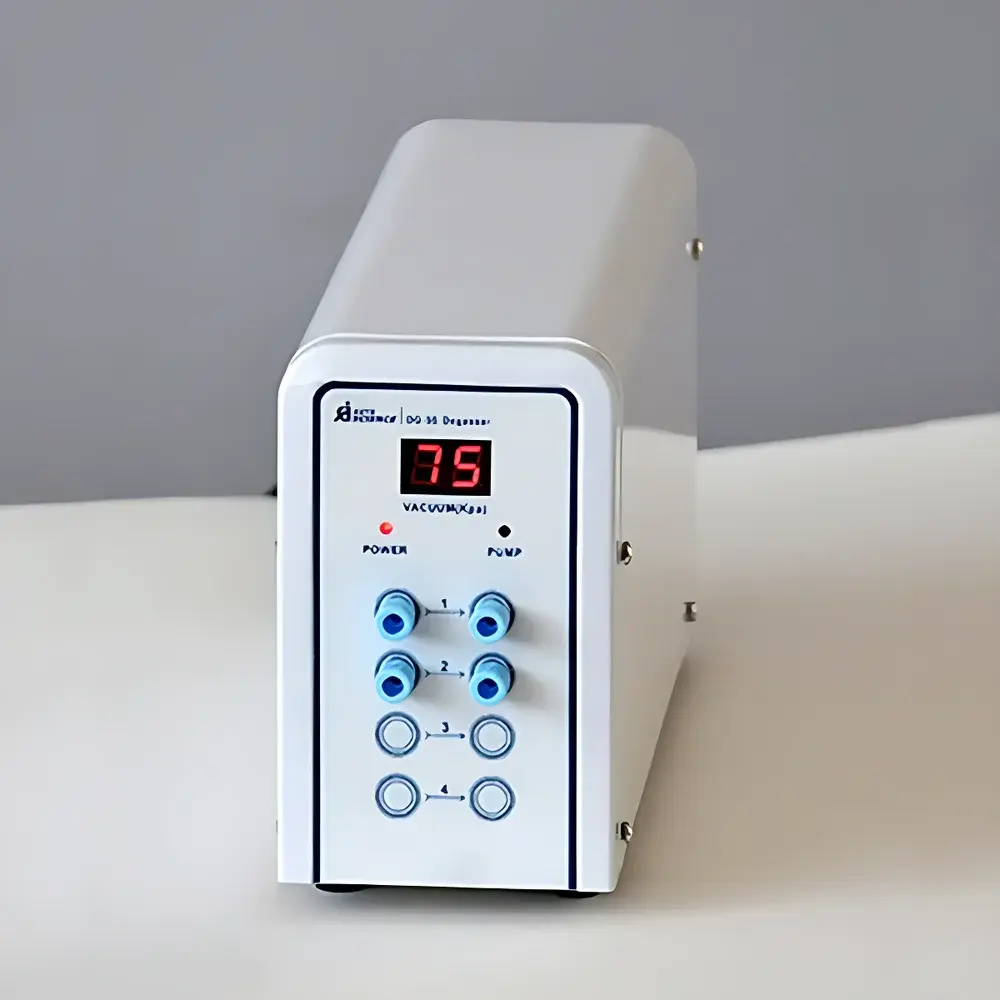
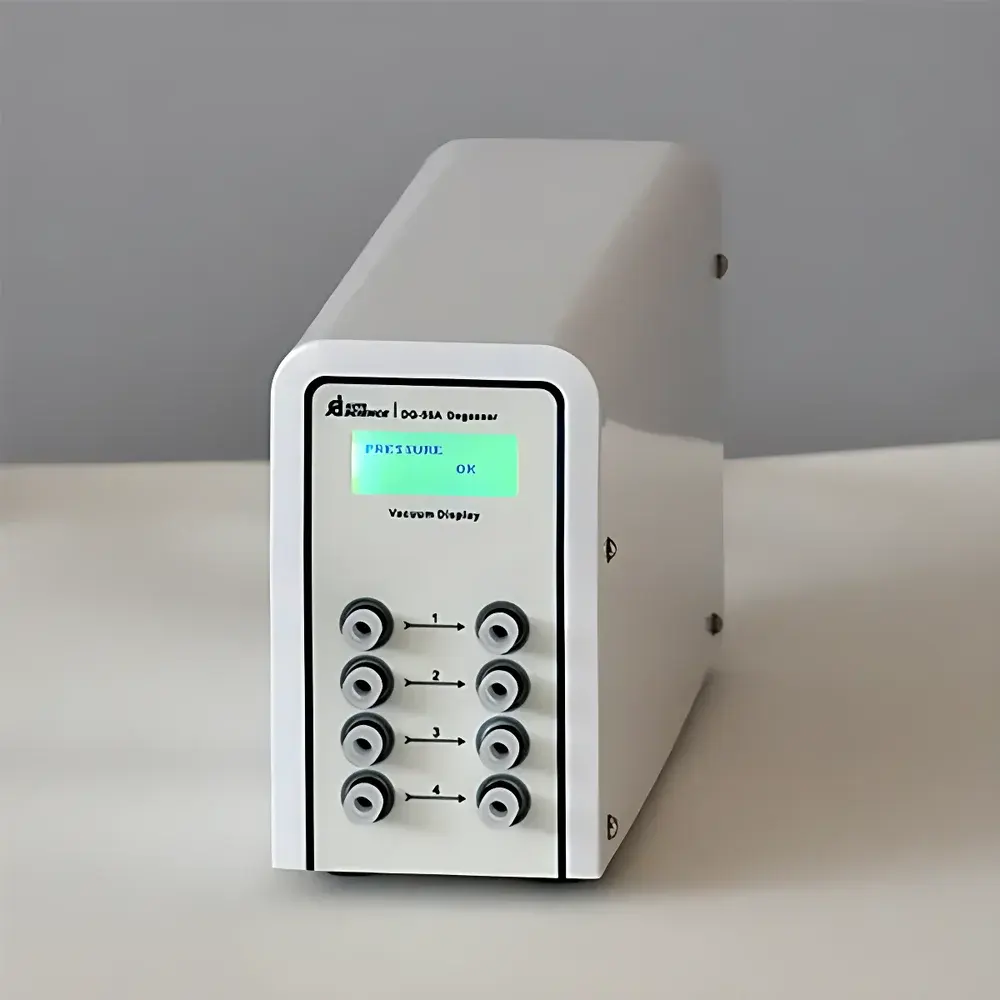
- Configurable platform available in 2-, 3-, and 4-channel variants to match binary, ternary, or quaternary solvent delivery systems used in modern HPLC and UHPLC platforms.
- Stable degassing performance at up to 10 mL/min per channel, compatible with standard LC flow rates and low-flow microbore applications.
- Low-pressure design (max. 5 psi operating pressure per channel) minimizes risk of membrane rupture and enables safe use with low-viscosity solvents including water, methanol, acetonitrile, and THF.
- Compact footprint (86 × 278 × 155 mm) and lightweight construction (6 kg) facilitate benchtop installation adjacent to pump modules or within integrated LC cabinets.
- Universal power input (110/220 V, 50/60 Hz) supports global deployment without voltage conversion hardware.
Sample Compatibility & Compliance
The DG Series is validated for use with common HPLC-grade organic and aqueous mobile phases—including buffered solutions, ion-pair reagents, and volatile additives such as formic acid and ammonium acetate. It is not recommended for highly corrosive solvents (e.g., concentrated mineral acids or halogenated hydrocarbons) or suspensions containing particulates >0.22 µm. Each unit undergoes factory leak testing and vacuum integrity verification. The device supports laboratory quality management frameworks: its passive, non-invasive degassing process requires no consumables or recalibration, contributing to audit-ready documentation under ISO/IEC 17025, FDA 21 CFR Part 11 (when paired with compliant data acquisition software), and pharmaceutical GMP environments where mobile phase consistency directly impacts method robustness and system suitability outcomes.
Software & Data Management
As a hardware-level degassing module, the DG Series operates autonomously without embedded firmware or digital interfaces. It does not generate telemetry or require driver installation. However, its impact on analytical stability is quantifiable via standard system suitability tests: reduction in baseline noise (RMS deviation), improved peak area RSD (<1.0% over n=6 injections), and extended time-to-first-bubble in detector flow cells. When deployed in regulated settings, users may document operational parameters—including channel assignment, solvent composition, vacuum status (via optional external gauge), and maintenance logs—as part of instrument qualification (IQ/OQ/PQ) packages. Integration with LIMS or ELN systems occurs at the procedural level, not via direct connectivity.
Applications
- Stabilization of mobile phases in reversed-phase, HILIC, and ion-exchange HPLC methods where oxygen-induced oxidation of analytes or column stationary phases compromises reproducibility.
- Enabling low-detection-limit fluorescence assays by eliminating quenching effects from molecular oxygen in excitation/emission pathways.
- Maintaining consistent electrochemical detector response in pulsed amperometric detection (PAD) and coulometric analysis.
- Preventing air-lock formation in low-volume capillary and nano-LC systems where even sub-microliter gas pockets disrupt flow control.
- Supporting long-duration gradient runs (>60 min) by sustaining degassing efficiency without saturation of membrane surfaces.
FAQ
What types of solvents are compatible with the DG Series?
The DG Series is compatible with standard HPLC solvents including water, methanol, acetonitrile, tetrahydrofuran, isopropanol, and buffered aqueous solutions (pH 2–9). Avoid use with strong oxidizers, concentrated acids/bases, or solvents that swell or degrade PTFE.
Does the DG Series require periodic membrane replacement?
Under normal operation with filtered, particle-free solvents, the PTFE membranes exhibit service lifetimes exceeding 12 months. Replacement is only necessary if vacuum draw time increases significantly or visible membrane discoloration or swelling occurs.
Can the DG Series be used with supercritical fluid chromatography (SFC) systems?
No—the DG Series is designed exclusively for liquid-phase degassing at ambient temperatures and low pressures. It is not rated for CO₂ or co-solvent mixtures under supercritical conditions.
Is validation documentation available for GMP environments?
Yes. Otisience provides a Factory Acceptance Test (FAT) report, material compliance certificates (RoHS, REACH), and a user-installable IQ/OQ protocol template aligned with ASTM E2500 and USP guidelines.
How does the DG Series compare to helium sparging or sonication?
Unlike helium sparging—which introduces variable gas composition and requires continuous gas supply—or sonication—which is batch-based and inconsistent—the DG Series delivers continuous, pressure-stable, and operator-independent degassing with no consumables or manual intervention.




