
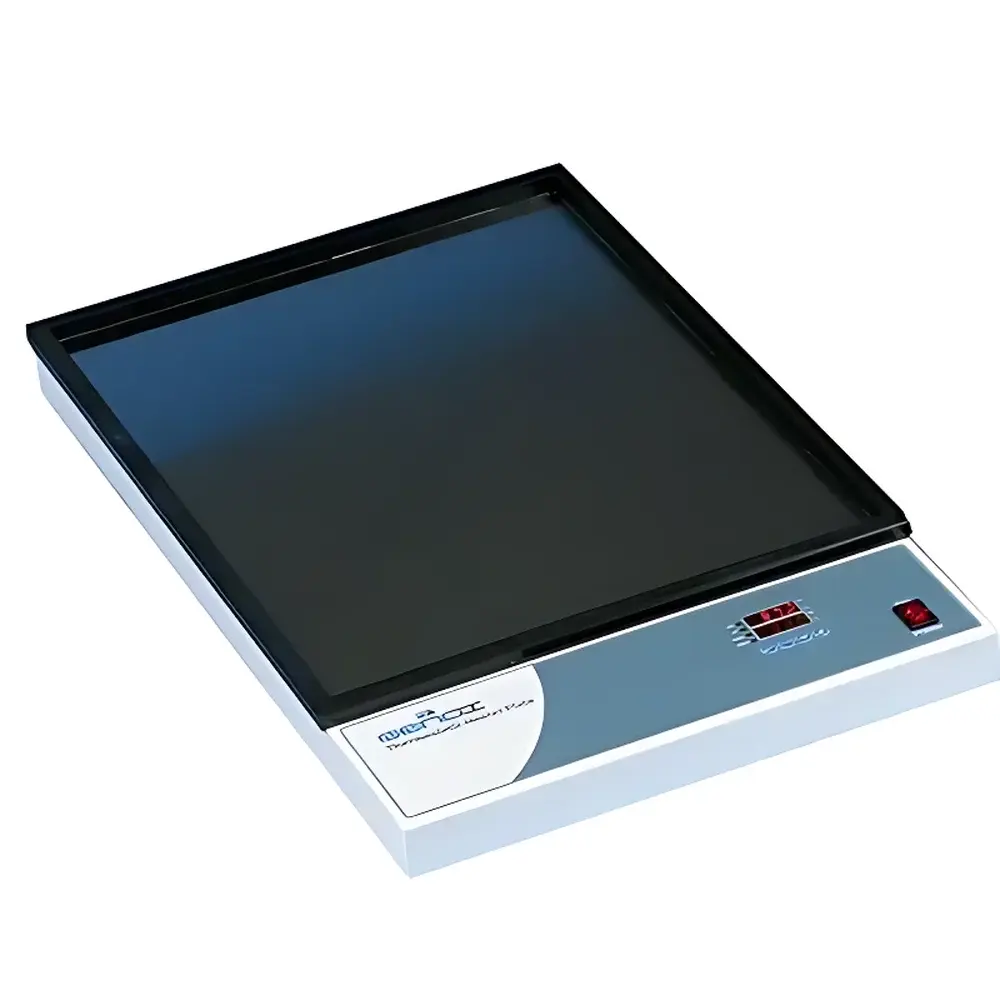
Otseins MH-5800 Multi-Function Constant-Temperature Heating Plate
| Brand | Otseins |
|---|---|
| Origin | Tianjin, China |
| Model | MH-5800 |
| Temperature Range | +3 °C to 80 °C above ambient |
| Heating Power | 240 W |
| Temperature Accuracy | ±0.5 °C (adjustable) |
| Temperature Stability | ±0.2 °C |
| Temperature Resolution | 0.1 °C |
| External Dimensions (L×W×H) | 515 × 325 × 45 mm |
| Working Surface Dimensions (L×W) | 400 × 300 mm |
| Power Supply | 220 V / 50 Hz |
| Fuse Rating | 3 A |
| Control Display | Dual 4-digit LED (SV/PV) |
| Safety Features | Over-temperature cut-off with audible alarm |
| Calibration Function | User-accessible “Pu-b” offset correction |
| Heating Surface Material | Stainless steel (304) |
| Design Profile | Low-profile, compact footprint |
Overview
The Otseins MH-5800 Multi-Function Constant-Temperature Heating Plate is an engineered thermal platform designed for precise, uniform, and reproducible heating across diverse laboratory workflows. Unlike conventional hotplates relying on simple on/off control, the MH-5800 implements a digital PID (Proportional-Integral-Derivative) feedback loop to actively regulate power delivery in real time—minimizing thermal overshoot and achieving stable equilibrium within ±0.2 °C under steady-state conditions. Its 400 mm × 300 mm stainless-steel heating surface provides broad spatial uniformity, making it suitable for simultaneous processing of multiple vessels—including beakers, flasks, Petri dishes, and sample racks—without significant radial temperature gradients. The operational range spans from ambient +3 °C to 80 °C, covering common requirements for enzyme incubation, solvent evaporation, reagent pre-warming, culture media preparation, and sample conditioning prior to chromatographic or spectroscopic analysis. Its low-profile mechanical architecture (45 mm height) optimizes benchtop ergonomics and integration beneath fume hoods or within laminar flow cabinets.
Key Features
- Dual 4-digit LED display showing setpoint temperature (SV) and real-time process value (PV) simultaneously for immediate verification and traceability
- User-accessible “Pu-b” calibration offset function enabling field adjustment of displayed temperature against certified reference standards—critical for GLP-compliant documentation
- Over-temperature safety cutoff with audible alarm and automatic power disengagement at preset threshold, satisfying IEC 61010-1 electrical safety requirements for laboratory equipment
- Stainless-steel (AISI 304) heating plate surface—resistant to corrosion, easy to clean, and compatible with aqueous, mildly acidic, and organic solvent exposure
- Compact low-profile chassis (515 × 325 × 45 mm) minimizing vertical clearance while maintaining full working area; ideal for space-constrained analytical labs and QC environments
- 240 W heating capacity balanced for rapid thermal response without excessive energy draw—supports consistent ramp rates up to ~1.2 °C/min under standard load conditions
Sample Compatibility & Compliance
The MH-5800 accommodates glassware (e.g., 50–1000 mL Erlenmeyer flasks, round-bottom flasks, crystallizing dishes), polypropylene tubes, aluminum blocks, and ceramic crucibles. Its flat, rigid surface ensures mechanical stability during prolonged heating cycles. The device complies with ISO/IEC 17025 general requirements for competence of testing and calibration laboratories regarding instrument verification procedures. While not classified as a medical device, its temperature accuracy and stability meet typical validation criteria referenced in USP Analytical Instrument Qualification and ASTM E2593–18 Standard Guide for Good Laboratory Practice in Chemical Testing. Routine performance verification may be conducted using NIST-traceable thermometers or calibrated RTD probes placed at three locations (center, front-left, rear-right) per SOP.
Software & Data Management
The MH-5800 operates as a standalone analog-digital hybrid controller with no embedded firmware or network interface. All configuration and operation are performed via front-panel push-button controls and visual LED feedback—ensuring deterministic behavior, immunity to software crashes, and compatibility with air-gapped or regulated IT environments. For laboratories requiring electronic record retention, external data loggers (e.g., Omega OM-DAQPRO-5300 series) may be connected via PT100 output (optional accessory) or non-contact IR thermometry. The absence of proprietary software eliminates cybersecurity vulnerabilities associated with remote access protocols and aligns with FDA 21 CFR Part 11 expectations for systems where audit trails are maintained manually or through validated third-party logging solutions.
Applications
- Pre-heating mobile phases and solvents prior to HPLC/UHPLC injection to reduce baseline drift and improve retention time reproducibility
- Controlled warming of biological samples (serum, cell lysates, PCR master mixes) to prevent cold-induced precipitation or denaturation
- Accelerated drying of thin-layer chromatography (TLC) plates post-development under gentle, uniform thermal conditions
- Temperature conditioning of pH electrodes and conductivity cells prior to calibration
- Supporting solid-phase extraction (SPE) manifold operations by maintaining elution solvent at optimal viscosity
- Standardized incubation of environmental water samples for BOD5 or coliform enumeration protocols requiring fixed 20 °C or 35 °C setpoints
FAQ
Is the MH-5800 suitable for use with flammable solvents?
No. The MH-5800 lacks explosion-proof certification and is not rated for Class I, Division 1 hazardous locations. It must be operated only in well-ventilated areas away from open flames or ignition sources when handling volatile organics.
Can the temperature calibration be verified and adjusted internally?
Yes. The “Pu-b” function allows users to apply a single-point offset correction (±9.9 °C range) after comparing the displayed PV against a NIST-traceable reference thermometer placed centrally on the plate surface.
What maintenance is required to ensure long-term temperature accuracy?
Annual verification using a calibrated thermocouple or RTD probe is recommended. Clean the stainless-steel surface regularly with isopropyl alcohol and lint-free wipes; avoid abrasive cleaners that may scratch the finish and affect emissivity.
Does the unit support external temperature probe input for closed-loop control?
Not natively. The MH-5800 regulates based solely on internal sensor feedback. An optional PT100 output port is available for external monitoring but does not feed back into the control algorithm.
Is the MH-5800 compliant with RoHS and WEEE directives?
Yes. As manufactured by Otseins in Tianjin, the unit conforms to EU Directive 2011/65/EU (RoHS2) and 2012/19/EU (WEEE), with full material declarations available upon request for supply chain due diligence.



