
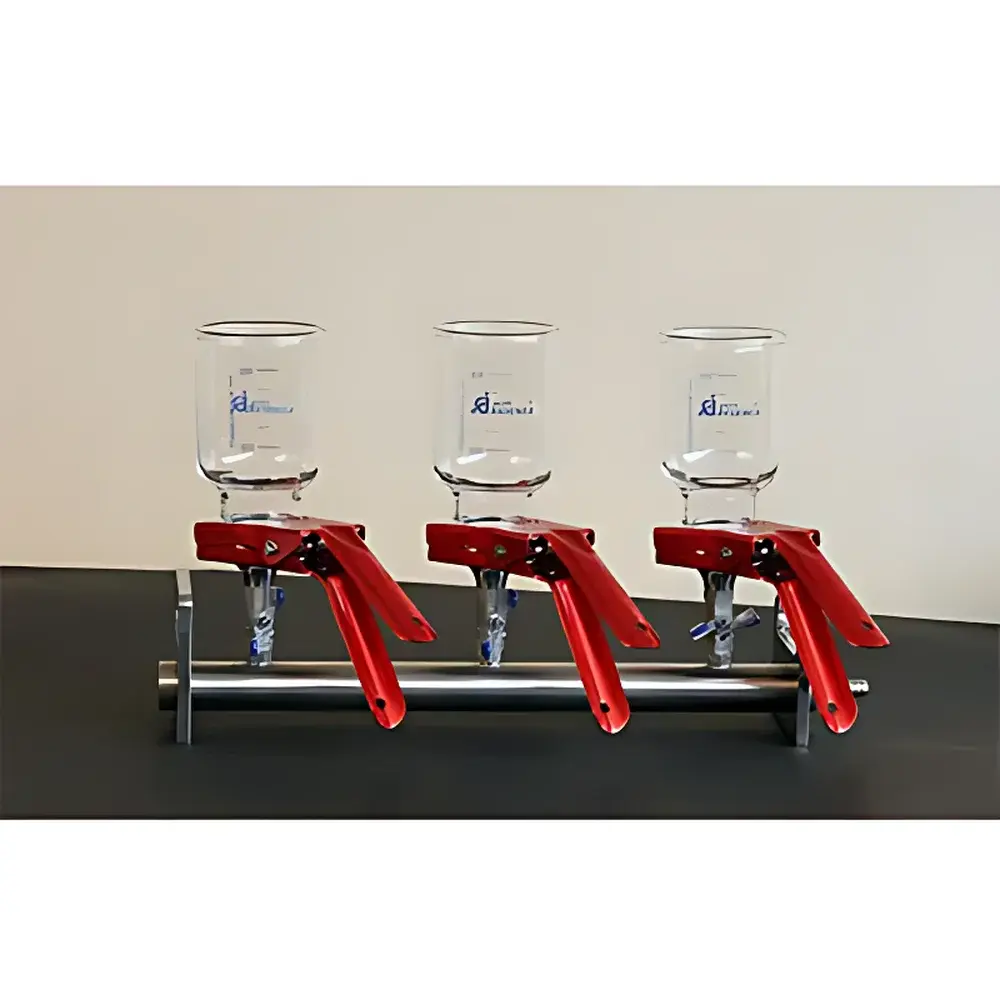
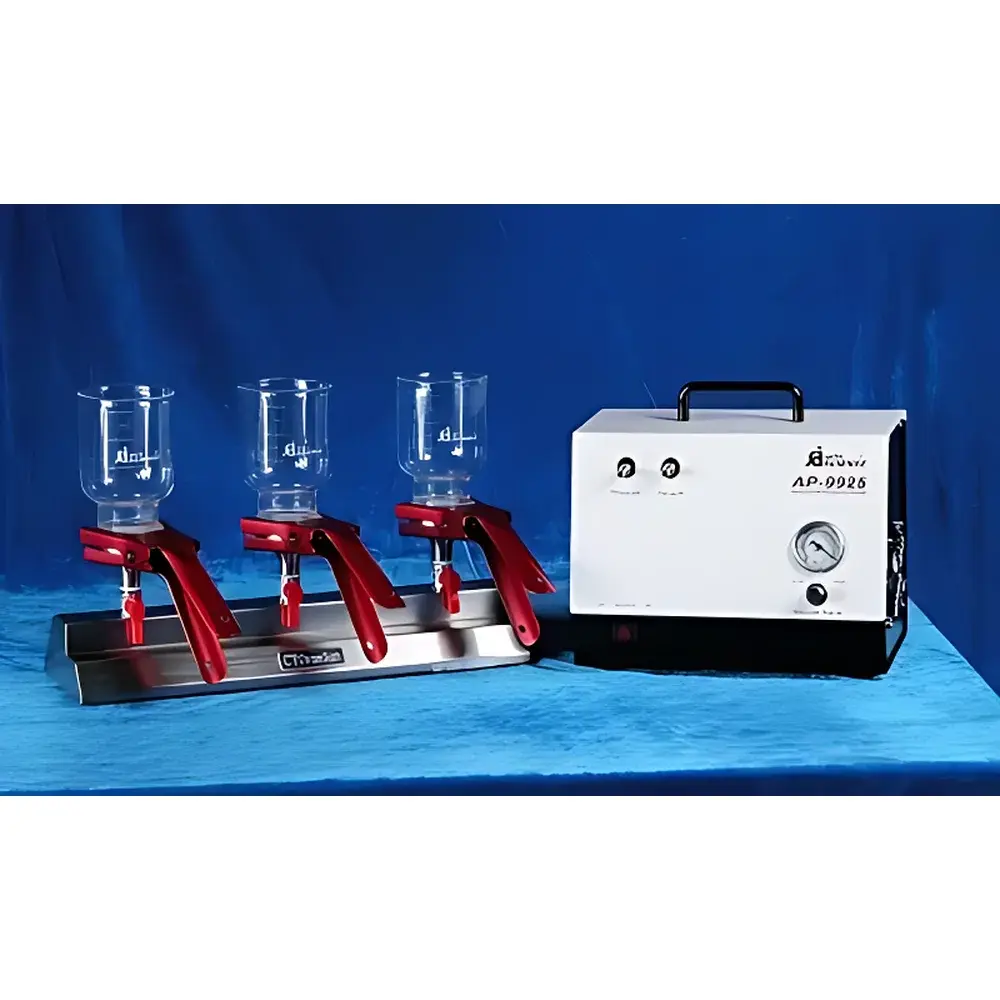
Ottescience SSM-3/6 Multi-Station Filtration Manifold
| Brand | Ottescience |
|---|---|
| Model | SSM-3/6 |
| Construction | 316 Stainless Steel (SSM-3: 3-position |
| SSM-6 | 6-position) |
| Material Compliance | USP Class VI-certified elastomers, FDA-compliant wetted surfaces |
| Sterilization | Autoclavable (121°C, 30 min) and flame-sterilizable |
| Filtration Compatibility | Membranes up to 47 mm diameter, standard Luer-lock or threaded filter holders |
| Vacuum Interface | Dual-port universal vacuum inlet with integrated pressure relief valve |
| Weight | SSM-3 ≈ 1.8 kg |
| Operating Temperature Range | -20°C to +150°C (glass components rated to ≥200°C thermal shock) |
| Sealing System | Anodized aluminum clamping arms with dual O-ring compression seals |
Overview
The Ottescience SSM-3/6 Multi-Station Filtration Manifold is an engineered solution for parallel sample processing in regulated life science laboratories. Designed around the principles of laminar-flow vacuum filtration under controlled negative pressure, the system enables simultaneous, independent filtration of up to three (SSM-3) or six (SSM-6) liquid samples using standard 47 mm membrane filters. Its architecture adheres to fundamental fluid dynamics constraints—minimizing cross-contamination risk through isolated valve-controlled flow paths and eliminating dead-volume retention via precision-machined 316 stainless steel manifolds and polished internal surfaces. Unlike modular plastic-based alternatives, the SSM series integrates full-system sterilizability without compromising mechanical integrity, making it suitable for aseptic processing workflows in pharmaceutical QC, environmental microbiology, and bioprocess monitoring.
Key Features
- Independent per-station on/off valves with tactile feedback and visual position indicators—enabling selective activation without interrupting ongoing filtrations.
- 316 stainless steel manifold body with electropolished interior finish (Ra ≤ 0.4 µm), compliant with ASME BPE-2022 surface roughness requirements for sanitary process equipment.
- Heat-resistant borosilicate glass filtration funnels rated for thermal cycling between –20°C and +200°C, certified per ISO 3585 for hydrolytic resistance (Class HGB).
- Anodized aluminum clamping mechanism featuring dual concentric O-rings (EPDM/FKM blend, USP Class VI) ensuring leak-tight sealing at vacuum levels down to 10 mbar absolute.
- Integrated dual-port vacuum inlet with built-in pressure relief valve and calibrated vacuum gauge port—compatible with oil-free vacuum pumps meeting ISO 8573-1 Class 0 air purity standards.
- Modular base design supports direct mounting onto standard laboratory vacuum traps or integration into automated benchtop filtration platforms via M6 threaded inserts.
Sample Compatibility & Compliance
The SSM-3/6 accommodates all commercially available 47 mm membrane formats—including mixed cellulose ester (MCE), polyethersulfone (PES), nylon, PVDF, and track-etched polycarbonate—without adapter requirements. Its wetted path complies with USP , EP 3.1.5, and ISO 10993-5 for cytotoxicity. The system supports validation protocols aligned with ASTM D2972 (microbial retention testing), ISO 13408-2 (aseptic processing), and EU GMP Annex 1 (sterile filtration). All elastomeric components carry FDA 21 CFR 177.2600 certification, and the stainless steel manifold meets EN 10204 3.1 material traceability requirements. Flame sterilization capability satisfies USP sterility assurance for critical applications where autoclaving is impractical.
Software & Data Management
While the SSM-3/6 operates as a standalone mechanical manifold, its design incorporates digital readiness features: a standardized 1/8″ NPT vacuum gauge port enables integration with third-party pressure logging systems (e.g., LabVIEW-compatible transducers); clamp position sensors can be retrofitted for audit-trail generation; and the manifold’s dimensional footprint aligns with ISO/IEC 17025-compliant lab layout schematics. For GLP/GMP environments, users may document operational parameters—including vacuum setpoint, filtration duration, and membrane lot numbers—within validated electronic lab notebooks (ELN) such as LabArchives or Benchling. The system fully supports 21 CFR Part 11 compliance when paired with appropriate access-controlled software layers and electronic signature workflows.
Applications
- Environmental testing: Simultaneous filtration of water samples for heterotrophic plate count (HPC), coliform enumeration (ISO 9308-1), and total suspended solids (TSS) analysis per EPA Method 160.1.
- Pharmaceutical microbiology: Sterility testing of injectables and ophthalmic solutions following USP and Ph. Eur. 2.6.1 protocols.
- Food & beverage QA: Yeast/mold counts in juices, beer clarity assessment (turbidity reduction), and particulate load quantification prior to membrane integrity testing.
- Biotechnology: Clarification of cell culture supernatants pre-chromatography, buffer exchange via tangential flow filtration (TFF) support, and harvest stream sampling during upstream bioprocessing.
- Academic research: High-throughput preparation of filtered standards for ICP-MS, HPLC mobile phase degassing verification, and nanoparticle suspension stabilization studies.
FAQ
Can the SSM-3/6 be used with aggressive solvents such as chloroform or THF?
Yes—the 316 stainless steel manifold, borosilicate glass funnels, and FKM-sealed valves are chemically resistant to halogenated and polar aprotic solvents per ASTM D471 testing. Avoid prolonged exposure to concentrated hydrofluoric acid or hot alkaline solutions above pH 13.
Is calibration required before first use?
No routine calibration is mandated, as the system contains no active sensors. However, users must verify vacuum integrity per ISO 13485 Annex C prior to GMP-critical applications using a calibrated digital manometer.
What vacuum pump specifications are recommended?
A dry, oil-free pump delivering ≥60 L/min at 10 mbar absolute pressure is optimal. The Ottescience AP-200 series (200 L/min, ultimate vacuum 0.5 mbar) is validated for full-load operation across all six stations simultaneously.
How often should the O-rings be replaced?
Under continuous daily use, replace EPDM/FKM O-rings every 12 months or after 200 autoclave cycles—whichever occurs first—to maintain seal integrity per ISO 9001 preventive maintenance guidelines.
Does the system support sterile filtration validation per PDA TR26?
Yes—its geometric consistency, material extractables profile (tested per USP ), and pressure decay test compatibility enable full validation against PDA Technical Report No. 26 for microbial retention and extractables/leachables assessment.




