
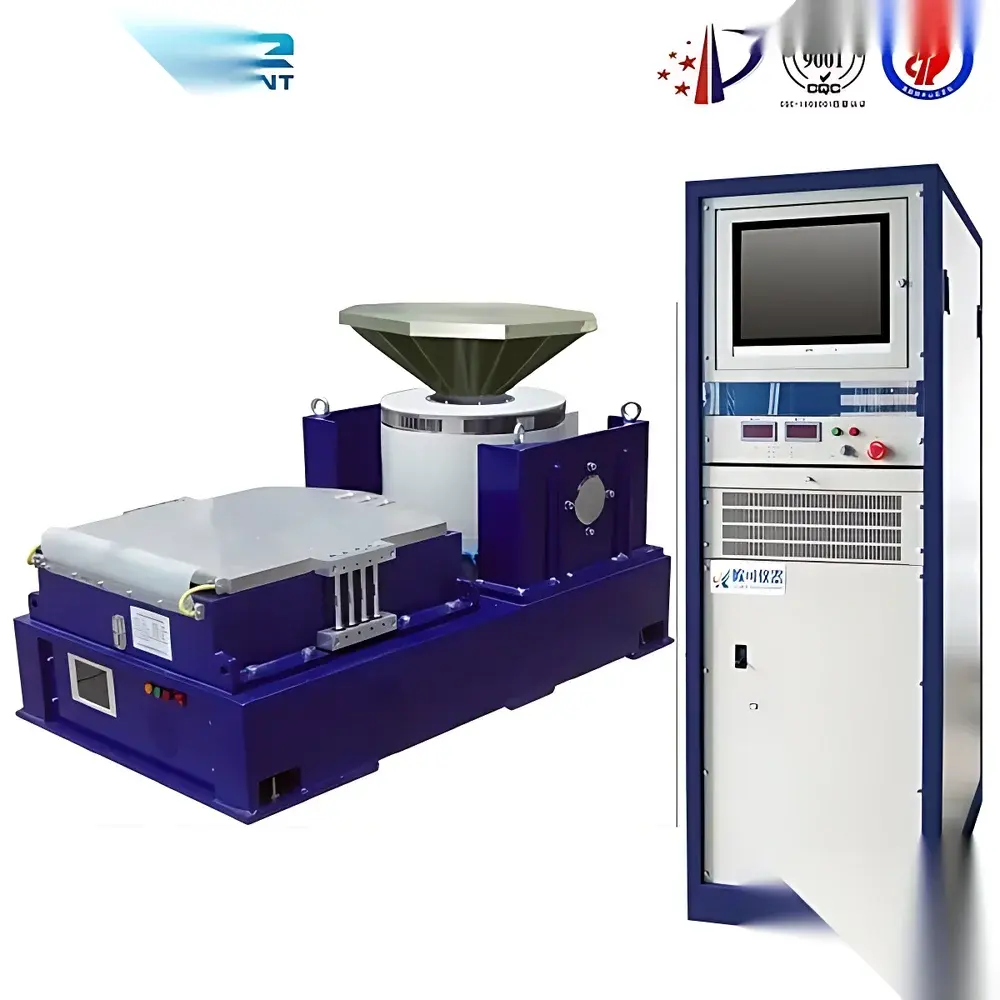
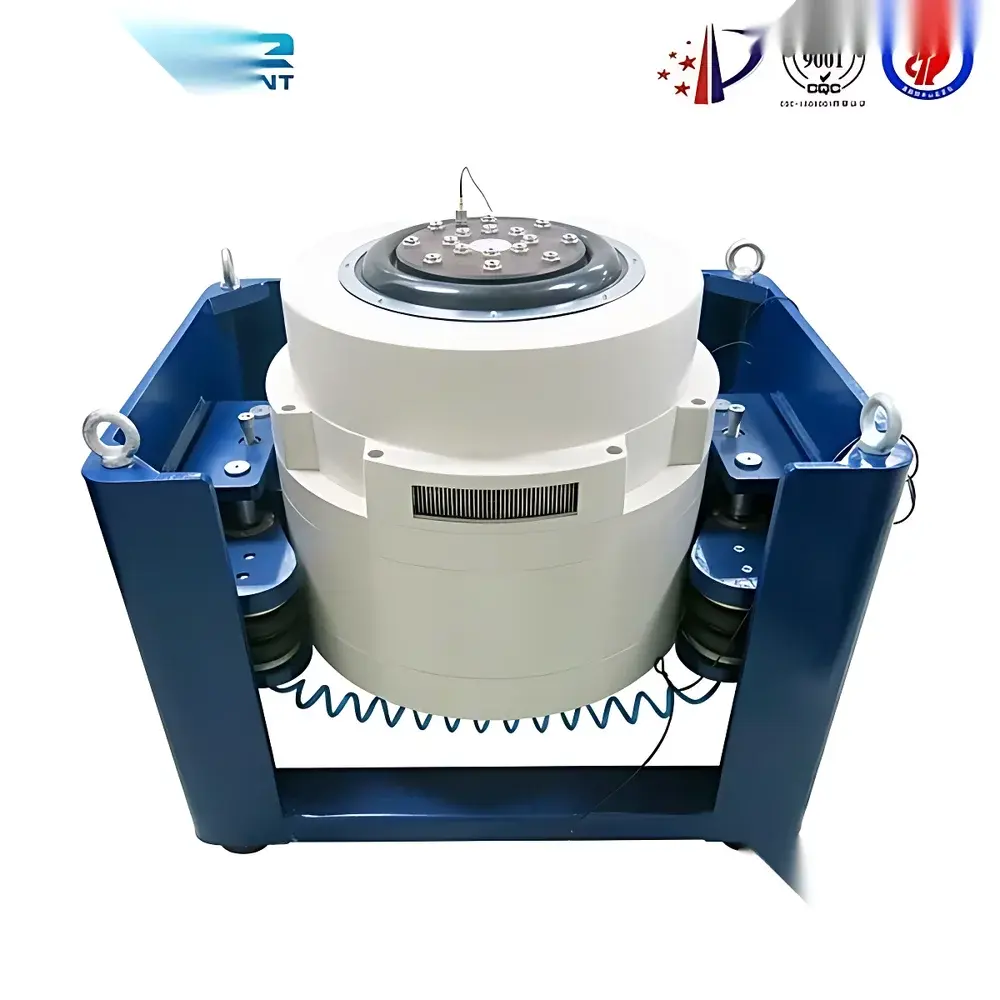
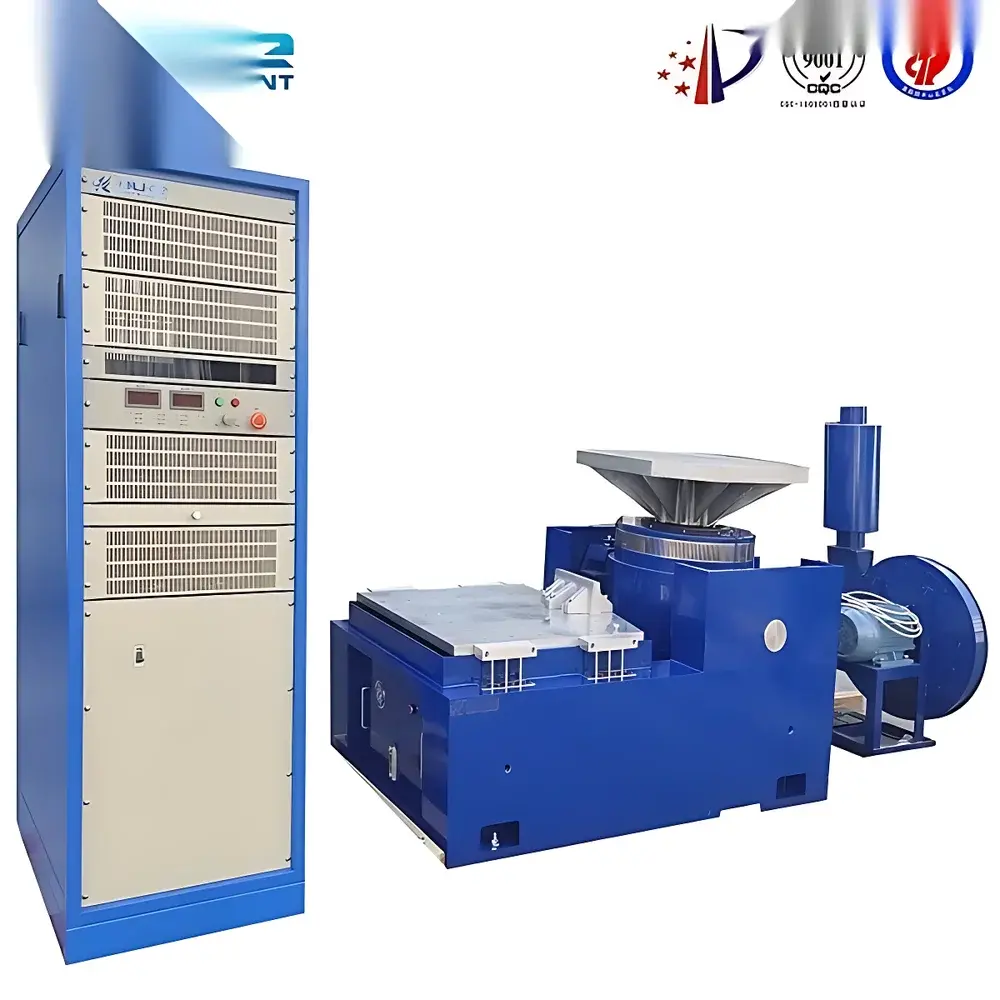
Ouke Electric Vibration Testing System
| Brand | Other Brands |
|---|---|
| Origin | Imported |
| Manufacturer Type | General Distributor |
| Price | USD 21,500 (approx.) |
| Table Size | 450 × 450 mm or 500 × 500 mm |
| Amplitude Range | 0–5 mm (adjustable) |
| Frequency Range | 1–400 Hz / 1–2000 Hz / 1–5000 Hz (selectable) |
| Load Capacity | 150 kg |
| Waveform | Sine (half-wave or full-wave, adjustable) |
| Acceleration Range | 0–20 g (adjustable) |
| Sweep Function | 1–5000 Hz (user-defined upper/lower limits and dwell time) |
| Programmable Mode | Up to 15 segments, each with independent frequency and duration settings |
| Octave Sweep | 15-step, bidirectional (low-to-high, high-to-low, low-to-high-to-high), loopable |
| Logarithmic Sweep | Three modes (low-to-high, high-to-low, low-to-high-to-low), loopable |
| Vibration Axis | Vertical (Y), Horizontal (X/Z), or Triaxial (X/Y/Z) |
| Motor Power | 2.2 kW |
| Supply Voltage | 220 V, 50 Hz |
| Max Current | 10 A |
| Timing Control | User-defined duration (in seconds) |
| Control Interface | Full PC-based control with optional analog/digital I/O |
| Measurement Output | Requires external accelerometer and displacement sensor for quantitative amplitude/acceleration validation |
Overview
The Ouke Electric Vibration Testing System is an electromechanical shaker platform engineered for controlled sinusoidal and swept-frequency vibration excitation in laboratory and production-line environments. Based on electromagnetic force generation via voice-coil actuator technology, it delivers repeatable mechanical stimulus across a broad dynamic range—enabling simulation of real-world transport, handling, and operational vibration profiles. Unlike hydraulic or servo-hydraulic systems, this electric shaker offers superior energy efficiency, minimal thermal drift, and inherently low acoustic emissions—making it suitable for integration into QC labs, R&D facilities, and inline inspection stations where ambient noise, power constraints, or maintenance downtime must be minimized. Its architecture complies with fundamental mechanical testing principles defined in ISO 10816 (mechanical vibration evaluation of machines), ASTM D999 (vibration testing of packaged products), and IEC 60068-2-6 (environmental testing—part 2: tests—test Fc: vibration sinusoidal).
Key Features
- Electromagnetic drive system delivering high thrust-to-power ratio and stable output up to 20 g peak acceleration at rated load
- Adjustable amplitude (0–5 mm peak-to-peak) with mechanical and electronic limiting safeguards to prevent over-travel or resonant runaway
- Three selectable frequency bandwidths (1–400 Hz, 1–2000 Hz, 1–5000 Hz) accommodating both low-frequency durability screening and high-frequency resonance mapping
- Triaxial excitation capability: independent or coupled vertical (Y), horizontal (X/Z), and simultaneous 3-axis operation for multi-directional stress assessment
- Integrated controller with intuitive interface supporting sine, sweep, programmable, octave, and logarithmic test profiles—all fully user-configurable and repeatable
- Robust table construction (450 × 450 mm or 500 × 500 mm aluminum alloy surface) with T-slots for universal fixture mounting and load distribution verification
- Full PC-based control via Ethernet or USB, supporting remote monitoring, script-based automation, and data logging without proprietary hardware lock-in
- Noise-optimized design: <55 dB(A) at 1 m under no-load operation, meeting ISO 7779 and EN ISO 3744 acoustic emission requirements for shared lab spaces
Sample Compatibility & Compliance
The system accommodates rigid and semi-rigid specimens up to 150 kg mass, including automotive ECUs, PCB assemblies, medical device enclosures, pharmaceutical packaging, ceramic components, and consumer electronics subassemblies. Fixturing is compatible with standard DIN 53443 and ASTM D3580 mounting configurations. All test profiles adhere to traceable calibration practices aligned with ISO/IEC 17025 requirements. While the base unit does not include certified transducers, its analog output ports support connection to third-party accelerometers (e.g., PCB Piezotronics models) and laser Doppler vibrometers for NIST-traceable amplitude and acceleration validation—essential for GLP/GMP-regulated validation protocols. The system supports audit-ready documentation when paired with compliant data acquisition software.
Software & Data Management
Control and analysis are performed through vendor-neutral Windows-compatible software featuring real-time FFT spectrum display, time-domain waveform capture, and automated pass/fail thresholding. Test sequences—including multi-segment programmable sweeps—are stored as XML-based configuration files enabling version control and cross-platform reproducibility. Raw time-series data export is supported in CSV and MATLAB (.mat) formats. Optional add-ons provide 21 CFR Part 11-compliant electronic signatures, audit trails, and role-based user access control—critical for regulated industries such as medical device manufacturing (ISO 13485) and pharmaceutical packaging (USP ). No dongle or vendor-specific hardware key is required for full functionality.
Applications
- Environmental stress screening (ESS) per MIL-STD-810H Method 514.8 for early-life defect detection
- Reliability qualification testing of electronic assemblies subjected to rail, road, or air transport vibration spectra
- Structural fatigue analysis of plastic housings, solder joints, and adhesive bonds using accelerated life models
- Vibration-induced loosening assessment of fasteners and connectors under variable g-level and frequency conditions
- Resonance search and modal analysis prelude for finite element model correlation
- Package integrity verification per ISTA 3A and ASTM D4169 distribution cycle simulations
- In-process quality gate testing on assembly lines—capable of 100% unit screening with programmable pass criteria
FAQ
Does the system include calibrated sensors for amplitude and acceleration measurement?
No. Quantitative amplitude and acceleration values require external Class 1 accelerometers and displacement sensors, which must be calibrated per ISO 16063-21 and traceable to national standards. The system provides analog outputs (±10 V) compatible with industry-standard DAQ systems.
Can the shaker operate continuously at maximum amplitude and frequency?
Yes—within thermal limits defined by the 2.2 kW motor and forced-air cooling. Continuous operation at 5 mm peak-to-peak and 2000 Hz is permissible for durations up to 30 minutes; extended runs require duty-cycle management per IEC 60034-1 thermal class specifications.
Is triaxial vibration synchronized or sequential?
Synchronized triaxial excitation is supported via phase-locked drive signals, enabling coherent multi-axis input for realistic environmental replication. Sequential mode is also available for isolated axis characterization.
What safety interlocks are integrated?
Hardware-enforced emergency stop, over-temperature cutoff, over-current protection, table over-travel limit switches, and door-sensor interlock for enclosure variants—meeting IEC 61800-5-2 functional safety requirements.
Is firmware upgradeable in the field?
Yes. Firmware updates are delivered via secure HTTPS download and installed through the host PC interface without requiring service technician intervention.



