
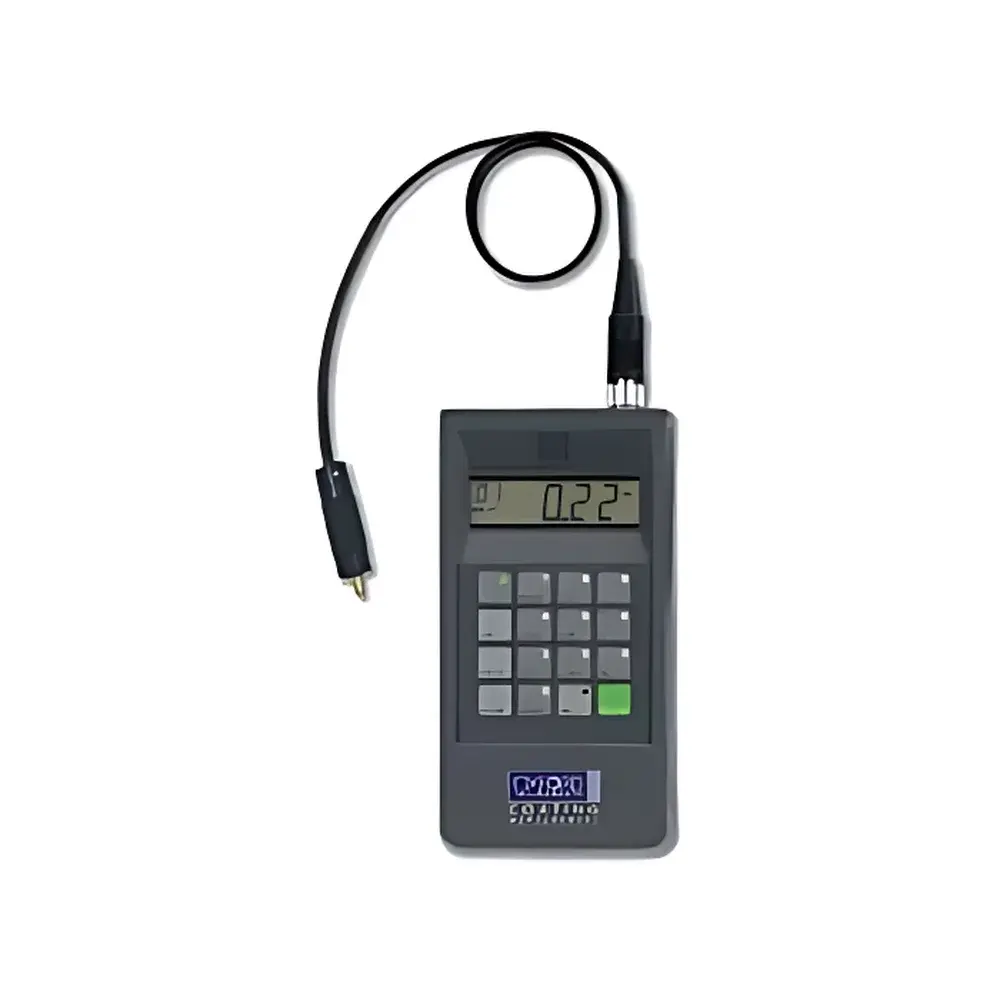
Oxford Instruments CMI243 Electromagnetic Eddy Current Coating Thickness Gauge
| Brand | Oxford Instruments |
|---|---|
| Origin | USA |
| Model | CMI243 |
| Accuracy | ±1% |
| Measurement Range | 2–38 µm (0.08–1.50 mils) |
| Resolution | 0.25 µm (0.01 mil) |
| Minimum Measurable Radius | 1.55 mm (0.06 in) |
| Standards Compliance | ASTM B244, ASTM B259, DIN 50984, ISO 2360, ISO 29168 (Draft), BS 5411 Part 3 |
| Data Storage | 12,400 readings |
| Display | LCD with 1.27 cm character height |
| Interface | RS-232 serial port (adjustable baud rate) |
| Power | 9 V alkaline or rechargeable battery |
| Dimensions | 14.9 × 7.94 × 3.02 cm |
| Weight | 0.26 kg (including battery) |
Overview
The Oxford Instruments CMI243 is a handheld electromagnetic eddy current coating thickness gauge engineered for non-destructive, high-reproducibility measurement of non-conductive and non-magnetic coatings on ferromagnetic substrates—such as zinc, nickel, chromium, cadmium, and copper electrodeposits on steel or iron. Unlike destructive methods like coulometric stripping (ASTM B504), the CMI243 relies on the principle of electromagnetic induction: a high-frequency alternating current in the probe coil generates eddy currents in the conductive substrate; the presence and thickness of the insulating coating modulates the impedance of the coil, which is quantitatively correlated to coating thickness via factory-calibrated algorithms. This method delivers X-ray fluorescence–level precision without ionizing radiation, regulatory licensing, or sample preparation—making it ideal for in-line quality control, field verification, and laboratory-grade validation in automotive, aerospace fastener manufacturing, and electroplating facilities.
Key Features
- High-sensitivity ECP-M probe optimized for thin metallic coatings (2–38 µm) on ferrous substrates, including Zn/Fe, Ni/Fe, Cr/Fe, Cd/Fe, and Cu/Fe systems
- ±1% measurement accuracy traceable to NIST-certified reference standards, validated per ASTM B244 and ISO 2360
- Minimum measurable curvature radius of 1.55 mm—enabling reliable measurements on small-diameter fasteners, threaded components, and gear teeth
- Auto-switching between metric (µm) and imperial (mils) units with real-time conversion during operation
- Integrated statistical engine computing mean, standard deviation, min/max values, and final reading from up to 12,400 stored measurements
- Rugged, ergonomic housing (14.9 × 7.94 × 3.02 cm; 0.26 kg) with high-contrast LCD display (1.27 cm character height) for readability under workshop lighting conditions
- RS-232 serial interface supporting configurable baud rates (1200–115,200 bps) for direct connection to printers, PCs, or LIMS systems
Sample Compatibility & Compliance
The CMI243 is validated for use on flat, curved, and irregularly shaped ferromagnetic parts where coating integrity and thickness uniformity are critical to corrosion resistance and functional performance. It supports routine inspection of automotive suspension components, stamped chassis parts, threaded fasteners (bolts, screws, nuts), hydraulic fittings, and precision machined gears. All measurement protocols adhere to internationally recognized standards: ASTM B244 (standard test method for measurement of thickness of nonconductive coatings on nonferrous metals using eddy current), ASTM B259 (for electrodeposited coatings), DIN 50984 (German industrial specification), ISO 2360 (non-magnetic coatings on magnetic substrates), and ISO 29168 (draft standard for multi-layer systems). The instrument’s calibration stability and repeatability meet GLP and GMP documentation requirements when used with audit-trail-enabled data export workflows.
Software & Data Management
Data acquisition and reporting are supported through Oxford Instruments’ proprietary CMI DataLink software (Windows-compatible), enabling bidirectional communication via RS-232. Users can download full measurement logs—including timestamp, location ID (user-defined), operator code, and statistical summaries—for integration into SPC dashboards or electronic batch records. Export formats include CSV and XML, facilitating import into Excel, Minitab, or enterprise QMS platforms. While the CMI243 itself does not implement FDA 21 CFR Part 11-compliant electronic signatures, its raw data output and metadata structure support compliant archival when deployed within validated IT environments governed by organizational SOPs.
Applications
- Quality assurance of galvanized steel components in construction and infrastructure supply chains
- In-process monitoring of electroplating baths in Tier-1 automotive suppliers (e.g., Zn/Ni alloy coatings on brake calipers)
- Final inspection of aerospace fasteners requiring strict adherence to AMS 2406 or DEF STAN 03-15 specifications
- Verification of decorative chrome plating thickness on consumer electronics housings
- Third-party certification testing for ISO/IEC 17025-accredited laboratories performing coating thickness accreditation
- Maintenance of coating thickness databases for predictive corrosion modeling in offshore oil & gas assets
FAQ
Can the CMI243 measure coatings on non-ferrous substrates such as aluminum or copper?
No—the CMI243 is specifically designed for non-magnetic coatings on ferromagnetic substrates (e.g., steel, iron). For non-ferrous substrates, Oxford Instruments recommends the CMI240 (dual-mode magnetic induction/eddy current) or the X-Strata 920 (XRF-based) platform.
Is probe recalibration required after every battery change or power cycle?
No—zero-point calibration is retained in non-volatile memory. However, periodic verification using certified foil or step standards (per ASTM B244 Annex A2) is recommended before each shift or after environmental changes exceeding ±5°C.
Does the instrument support custom calibration curves for proprietary coating-substrate combinations?
Yes—up to 10 user-defined calibration sets can be stored onboard, each with unique slope/intercept coefficients and tolerance limits, accessible via password-protected menu navigation.
What is the typical service life of the ECP-M probe under daily industrial use?
With proper handling and avoidance of mechanical impact or abrasive contact, the probe maintains specified accuracy for ≥50,000 measurements or 24 months—whichever occurs first—under normal operating conditions (15–35°C, <80% RH).
Is firmware upgrade capability available, and how is it performed?
Firmware updates are distributed annually via Oxford Instruments’ secure customer portal and installed using the CMI DataLink software and RS-232 connection—no hardware modification or field service visit required.



