
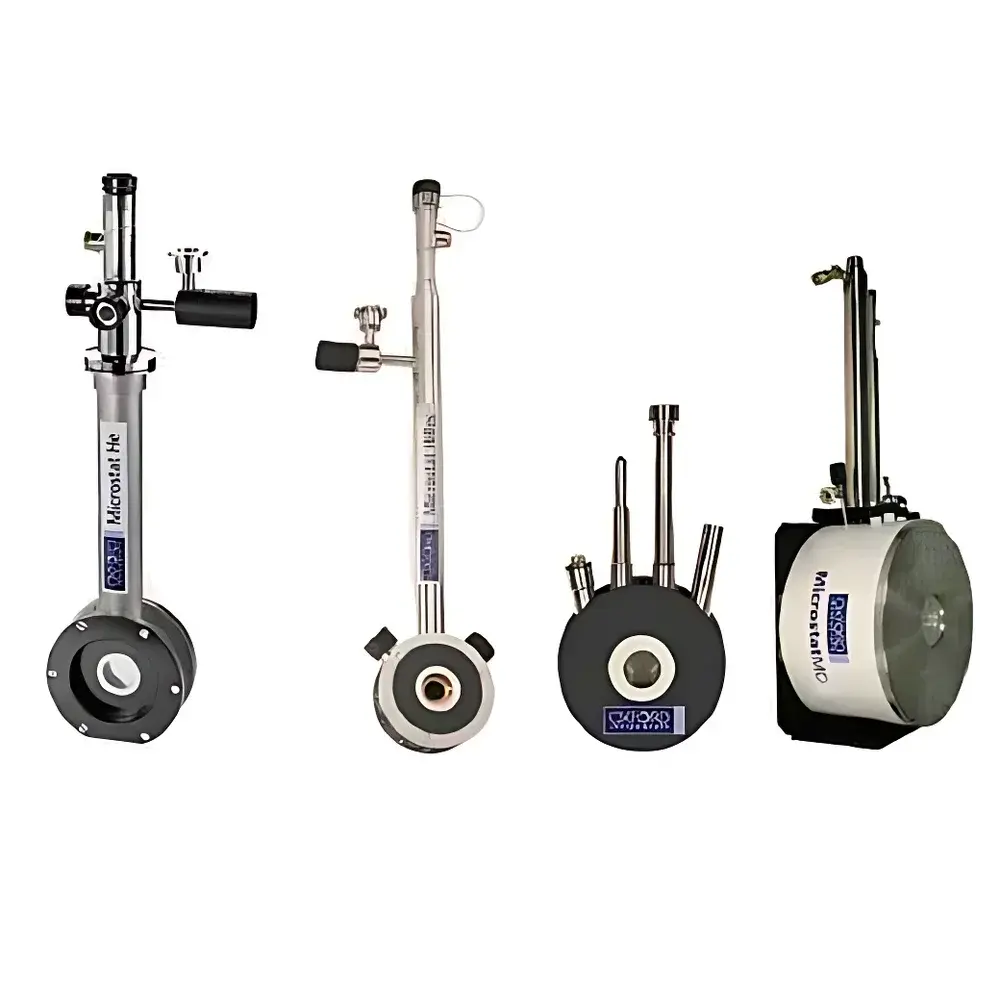
Oxford Instruments Microstat Cryogenic Microscope Refrigerator
| Origin | UK |
|---|---|
| Manufacturer Type | Authorized Distributor |
| Origin Category | Imported |
| Model | Microstat |
| Price Range | USD 42,000 – 70,000 |
Overview
The Oxford Instruments Microstat series represents a family of compact, high-stability cryogenic refrigerators engineered specifically for integration with optical microscopes and spectroscopic platforms. Operating on closed-cycle or bath-cooled cryogenic principles—depending on configuration—the Microstat delivers precise, vibration-isolated thermal control to samples under observation. Each variant leverages either liquid nitrogen (LN₂) or liquid helium (LHe) as the primary cryogen, enabling temperature ranges from 2.2 K (MicrostatHe) up to 500 K across multiple models. The system’s core architecture is built around a thermally anchored cold finger, low-thermal-conductivity support structure, and patented heat-sinking pathways that minimize parasitic heating and maximize cooling efficiency. Designed for in situ characterization, the Microstat supports real-time optical access with minimal working distance constraints and sub-micron mechanical stability—critical for high-resolution confocal microscopy, micro-Raman, and photoluminescence mapping where thermal drift directly impacts spectral resolution and spatial registration.
Key Features
- Modular platform architecture with four standardized configurations: MicrostatN (LN₂-only), MicrostatHe (LHe/LN₂ dual-mode), MicrostatHires (ultra-low-drift LHe operation), and MicrostatMO (integrated 5 T superconducting magnet option)
- Exceptional thermal stability: ±0.1 K at base temperature for MicrostatHe, MicrostatHires, and MicrostatMO; >0.5 K for MicrostatN
- Sub-20 nm vertical jitter performance (MicrostatHires & MicrostatMO) and drift rates as low as <4 nm/minute (MicrostatMO) under stabilized conditions
- Patented cryogen management system reducing LHe consumption to <0.45 L/h (MicrostatHe) and LN₂ use to <0.5 L/h (MicrostatN)
- Optimized optical geometry: working distances from 2 mm (MicrostatN) to 8.5 mm (MicrostatMO); sample chambers dimensioned for standard microscope objectives and spectrometer coupling
- Lightweight construction: 0.4 kg (MicrostatN) to <25 kg (MicrostatMO), facilitating rapid installation on inverted, upright, and confocal microscope frames without structural reinforcement
Sample Compatibility & Compliance
The Microstat series accommodates a broad spectrum of solid-state and thin-film specimens—including semiconductor wafers, 2D materials (e.g., graphene, TMDCs), quantum dots, perovskite crystals, and single-photon emitters—within its cylindrical or square sample wells (diameters from 11 mm to 20 mm; heights up to 11 mm). All models comply with IEC 61000-6-3 (EMC emission standards) and are designed to meet laboratory safety requirements for cryogenic handling per ISO 20482. When deployed in regulated environments (e.g., academic core facilities operating under GLP or industrial R&D labs aligned with ISO/IEC 17025), the Microstat supports audit-ready documentation packages including calibration certificates traceable to NPL (UK) and factory-installed temperature sensor verification logs. Optional PT100 or Cernox™ sensors provide NIST-traceable thermal monitoring compatible with third-party DAQ systems.
Software & Data Management
Oxford Instruments provides the Microstat Control Suite—a Windows-based application supporting real-time temperature ramping, hold profiles, and multi-segment thermal protocols. The software integrates with LabVIEW™ via TCP/IP and offers ASCII-based SCPI command sets for custom automation. All temperature setpoints, actual readings, and cryogen level estimates are timestamped and logged in CSV format, enabling synchronization with spectral acquisition timestamps from Horiba, Renishaw, or Andor platforms. For compliance-driven workflows, optional 21 CFR Part 11–compliant modules are available, delivering electronic signatures, user-access controls, and immutable audit trails for temperature history and parameter changes—fully aligned with FDA-regulated material qualification processes.
Applications
- Micro-photoluminescence (µ-PL) and cathodoluminescence (CL) spectroscopy of III–V and wide-bandgap semiconductors
- Low-temperature FTIR and micro-Fourier transform infrared imaging of biological membranes and polymer phase transitions
- Confocal Raman mapping of strain distribution in monolayer MoS₂ and hBN heterostructures
- Single-molecule fluorescence tracking and lifetime analysis under cryogenic quenching
- Magnetotransport + optical correlation studies using the MicrostatMO’s integrated 5 T magnet and collinear optical path
- Calibration reference source stabilization for radiometric and quantum efficiency measurements (e.g., QE of Si PMTs or SNSPDs)
FAQ
What cryogens are required for each Microstat model?
MicrostatN operates exclusively with liquid nitrogen (77.2–500 K). MicrostatHe and MicrostatHires accept either liquid helium (2.2–500 K or 2.7–500 K) or liquid nitrogen. MicrostatMO requires liquid helium for magnet cooldown and sample operation below 10 K.
Can the Microstat be retrofitted into an existing microscope stage?
Yes—each model includes standardized kinematic mounting interfaces and optional adapter plates for Zeiss, Leica, Nikon, and Olympus microscope frames. Mechanical drawings and CAD files are provided upon order.
Is remote monitoring supported?
All models feature Ethernet and RS-232 interfaces. Temperature and status data can be streamed continuously to external SCADA or Python-based monitoring scripts using documented Modbus RTU or TCP protocols.
How often does the system require recalibration?
Oxford recommends annual verification of temperature sensors against a certified reference thermometer. Factory recalibration is available through authorized service centers with NPL-traceable equipment.
Does the MicrostatMO’s 5 T magnet interfere with optical measurements?
No—the magnet’s persistent mode design eliminates field fluctuations during operation, and its bore geometry preserves unobstructed optical access along the Z-axis with Faraday rotation compensated in post-processing when necessary.



