
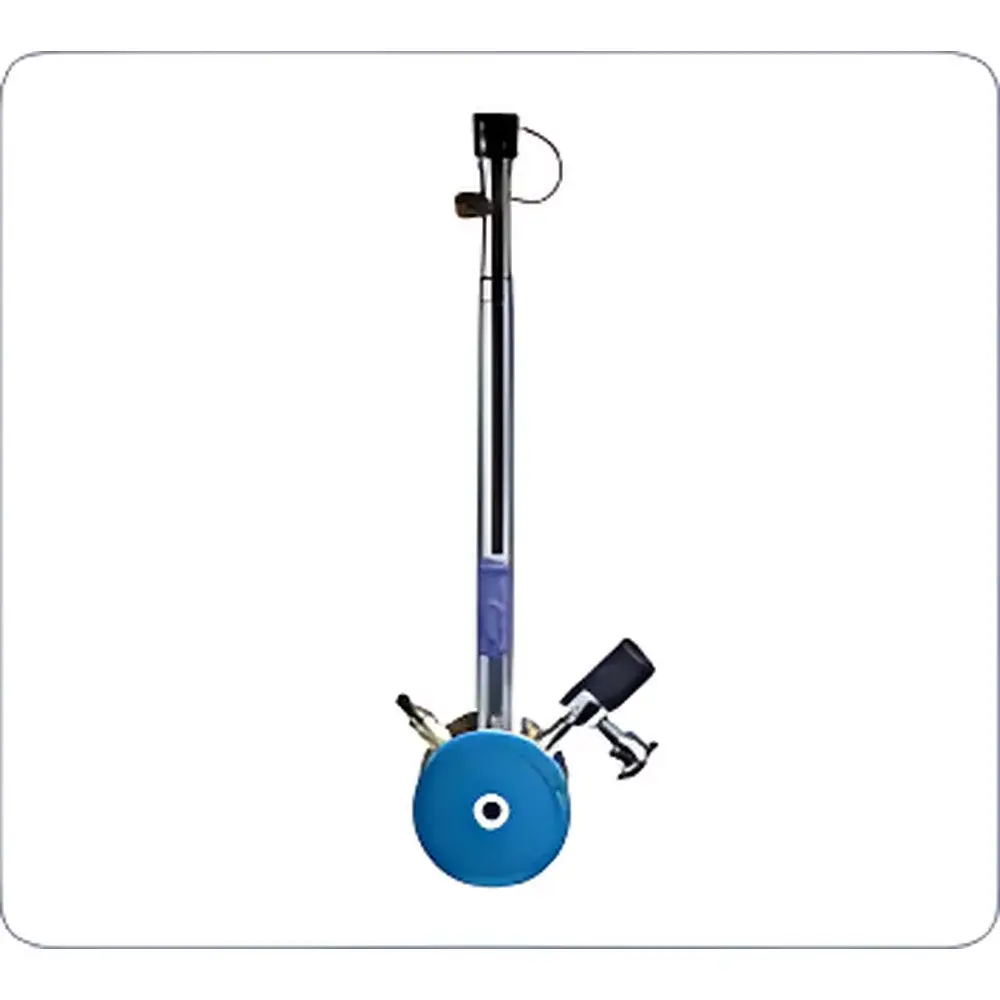
Oxford Instruments MicrostatHiRes Optical Cryostat
| Brand | Oxford Instruments |
|---|---|
| Origin | United Kingdom |
| Model | MicrostatHiRes |
| Temperature Range | 2.7 K – 500 K (with optional rotary pump) / 3.4 K – 500 K (standard) |
| Base Temperature Stability | ±0.1 K |
| Helium Consumption at 4.2 K | < 0.70 L/hr (with low-loss transfer line) |
| Cool-down Time from RT to 4.2 K | ~15 min (with pre-cooled transfer line) |
| Working Distance | 2.2 mm |
| Sample Vibration | < 20 nm (measured in SEM environment) |
| Mass | 1.5 kg |
| Controller | Mercury iTC |
| Communication Interfaces | RS232, USB (serial emulation), TCP/IP, GPIB |
| Software Integration | LabVIEW driver library and virtual instrument support |
| Compliance | Designed for GLP/GMP-adjacent research environments |
Overview
The Oxford Instruments MicrostatHiRes is a high-resolution optical cryostat engineered for precision low-temperature microscopy and spectroscopy applications. It operates on continuous-flow cryogenic cooling, enabling stable thermal control of samples under high vacuum conditions—critical for minimizing thermal drift, condensation, and background interference in optical measurements. Its core architecture leverages a compact, lightweight design (1.5 kg) with an ultra-short working distance of just 2.2 mm, facilitating integration with high-numerical-aperture objectives and confocal microscopes. The system achieves base temperatures as low as 2.7 K when paired with an optional rotary pump, and maintains standard operation from 3.4 K to 500 K using liquid helium or liquid nitrogen (77 K–500 K). Temperature stability is maintained within ±0.1 K across the operational range, supported by the Mercury iTC intelligent temperature controller, which implements multi-sensor feedback and PID optimization for dynamic thermal load compensation.
Key Features
- Ultra-low mechanical noise: Sample vibration < 20 nm (verified under scanning electron microscope metrology), ensuring sub-wavelength positional fidelity for quantum dot photoluminescence mapping and single-photon source characterization.
- Optimized thermal efficiency: Helium consumption ≤ 0.70 L/hr at 4.2 K with low-loss transfer line; nominal 0.8 L total consumption to reach base temperature.
- Fast thermal response: Cool-down from ambient (300 K) to 4.2 K in approximately 15 minutes when using a pre-cooled transfer line—enabling rapid experimental iteration.
- Modular optical interface: Standard configuration supports both transmission and reflection geometries; interchangeable window options (e.g., fused silica, CaF₂, sapphire) accommodate UV–IR spectral ranges.
- Integrated electrical access: 10-pin feedthrough for DC/low-frequency biasing and signal acquisition, compatible with lock-in amplifiers and quantum transport measurement setups.
- Compact footprint and vacuum-compatible construction: Host unit dimensions optimized for integration into optical tables, probe stations, and electromagnetic solenoids via optional cylindrical heat exchanger mounting.
Sample Compatibility & Compliance
The MicrostatHiRes accommodates standard optical sample substrates—including silicon wafers, glass slides, TEM grids, and custom-mounted quantum emitters—within its vacuum chamber. All internal materials conform to UHV-compatible standards (outgassing rate 1×10⁻⁷ mbar typical operating pressure). The system meets mechanical and thermal safety requirements per IEC 61010-1:2010 for laboratory equipment. While not certified for clinical or industrial process control, its temperature calibration traceability aligns with ISO/IEC 17025 guidelines when used with NIST-traceable reference sensors. For regulated research environments (e.g., academic labs supporting FDA-regulated preclinical studies), audit-ready operation is supported through Mercury iTC’s logging capabilities, including timestamped temperature records and controller parameter history.
Software & Data Management
Oxford Instruments provides native software drivers for LabVIEW 2015 and later, including a fully documented function library and a virtual instrument panel for real-time monitoring and scripting-based automation. Communication protocols include RS232 (legacy serial), USB (CDC-class serial emulation), TCP/IP (for remote networked control), and GPIB (IEEE-488.2). All temperature setpoints, sensor readings, heater outputs, and alarm states are accessible programmatically. Data logging resolution supports millisecond-level sampling for transient thermal analysis. The Mercury iTC firmware includes configurable alarm thresholds, ramp-rate limiting, and automatic cooldown/warm-up sequencing—features essential for unattended overnight experiments. Export formats include CSV and TDMS, compatible with MATLAB, Python (via PyVISA), and commercial data analysis platforms.
Applications
- Low-temperature photoluminescence (PL) and cathodoluminescence (CL) spectroscopy of semiconductor nanostructures (e.g., quantum dots, 2D materials, color centers in diamond).
- Micro-Raman and Fourier-transform infrared (FTIR) microscopy requiring minimal thermal broadening and high spatial resolution.
- Quantum optics experiments involving single-photon sources, spin-photon interfaces, and cavity quantum electrodynamics (cQED).
- In situ electrical transport characterization (e.g., Hall effect, magnetoresistance) combined with optical excitation.
- Time-resolved fluorescence lifetime imaging (FLIM) under cryogenic conditions where thermal quenching must be suppressed.
- Integration into magnetic resonance platforms (e.g., ODMR) via optional electromagnetic coil compatibility kits.
FAQ
What is the minimum achievable base temperature, and what configuration is required?
With the standard liquid helium continuous-flow setup, the base temperature is 3.4 K. Using an optional rotary pump for enhanced vacuum isolation of the cold head, the system reaches 2.7 K.
Can the MicrostatHiRes be operated with liquid nitrogen only?
Yes—the system supports dual-cryogen operation. With liquid nitrogen, the usable temperature range is 77 K to 500 K.
Is the Mercury iTC controller included as standard equipment?
Yes, the Mercury iTC is supplied as part of the standard system configuration, including front-panel interface, sensor inputs, and heater output channels.
What vacuum level is required, and is a pump provided?
The system requires a roughing pump (rotary vane or dry scroll) capable of reaching ≤1×10⁻² mbar prior to cool-down. Pumps are not included but are available as optional accessories.
How is temperature calibration performed, and is it traceable?
Calibration uses factory-installed Cernox® or RuO₂ sensors, each supplied with individual calibration coefficients. Traceability to NIST standards is available upon request for metrology-critical applications.



