
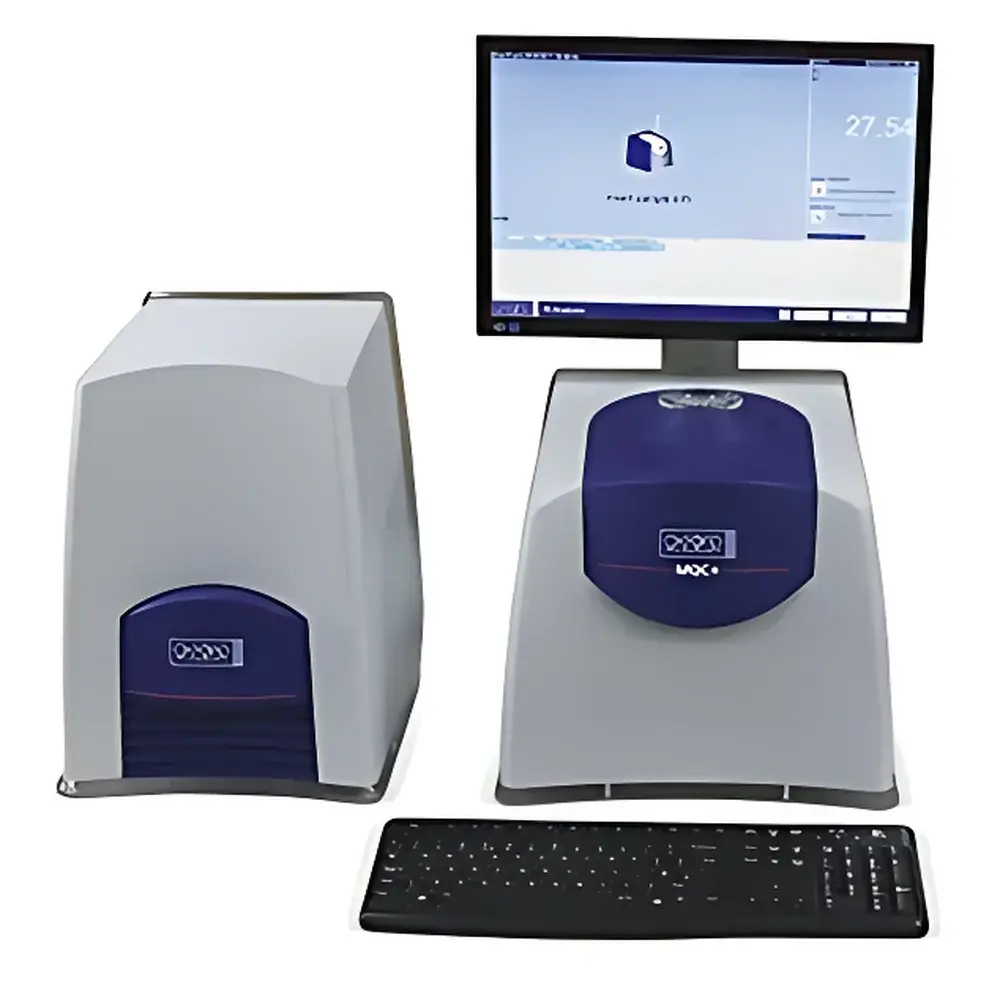
Oxford Instruments MQC+ Benchtop Low-Field Nuclear Magnetic Resonance Analyzer
| Brand | Oxford Instruments |
|---|---|
| Origin | United Kingdom |
| Model | MQC+ |
| Instrument Type | Low-Field NMR Analyzer |
| Sample Types | Solid-Liquid Dual-Phase |
| Resolution | <1 Hz |
| Dimensions (Standard Configuration) | 235 mm (diameter) / 0.2 mL sample volume |
Overview
The Oxford Instruments MQC+ is a benchtop low-field nuclear magnetic resonance (NMR) analyzer engineered for rapid, non-destructive quantification of mobile and immobile components in heterogeneous solid and semi-solid materials. Operating at a fixed Larmor frequency (typically 23 MHz for 1H), the system exploits spin relaxation time measurements—primarily T2 (transverse relaxation) and, where applicable, T1 (longitudinal relaxation)—to differentiate and quantify oil, water, fluorine-containing compounds, and solid fat content without chemical separation or solvent extraction. Unlike high-field NMR spectrometers designed for molecular structure elucidation, the MQC+ is purpose-built for industrial process control and quality assurance environments where robustness, throughput, and method transferability are paramount. Its permanent magnet architecture delivers stable field homogeneity and minimal drift over extended operation, enabling reproducible measurements across shifts and laboratories.
Key Features
- True benchtop footprint with integrated magnet, probe, and console—no external cryogens, shimming coils, or RF shielding required
- Multi-sample capacity configurations: standard (0.2–14 mL), large-volume (40–100 mL), and fluorine-optimized (MQC+F) variants for specialized detection
- Temperature-controlled probe options (±0.1 °C stability) for SFC (Solid Fat Content) profiling per ISO 8588 and AOCS Cd 16b-93
- Automated pulse sequence selection (CPMG, IR, Inversion Recovery) with pre-calibrated methods for >30 industry-standard applications
- Self-diagnostic hardware monitoring with real-time status LEDs at sample insertion port and software-driven calibration alerts
- GLP-compliant audit trail logging, user-access-level management, and optional 21 CFR Part 11 electronic signature support via optional software module
Sample Compatibility & Compliance
The MQC+ accepts intact, unprocessed samples—including opaque solids, emulsions, pastes, granules, and powders—without grinding, dissolution, or filtration. Its low-field design ensures uniform excitation and signal acquisition across bulk volumes, eliminating surface-bias artifacts common in optical or near-infrared techniques. The analyzer complies with IEC 61000-6-3 (EMC emissions) and IEC 61000-6-2 (immunity), and its measurement protocols align with internationally recognized standards including ASTM D7429 (petroleum wax analysis), ISO 16584 (chocolate fat content), AOCS Cd 16b-93 (SFC), and USP <1058> (analytical instrument qualification). All factory-installed methods undergo IQ/OQ/PQ validation documentation packages, supporting GMP-regulated environments in food, pharmaceutical, and polymer manufacturing.
Software & Data Management
MQC+ is operated via Oxford Instruments’ proprietary MestReNova-based NMR Analysis Suite, featuring intuitive wizard-driven workflows, customizable report templates (PDF/CSV/XLSX export), and multi-language UI support (English, German, French, Spanish, Chinese, Japanese). The software includes embedded statistical process control (SPC) tools—X-bar/R charts, capability indices (Cp, Cpk), and trend analysis—with direct integration into enterprise MES and LIMS platforms via OPC UA and ODBC interfaces. Raw FID data, processed spectra, and relaxation decay curves are stored in vendor-neutral HDF5 format, ensuring long-term archival integrity and third-party algorithm compatibility. Remote diagnostics and firmware updates are supported via secure HTTPS channel with TLS 1.2 encryption.
Applications
- Food & Confectionery: Total fat, oil uptake in fried snacks, cocoa butter crystallinity, and Solid Fat Content (SFC) profiling across temperature ramps
- Agriculture & Oilseeds: Oil and moisture content in soybeans, rapeseed, sunflower seeds, and palm fruit mesocarp—validated per ISO 659 and AOCS Am 2-93
- Textiles & Coatings: Oil pick-up (OPU) on synthetic fibers, lubricant retention on yarns (FoY), and coating uniformity in nonwovens
- Pharmaceuticals & Oral Care: Fluoride concentration in toothpaste (MQC+F variant), excipient hydration state, and tablet coating thickness estimation
- Petroleum & Polymers: Hydrogen index in fuels, wax/oil ratio in paraffin blends, plasticizer content in PVC, and crystallinity assessment in polyolefins
- Construction & Minerals: Bitumen binder content in asphalt mixtures, limestone filler dispersion, and fluorine quantification in fluorspar ores
FAQ
Is the MQC+ suitable for regulatory submissions in FDA-regulated industries?
Yes—when configured with 21 CFR Part 11 compliance software, audit trail logging, electronic signatures, and validated methods, the MQC+ meets ALCOA+ data integrity principles and supports submission-ready analytical data packages.
Can the MQC+ measure solid fat content (SFC) according to ISO standards?
Yes—the system implements standardized CPMG pulse trains with precise temperature ramping (–40 °C to +40 °C, ±0.1 °C) and automated T2 inversion fitting per ISO 8588 and AOCS Cd 16b-93.
What sample preparation is required prior to analysis?
Minimal preparation: samples are transferred directly into standard NMR tubes or custom holders; no solvents, derivatization, or homogenization is needed for most applications.
How does low-field NMR differ from high-field NMR in terms of application scope?
Low-field NMR prioritizes quantitative bulk property analysis (relaxation times, diffusion coefficients, component ratios) over spectral resolution; it excels in routine QC where speed, ruggedness, and method robustness outweigh structural detail requirements.
Does Oxford Instruments provide application-specific method development support?
Yes—Oxford’s global Applications Lab offers remote and on-site method transfer, validation assistance, and custom pulse sequence development aligned with client-specific matrices and regulatory frameworks.





