
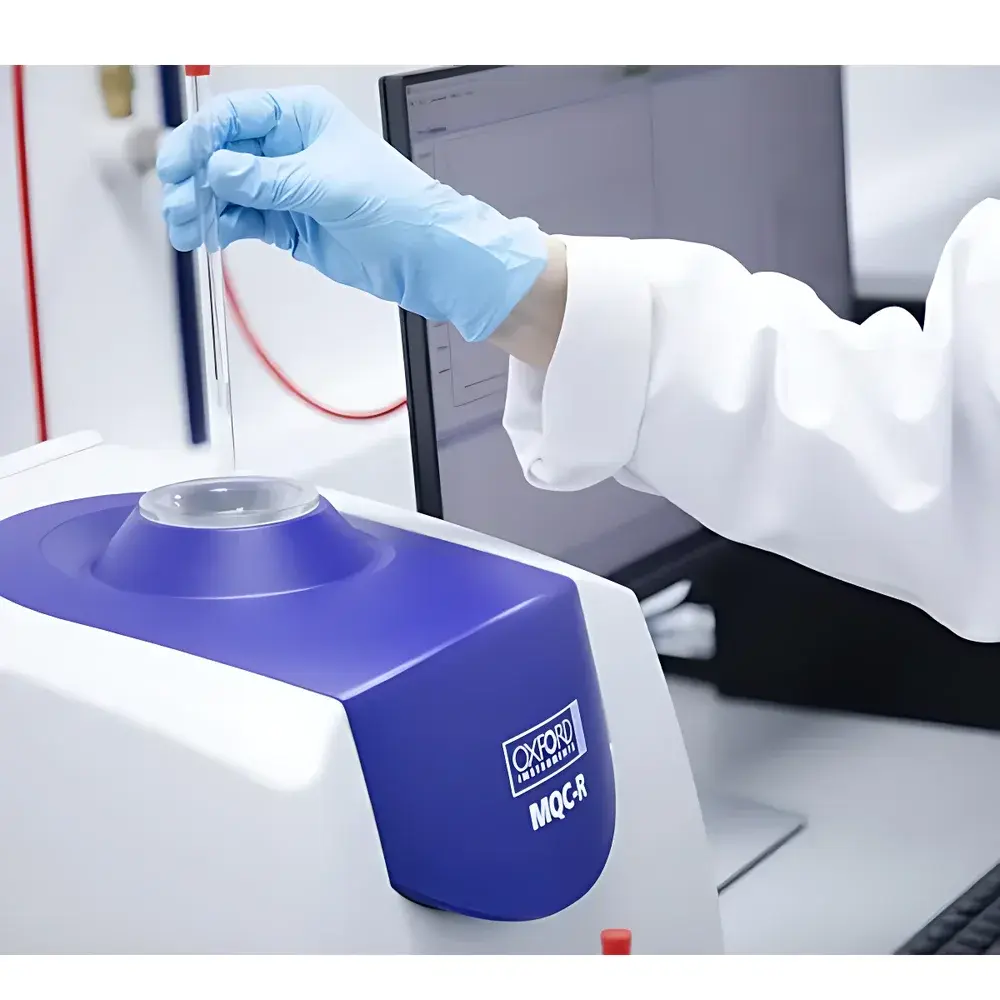
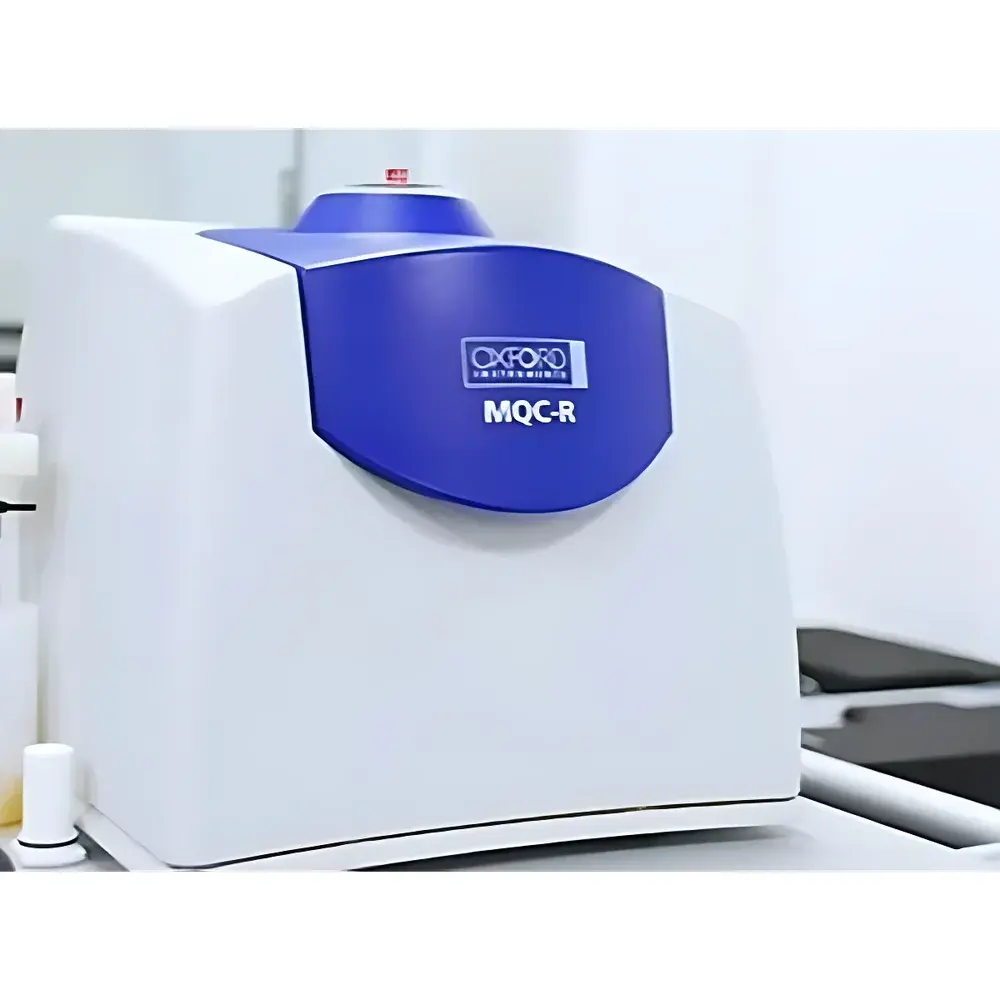
Oxford Instruments MQC-R Benchtop Time-Domain Nuclear Magnetic Resonance Spectrometer
| Brand | Oxford Instruments |
|---|---|
| Origin | United Kingdom |
| Model | MQC-R |
| Magnet Frequency | 23 MHz |
| Probe Diameter Range | 10–26 mm |
| Sample Volume Capacity | Up to 14 mL |
| Temperature Control Range (Liquid) | –5 °C to +70 °C |
| Pulsed Field Gradient (PFG) Strength | >3.0 T/m |
| Nuclei Support | ¹H, ¹⁹F, and other quadrupolar/non-quadrupolar nuclei via configurable probes |
| Configurability | Modular hardware and software options for TD-NMR experiments including 1D/2D relaxation, diffusion, and distribution analysis |
Overview
The Oxford Instruments MQC-R is a benchtop time-domain nuclear magnetic resonance (TD-NMR) spectrometer engineered for quantitative, non-invasive characterization of material structure and composition across academic, industrial, and quality control environments. Unlike high-field Fourier-transform NMR systems, the MQC-R operates on the principle of pulsed radiofrequency excitation and free induction decay (FID) detection at a fixed Larmor frequency of 23 MHz—optimized for robust signal-to-noise ratio in routine solid and liquid phase analysis. Its permanent magnet architecture delivers stable field homogeneity without cryogens or external power conditioning, enabling deployment on laboratory benches, mobile carts, or near production lines. The system measures fundamental NMR parameters—including transverse (T₂), longitudinal (T₁), and stimulated echo (T₁ρ) relaxation times—as well as diffusion coefficients (D) and their distributions—providing direct insight into molecular mobility, phase separation, pore size distribution, water binding states, fluorinated compound concentration, and polymer chain dynamics.
Key Features
- Benchtop 23 MHz permanent magnet platform with <0.1 ppm/h field drift, eliminating cryogenic infrastructure and reducing operational overhead.
- Modular probe architecture supporting interchangeable RF coils for 10 mm, 15 mm, 18 mm, and 26 mm sample diameters—enabling analysis of volumes from 0.1 mL to 14 mL with consistent sensitivity calibration.
- Multi-nucleus capability: pre-tuned or user-configurable probes for ¹H, ¹⁹F, and selected low-γ nuclei (e.g., ²³Na, ³¹P), facilitating targeted quantification in pharmaceutical excipients, battery electrolytes, and fluoropolymer formulations.
- Integrated liquid temperature control unit enabling precise thermal profiling from –5 °C to +70 °C, supporting kinetic studies of crystallization, gelation, phase transitions, and hydration dynamics.
- Pulsed field gradient (PFG) module delivering gradients up to >3.0 T/m—validated for diffusion-ordered spectroscopy (DOSY)-equivalent analysis, droplet size distribution in emulsions, and restricted diffusion in porous media.
- Software-controlled pulse sequence library compliant with ISO/IEC 17025 traceability requirements, including CPMG, IR, STIR, PGSE, and 2D T₂–D correlation sequences.
Sample Compatibility & Compliance
The MQC-R accepts opaque, heterogeneous, and non-transparent samples—including slurries, gels, pastes, powders, and packaged foods—without dissolution, dilution, or labeling. No ionizing radiation or hazardous reagents are required. Its non-destructive nature preserves sample integrity for downstream testing (e.g., rheology, chromatography, or sensory evaluation). The instrument complies with IEC 61000-6-3 (EMC emissions) and IEC 61000-6-2 (immunity), and its software architecture supports audit trails, electronic signatures, and data integrity frameworks aligned with FDA 21 CFR Part 11 and EU Annex 11 for regulated environments. Optional IQ/OQ documentation packages are available for GLP and GMP validation in pharmaceutical and food safety laboratories.
Software & Data Management
MQC-R is operated via Oxford Instruments’ proprietary MqLab software—a Windows-based application designed for both novice and expert users. It features a workflow-driven interface with pre-validated methods for common applications (e.g., moisture content in seeds, oil/fat ratio in chocolate, fluorine assay in active pharmaceutical ingredients). Raw FID and echo train data are stored in HDF5 format with embedded metadata (pulse sequence, temperature, gradient strength, RF power), ensuring FAIR (Findable, Accessible, Interoperable, Reusable) data principles. Batch processing, automated peak integration, multi-exponential T₂ fitting (using NNLS or CONTIN algorithms), and 2D inverse Laplace transform for T₂–D mapping are supported. Export options include CSV, ASCII, and MATLAB-compatible .mat files; API access enables integration with LIMS and MES platforms.
Applications
- Food Science: Quantification of free/bound water in dairy, meat, and cereal matrices; fat crystallinity monitoring during tempering; shelf-life prediction via T₂ relaxation kinetics.
- Pharmaceuticals: Polymorph screening in amorphous solid dispersions; excipient compatibility assessment; residual solvent analysis in lyophilized products.
- Battery Research: Electrolyte wettability and Li⁺ ion mobility in separators; degradation tracking of cathode/anode materials via ¹⁹F relaxation changes.
- Polymers & Elastomers: Crosslink density estimation from T₂ distributions; filler dispersion homogeneity; aging and weathering effects on chain mobility.
- Construction Materials: Pore size distribution in cementitious systems; water ingress modeling in concrete; curing kinetics of geopolymers.
- Cosmetics: Emulsion stability profiling via droplet diffusion; penetration depth of actives in skin models using contrast-enhanced relaxometry.
FAQ
What sample types are compatible with the MQC-R?
Solid, semi-solid, liquid, and multiphase samples—including opaque suspensions, gels, foams, and sealed vials—are fully compatible. No sample preparation beyond standard containment in NMR tubes or custom holders is required.
Can the MQC-R be used for regulatory submissions?
Yes—when deployed with validated methods, audit-trail-enabled software, and documented IQ/OQ protocols, the MQC-R meets data integrity requirements for submissions to FDA, EMA, and Health Canada under ICH Q5, Q7, and Q9 guidelines.
Is remote operation or automation supported?
The system supports Ethernet-based remote control, scripting via Python API, and integration with robotic autosamplers for unattended overnight runs.
How does TD-NMR compare to FT-NMR or other analytical techniques?
TD-NMR offers superior robustness for routine QC, higher throughput than FT-NMR, and greater physical insight into molecular dynamics than DSC or DMA—without requiring spectral interpretation expertise or reference standards.
What maintenance is required?
The permanent magnet requires no servicing; routine calibration involves daily lock-check and quarterly shimming verification. Probe tuning and gradient calibration are performed annually or after hardware modification.
Related Products






