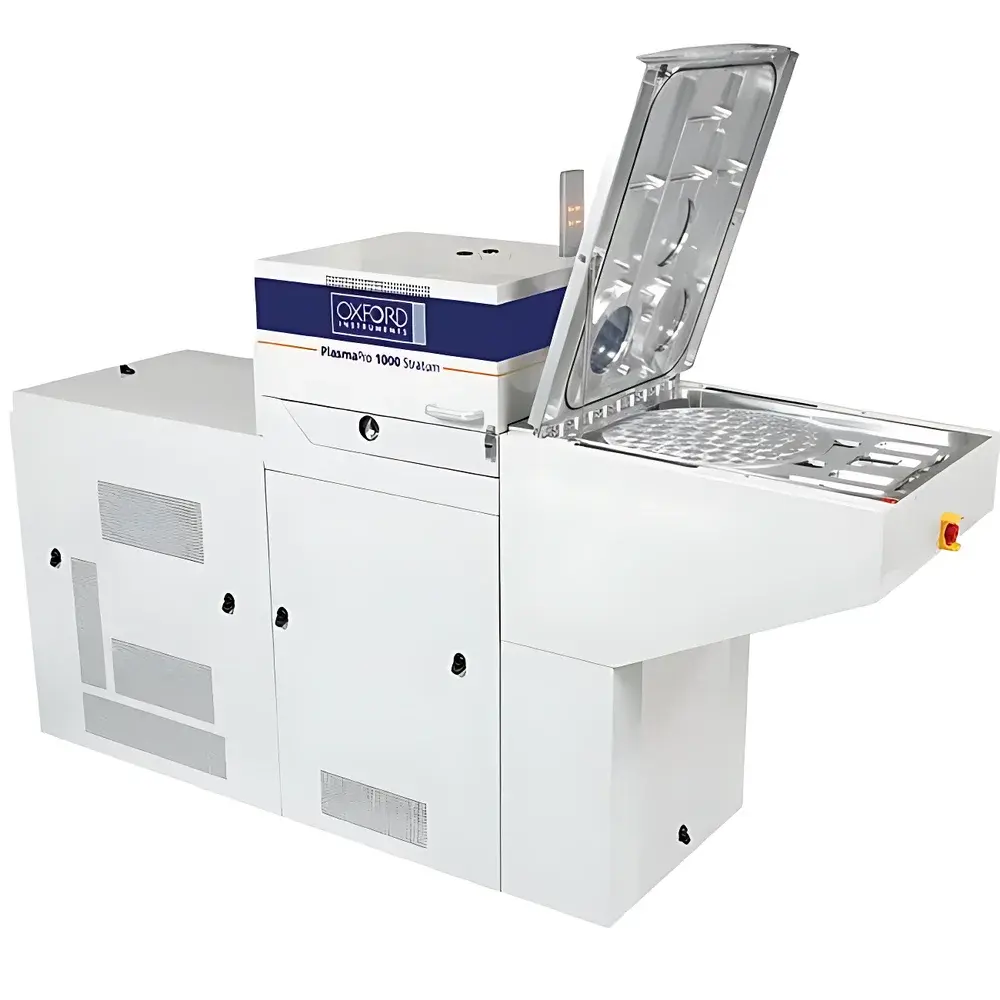
Oxford Instruments PlasmaPro 100 Estrelas Deep Reactive Ion Etcher
| Brand | Oxford Instruments |
|---|---|
| Origin | United Kingdom |
| Model | PlasmaPro 100 Estrelas |
| Substrate Size | 50–200 mm |
| Application Scope | Deep Silicon Etching (DSiE), MEMS, Advanced Packaging, Nanotechnology |
| Chamber Configuration | Single-chamber dual-mode (Bosch™ and cryogenic etching) |
| Process Flexibility | In-situ switchable between smooth sidewall, high-aspect-ratio, tapered via, and high-rate cavity etching |
| Key Hardware | Electrostatic/Heated chuck, optimized chamber liner, high-efficiency turbomolecular pump, fast-response mass flow controllers (MFCs), close-coupled RF delivery |
Overview
The Oxford Instruments PlasmaPro 100 Estrelas is a fully integrated deep reactive ion etcher (DRIE) engineered for precision, reproducibility, and operational versatility in advanced micro- and nanofabrication environments. Based on inductively coupled plasma (ICP) and bias-controlled reactive ion etching (RIE) principles, the system delivers controlled anisotropic silicon etching with sub-micron critical dimension (CD) uniformity across wafers up to 200 mm in diameter. Its core architecture supports both Bosch™ process cycling (alternating passivation and etch steps) and continuous cryogenic etching—enabling seamless transition between high-aspect-ratio (HAR) trench formation (>30:1), smooth sidewall profiles (<0.1° taper), tapered via fabrication, and high-throughput cavity etching—all within a single process chamber without hardware reconfiguration. Designed for dual-use in R&D laboratories and pilot-line production, the PlasmaPro 100 Estrelas meets the stringent demands of MEMS device development, through-silicon via (TSV) processing for 2.5D/3D packaging, and nanostructured surface engineering.
Key Features
- Single-chamber dual-mode capability: Simultaneous support for Bosch™ and cryogenic DRIE processes—eliminating cross-contamination risk and reducing tool qualification time.
- Electrostatic and heated chuck: Enables precise temperature control (–120 °C to +120 °C) and uniform wafer clamping for improved CD repeatability and reduced pattern distortion.
- Optimized chamber liner design: Minimizes particle generation and extends mean time between cleans (MTBC) by >40% compared to standard aluminum chambers—critical for low-defect yield requirements.
- High-efficiency vacuum architecture: Integrated high-speed turbomolecular pump and compact chamber geometry ensure rapid gas exchange (<5 s purge-to-pumpdown), enabling tight process window control and reduced step-to-step variability.
- Fast-response mass flow controllers (MFCs): Originally developed for atomic layer deposition (ALD) applications, these MFCs provide <50 ms response time and ±0.5% full-scale accuracy—essential for dynamic gas ratio modulation during complex multi-step etch sequences.
- Close-coupled RF delivery: Minimizes impedance mismatch and plasma impedance drift, ensuring stable ion energy distribution and consistent etch rate across substrate batches.
Sample Compatibility & Compliance
The PlasmaPro 100 Estrelas accommodates substrates from 50 mm (2″) to 200 mm (8″), including silicon, SiC, quartz, and compound semiconductors such as GaAs and InP—subject to process gas compatibility. It complies with ISO 14644-1 Class 5 cleanroom integration standards and incorporates safety interlocks conforming to IEC 61000-6-2 (EMC immunity) and IEC 61000-6-4 (EMC emissions). For regulated manufacturing environments, the system supports audit-ready logging (timestamped event logs, parameter change history) aligned with GLP and GMP documentation practices. While not pre-certified for FDA 21 CFR Part 11, its data management architecture is compatible with third-party electronic signature and audit trail modules required for medical device or aerospace-grade MEMS fabrication.
Software & Data Management
Controlled via Oxford Instruments’ proprietary PlasmaPro Suite v4.x, the platform provides recipe-driven operation with hierarchical parameter locking, version-controlled process templates, and real-time endpoint detection using optical emission spectroscopy (OES). All process data—including RF power, chamber pressure, gas flows, temperature, and OES intensity traces—are timestamped and stored in SQLite-based local databases with optional network export to centralized LIMS or MES systems. The software includes built-in statistical process control (SPC) dashboards, enabling Cp/Cpk calculation per etch step and automated SPC alerting on parameter drift exceeding user-defined sigma thresholds.
Applications
- MEMS fabrication: High-fidelity inertial sensors, micro-mirrors, resonators, and pressure transducers requiring vertical sidewalls and sub-100 nm feature resolution.
- Advanced packaging: TSV etching for memory stacking, fan-out wafer-level packaging (FOWLP), and interposer patterning with aspect ratios up to 50:1.
- Nanotechnology research: Fabrication of photonic crystals, plasmonic arrays, and nanowire templates requiring sub-5 nm linewidth control and atomic-layer-level surface smoothness.
- Power electronics: SiC and GaN device isolation trenches with minimized sidewall roughness and dopant profile preservation.
- Research prototyping: Rapid iteration of novel etch chemistries (e.g., SF6/C4F8, SF6/O2, XeF2-assisted vapor-phase etching) under reproducible vacuum and thermal conditions.
FAQ
Can the PlasmaPro 100 Estrelas perform both Bosch™ and cryogenic etching without hardware modification?
Yes—the chamber and RF subsystem are engineered for in-situ mode switching; no manual component replacement or recalibration is required.
What substrate sizes does the system support natively?
50 mm, 100 mm, 150 mm, and 200 mm wafers, with optional adaptors for non-standard or diced die carriers.
Is remote monitoring and predictive maintenance supported?
Standard Ethernet/IP connectivity enables remote diagnostics via secure VPN; predictive maintenance alerts are generated based on pump performance trends and MFC calibration drift metrics.
Does the system comply with semiconductor industry environmental standards?
Yes—it meets SEMI S2-0215 (safety) and SEMI F47-0217 (voltage sag immunity) specifications, and its exhaust interface is compatible with standard abatement systems for fluorine- and chlorine-based chemistries.
How is process traceability ensured for quality audits?
Every run generates a digitally signed XML log containing all setpoints, sensor readings, operator ID, and timestamped OES spectra—exportable in ASTM E2914-compliant format.