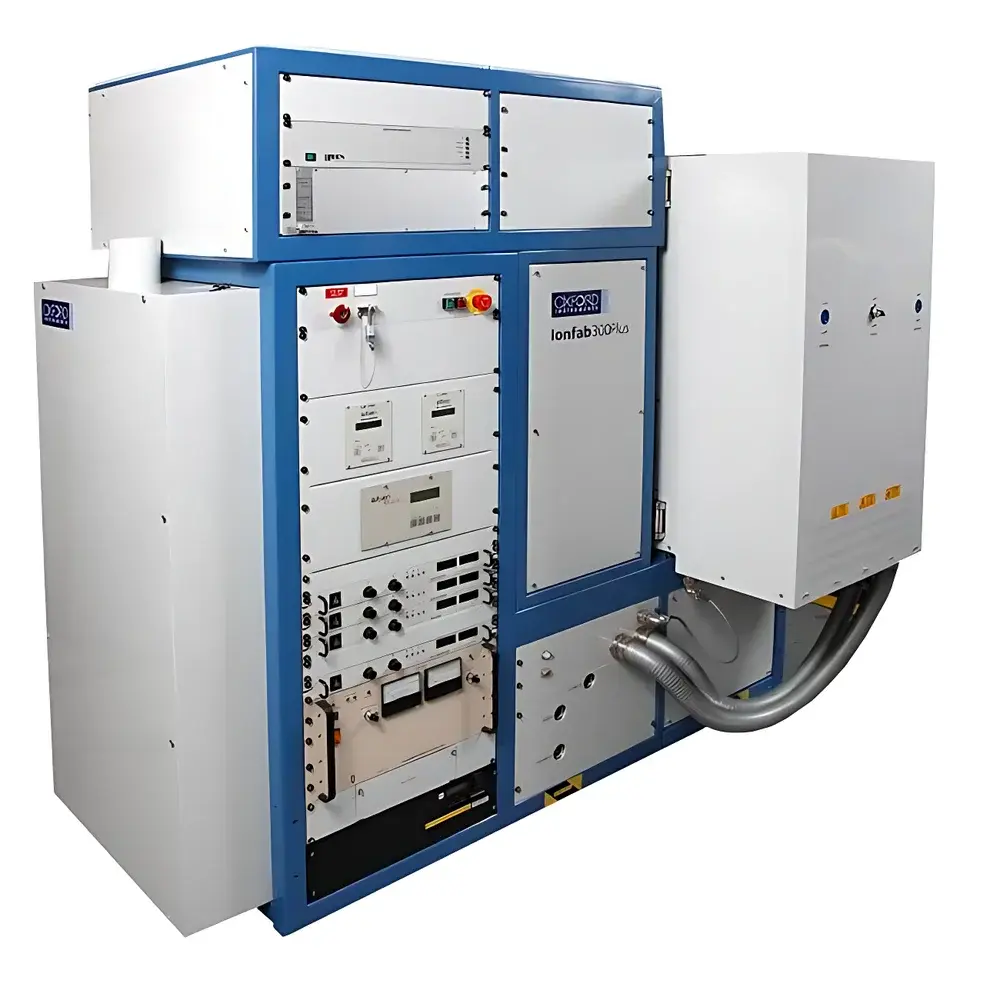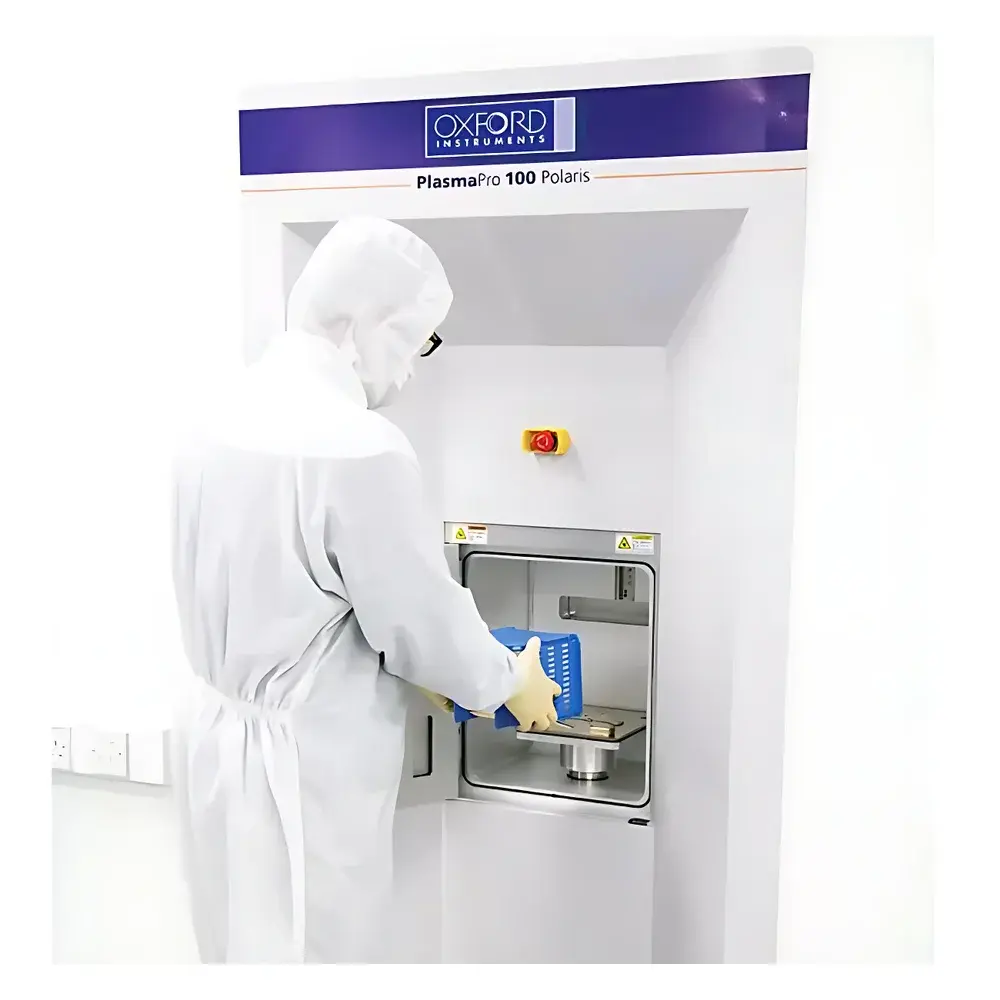
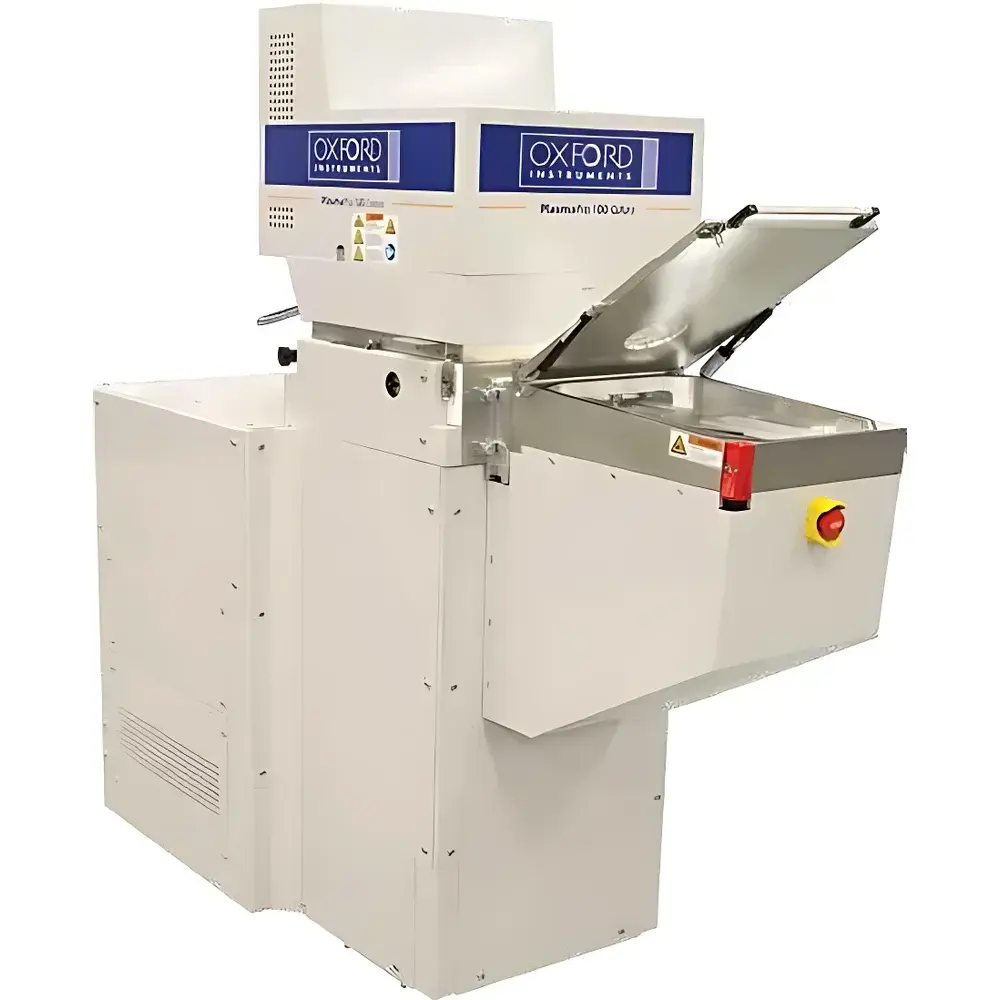
Oxford Instruments PlasmaPro 100 Polaris Single-Wafer Reactive Ion Etching System
| Brand | Oxford Instruments |
|---|---|
| Origin | United Kingdom |
| Model | PlasmaPro 100 Polaris |
| Wafer Size | 100 mm (4-inch) |
| Plasma Source | Inductively Coupled Plasma (ICP) with Magnetic Confinement |
| Electrode Configuration | Actively Cooled Bottom Electrode |
| Chuck Type | Electrostatic Chuck (ESC) with DC Bias Control |
| Chamber Liner | Heated, Anodized Aluminum |
| Pumping System | High-Capacity Turbomolecular Pump with Cryo-Assisted Roughing |
| Process Gas Compatibility | Cl₂, BCl₃, SF₆, CHF₃, O₂, Ar, N₂, and custom gas mixtures |
| Control Architecture | PLC-based real-time process control with Ethernet-enabled SECS/GEM interface |
| Compliance | CE-marked |
Overview
The Oxford Instruments PlasmaPro 100 Polaris is a compact, single-wafer reactive ion etching (RIE) system engineered for high-precision, low-damage plasma processing of wide-bandgap semiconductors—including gallium nitride (GaN), silicon carbide (SiC), and sapphire substrates. Built upon Oxford Instruments’ decades-long heritage in vacuum science and plasma physics, the Polaris platform leverages inductively coupled plasma (ICP) generation combined with magnetic confinement to deliver exceptional ion density (>1 × 10¹¹ cm⁻³), controllable ion energy distribution, and sub-nanometer-level etch profile control. Unlike conventional parallel-plate RIE tools, the PlasmaPro 100 Polaris integrates a high-power ICP source with a magnetically augmented plasma confinement ring—enabling uniform radical flux distribution across the full 100 mm wafer area while minimizing edge effects and microloading. Its modular chamber architecture supports rapid reconfiguration for diverse chemistries (e.g., Cl₂/BCl₃ for GaN, SF₆/O₂ for SiC, and CHF₃/Ar for sapphire), making it suitable for both R&D prototyping and pilot-line process development in compound semiconductor fabs.
Key Features
- Actively Cooled RF Electrode: Maintains substrate temperature within ±2 °C during extended etch cycles, critical for thermal budget-sensitive GaN HEMT and LED fabrication.
- High-Density ICP Source with Magnetic Confinement Ring: Enhances plasma uniformity and ion directionality, enabling anisotropic etch profiles with aspect ratios exceeding 20:1 on GaN.
- Electrostatic Chuck (ESC) with DC Bias Control: Provides uniform clamping force and precise ion energy tuning for sapphire and GaN-on-sapphire wafers—eliminating mechanical slippage and improving CD uniformity.
- Heated Anodized Aluminum Chamber Liner: Minimizes polymer deposition and particle generation by maintaining wall temperature above precursor condensation thresholds.
- Advanced Automatic Matching Unit (AMU): Achieves <95% power transfer efficiency across 1–100 W ICP and 1–500 W bias RF ranges, ensuring repeatable impedance matching under dynamic plasma conditions.
- Cryo-Assisted High-Vacuum Pumping System: Delivers base pressure <5 × 10⁻⁷ mbar and enables rapid pump-down (<60 s to 1 × 10⁻⁴ mbar), reducing cross-contamination between processes.
Sample Compatibility & Compliance
The PlasmaPro 100 Polaris supports standard 100 mm (4-inch) wafers—including bare and epitaxially grown GaN-on-sapphire, GaN-on-Si, SiC-on-Si, and Al₂O₃ substrates—with optional adaptors for 76 mm (3-inch) or diced die handling. All wetted components comply with SEMI F57 (ultra-high-purity surface finish) and ASTM F2196 (cleanroom-compatible materials). The system meets CE marking requirements per Machinery Directive 2006/42/EC and Electromagnetic Compatibility Directive 2014/30/EU. Integrated SECS/GEM communication enables seamless integration into factory automation systems compliant with SEMI E30 (GEM) and E40 (SECS-II) standards. Optional audit-trail logging and user-access controls support GLP and pre-GMP documentation workflows.
Software & Data Management
Control is executed via Oxford Instruments’ PlasmaPro Control Suite—a Windows-based application built on deterministic real-time scheduling. Each recipe stores complete parameter sets (gas flows, RF powers, pressure setpoints, ramp rates, step durations) with version-controlled revision history. Process logs include timestamped sensor data (chamber pressure, reflected power, electrode temperature, plasma emission intensity at key wavelengths), exported in CSV or HDF5 format for statistical process control (SPC) analysis. The system supports OPC UA server integration for MES connectivity and includes built-in alarm management aligned with ISA-88 batch control conventions. All user actions—including login, recipe modification, and manual intervention—are recorded with operator ID and timestamp, satisfying traceability requirements under ISO 9001 Clause 8.5.2.
Applications
- Etching of GaN-based HEMTs and Schottky diodes with vertical sidewalls and minimal undercut (<5 nm).
- High-selectivity patterning of SiC for power MOSFET and JBS diode fabrication.
- Low-damage mesa isolation of blue/UV LEDs on sapphire substrates using optimized Cl₂/BCl₃ chemistries.
- Surface preparation and trench definition for MEMS resonators and photonic integrated circuits (PICs) on AlN and ScAlN films.
- Development of atomic-layer etch (ALE) precursors through pulsed-plasma parameter optimization.
FAQ
What wafer sizes does the PlasmaPro 100 Polaris support?
The system is configured for 100 mm (4-inch) wafers as standard; mechanical adaptors are available for 76 mm (3-inch) substrates.
Is the system compatible with chlorine-based chemistries for GaN etching?
Yes—the chamber liner, seals, and gas delivery manifold are constructed from plasma-resistant materials (anodized aluminum, Kalrez® 6375, and ceramic insulators) rated for continuous Cl₂, BCl₃, and HBr exposure.
Can the PlasmaPro 100 Polaris be integrated into a cluster tool environment?
While designed as a standalone tool, its SECS/GEM interface, load-lock-ready flange configuration, and vacuum interlock signals allow integration with third-party transfer modules and atmospheric load ports.
Does the system support endpoint detection?
Optical emission spectroscopy (OES) capability is available as an option, with fiber-coupled spectrometer (200–800 nm) and real-time spectral monitoring software for endpoint determination.
What maintenance intervals are recommended for the ICP source and pumping system?
Oxford Instruments recommends quarterly inspection of the ICP coil cooling lines and annual replacement of turbomolecular pump bearings; full preventive maintenance is scheduled every 12 months or after 2,000 operating hours, whichever occurs first.