
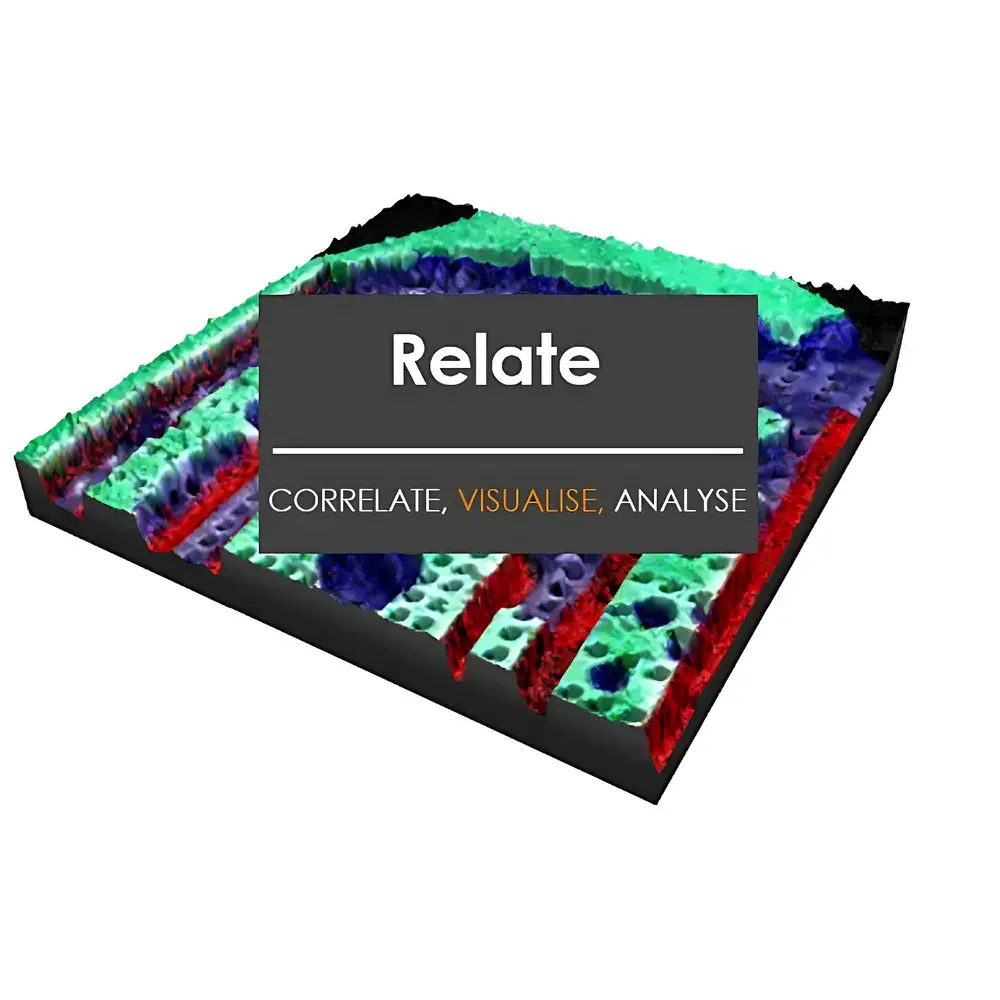
Oxford Instruments Relate Correlative Imaging Software
| Brand | Oxford Instruments |
|---|---|
| Origin | United Kingdom |
| Model | Relate Correlative Imaging Software |
| Data Format Support | Aztec H5oina, AFM native formats (e.g., Gwyddion, Nanoscope, SPIP) |
| Primary Function | Multi-modal correlative analysis of SEM/TEM, EDS, EBSD, and AFM datasets |
| Compatibility | Integrated with Oxford Instruments Aztec and Symmetry platforms |
| Licensing | Node-locked or floating license options |
| Compliance | Supports GLP/GMP-aligned documentation workflows, audit-trail-ready metadata logging |
Overview
Oxford Instruments Relate is a dedicated correlative imaging software platform engineered for rigorous, quantitative integration of heterogeneous microscopy data. It implements a physics-aware registration framework grounded in feature-based alignment, geometric transformation optimization, and uncertainty-aware spatial mapping—enabling precise pixel-to-pixel correspondence across disparate modalities including scanning electron microscopy (SEM), transmission electron microscopy (TEM), energy-dispersive X-ray spectroscopy (EDS), electron backscatter diffraction (EBSD), and atomic force microscopy (AFM). Unlike generic image overlay tools, Relate operates on calibrated coordinate systems derived from instrument metadata (e.g., stage position, magnification, detector geometry, scan parameters), ensuring traceable, reproducible correlation essential for materials science research, failure analysis, and advanced semiconductor characterization.
Key Features
- Multi-Modal Data Registration: Automated and manual alignment of SEM/TEM secondary electron (SE), backscattered electron (BSE), EDS elemental maps, EBSD phase/orientation maps, and AFM topography/amplitude/phase channels using intensity-, edge-, and feature-based algorithms.
- H5oina-Native Integration: Direct import of Aztec-generated H5oina files—including full metadata hierarchy (acquisition conditions, calibration parameters, processing history)—preserving analytical provenance without loss of fidelity.
- AFM Data Interoperability: Native support for common AFM vendor formats (Bruker Nanoscope, Keysight SPIP, Gwyddion) with automatic scaling, tilt correction, and plane fitting to ensure metrological consistency with EM-derived coordinates.
- 3D Correlative Visualization: Layered rendering engine enabling synchronized 2D overlays and interactive 3D volume reconstruction—combining AFM height data with EDS compositional layers and EBSD crystallographic orientation information into unified volumetric models.
- Quantitative Cross-Modal Analysis: Region-of-interest (ROI) definition across any layer with propagation to all registered datasets; measurement of X-ray counts, phase fraction, grain boundary density, surface roughness (Sa, Sq), and local crystallographic misorientation—all exportable with statistical descriptors (mean, std dev, min/max).
- Workflow Documentation & Reproducibility: Built-in annotation, versioning, and report generation; every alignment step, threshold selection, and measurement operation is logged with timestamp, operator ID, and parameter set—fully compliant with ISO/IEC 17025 and FDA 21 CFR Part 11 requirements for regulated environments.
Sample Compatibility & Compliance
Relate supports analysis of conductive and non-conductive specimens imaged under high-vacuum, low-vacuum, and environmental SEM conditions. It accommodates beam-sensitive materials (polymers, biological composites) through low-dose acquisition protocols preserved in H5oina metadata. The software conforms to ASTM E1558 (Standard Guide for Electron Backscatter Diffraction), ISO 14782 (Microbeam analysis — EBSD), and ISO 21363 (AFM — terminology and metrology). All data handling follows GDPR-compliant storage protocols, and audit trails meet GLP and GMP documentation standards for pharmaceutical excipient characterization and medical device material qualification.
Software & Data Management
Relate employs a modular architecture built on HDF5 (H5oina) as the canonical data container, ensuring long-term format stability and cross-platform compatibility. It integrates seamlessly with Oxford Instruments’ AztecLive cloud platform for remote collaboration and centralized license management. Data export includes TIFF/PNG (with embedded scale bars and metadata), CSV/TSV (tabular quantification), VTK (for third-party 3D visualization), and PDF reports with embedded hyperlinks to raw datasets. Batch processing scripts (Python API) enable automation of repetitive correlation tasks across large sample sets—critical for high-throughput quality control in battery electrode or additive manufacturing powder analysis.
Applications
- Correlating grain boundary networks (EBSD) with localized chemical segregation (EDS) and nanoscale surface topography (AFM) in Ni-based superalloys.
- Quantifying pore-throat connectivity in shale rock sections by overlaying FIB-SEM tomography with AFM-derived mechanical modulus maps.
- Validating lithographic pattern fidelity in EUV photoresists via simultaneous SEM edge detection, EDS line scans, and AFM critical dimension (CD) metrology.
- Mapping phase evolution in solid-state battery cathodes during in-situ cycling, combining time-resolved EBSD texture analysis with AFM electrochemical strain microscopy (ESM) signals.
- Supporting ISO 13322-2 compliant particle characterization where SEM size distribution is cross-validated against AFM height statistics.
FAQ
Does Relate require a separate Oxford Instruments hardware license to operate?
No—Relate is a standalone software application; however, full functionality (e.g., H5oina import, Aztec synchronization) requires prior installation of Oxford Instruments Aztec or Symmetry software on the same or networked system.
Can Relate perform sub-pixel registration between SEM and AFM images?
Yes—using iterative closest point (ICP) refinement and spline-based warping, Relate achieves sub-pixel alignment accuracy (≤0.3 px RMS error) when sufficient structural features are present in both modalities.
Is batch processing of multiple sample correlations supported?
Yes—via Python scripting interface (relate-api), users can define template workflows for automated alignment, ROI extraction, and CSV export across hundreds of datasets.
How is measurement traceability maintained across sessions?
Every analytical session generates an immutable HDF5 log file containing instrument configuration, user credentials, timestamps, and all applied transformations—enabling full forensic reconstruction per ISO/IEC 17025 clause 7.7.
Does Relate support real-time correlation during live AFM-SEM experiments?
Not natively—Relate is designed for post-acquisition analysis. Synchronized multi-modal acquisition requires external coordination via Oxford Instruments’ SmartStage or third-party trigger interfaces; Relate processes the resulting time-stamped datasets offline.




