
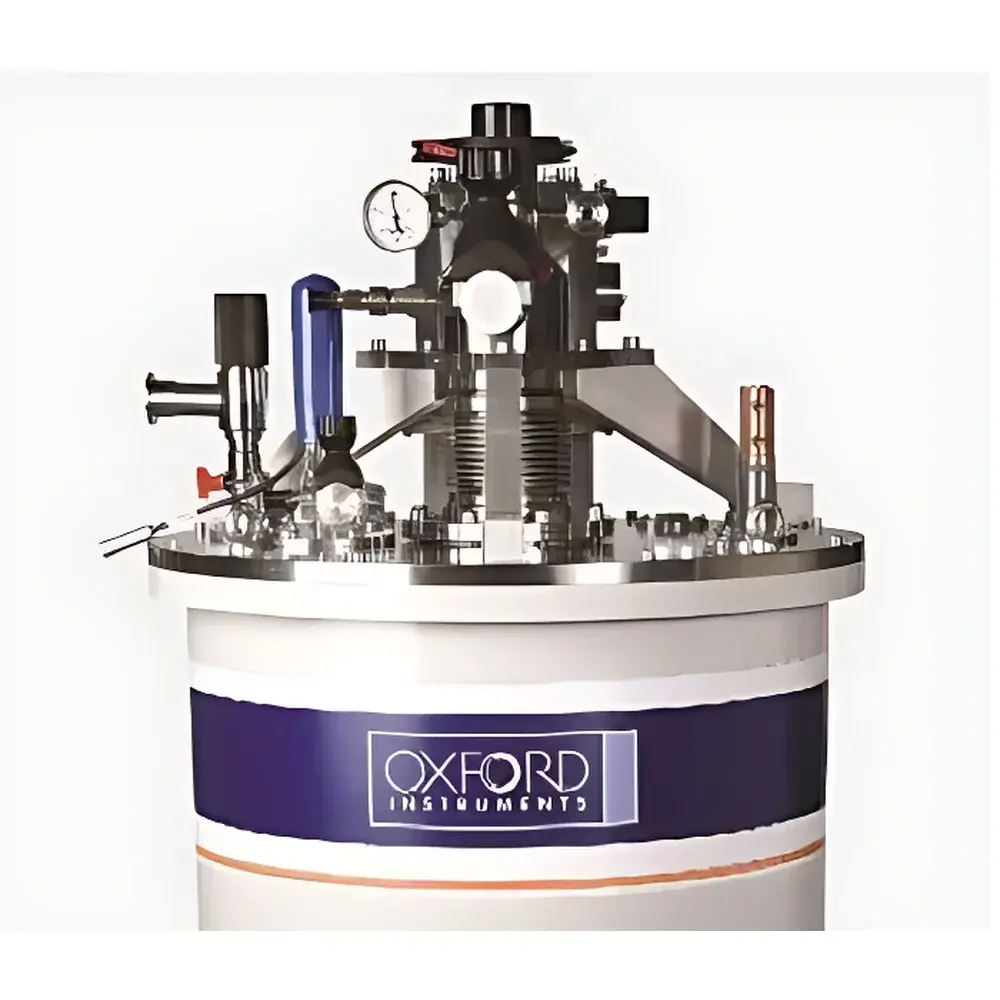
Oxford Instruments TeslatronPT Helium-Free Cryogenic Magnet System
| Brand | Oxford Instruments |
|---|---|
| Origin | United Kingdom |
| Model | TeslatronPT |
| Maximum Magnetic Field | 18 T |
| Temperature Range | 1.5 K to 300 K (standard VTI) |
| Sample Bore Diameter | 50 mm |
| Cooling Method | Single-pulse-tube cryocooler |
| Sample Access | Top-loading probe mechanism |
| Vibration Level | Ultra-low (suitable for SQUID, STM, and optical spectroscopy) |
| Internal Cold Trap | Yes |
| Gas Exchange Mode | Static exchange gas (no forced flow across sample) |
| Compliance | Designed for GLP/GMP-adjacent research environments |
Overview
The Oxford Instruments TeslatronPT is a fully integrated, helium-free cryogenic magnet system engineered for high-precision physical property measurements under simultaneous low-temperature and high-magnetic-field conditions. Unlike traditional liquid-helium-dependent systems, the TeslatronPT employs a closed-cycle pulse-tube cryocooler coupled with a persistent-mode superconducting magnet — eliminating the operational complexity, supply-chain dependency, and infrastructure overhead associated with bulk cryogens. Its core architecture follows the “integrated variable-temperature insert (VTI)” design principle: the magnet, cryocooler, thermal shielding, and sample stage are co-aligned and thermally optimized to deliver exceptional temperature stability (< ±5 mK over 24 h at 4 K) and magnetic field homogeneity (< 10 ppm over 1 cm³ at 14 T). The system operates across a continuous temperature range from 1.5 K to 300 K in standard configuration, with field strengths up to 18 T, making it suitable for quantum transport, magneto-optical spectroscopy, muon spin rotation (μSR), and advanced magnetic resonance applications requiring both thermal and field control fidelity.
Key Features
- Helium-free operation: Eliminates reliance on liquid helium supply chains while maintaining sub-kelvin base temperatures via high-efficiency pulse-tube refrigeration.
- Top-loading probe architecture: Enables rapid, in-situ sample exchange without warming the magnet or breaking vacuum — no load-lock mechanism required.
- 50 mm clear bore diameter: Accommodates custom sample holders, multi-probe electrical wiring, optical access paths, and hybrid measurement geometries.
- Ultra-low vibration design: Mechanical decoupling between cold stages and pulse-tube compressor, combined with static exchange gas cooling (no convective gas flow across the sample), ensures compatibility with atomic-force microscopy, scanning tunneling microscopy, and single-photon detection setups.
- Modular insert compatibility: Supports field-upgradeable cryogenic inserts including the HelioxVT (< 300 mK) and KelvinoxJT (< 25 mK), both retaining full magnet access and thermal anchoring integrity.
- Integrated cold trap: A continuously cooled internal sorption trap captures hydrocarbons and water vapor, extending vacuum lifetime and reducing contamination risk to sensitive samples and sensors.
- Energy-efficient operation: Single-stage pulse-tube cooler consumes ≤ 5 kW total electrical input during continuous 4 K operation — significantly lower than GM-cycle alternatives with comparable cooling power.
Sample Compatibility & Compliance
The TeslatronPT accommodates diverse sample formats: solid-state crystals, thin films on substrates, microfabricated devices, powder pellets, and sealed capillary cells. Its sealed, differential-pumping-capable sample chamber allows integration with ultra-high-vacuum (UHV) transfer lines and in-situ deposition tools. All thermal interfaces and electrical feedthroughs comply with IEC 61000-6-3 (EMC emissions) and IEC 61000-6-2 (immunity) standards. The system’s firmware and hardware architecture support audit-trail-enabled operation per FDA 21 CFR Part 11 requirements when paired with Oxford’s ILM software suite — enabling electronic signatures, user-access logging, and parameter-change history for regulated R&D environments. It is routinely deployed in laboratories adhering to ISO/IEC 17025 accreditation protocols for materials characterization.
Software & Data Management
Control and monitoring are managed via Oxford Instruments’ Intelligent Laboratory Manager (ILM) software — a Windows-based platform supporting real-time PID tuning, multi-channel temperature/magnet/current logging, and synchronized ramp sequencing. ILM exports time-stamped datasets in HDF5 and CSV formats, with metadata tags compliant with FAIR (Findable, Accessible, Interoperable, Reusable) principles. Remote operation is supported through secure TLS-encrypted Ethernet communication, allowing integration into centralized lab automation networks. Optional Python and LabVIEW APIs enable custom experiment scripting and third-party instrument synchronization (e.g., lock-in amplifiers, laser sources, RF synthesizers).
Applications
- Quantum materials research: Hall effect mapping, Shubnikov–de Haas oscillations, and quantum oscillation analysis in topological insulators and 2D heterostructures.
- Magneto-optical studies: Faraday/Kerr rotation, photoluminescence under high field, and time-resolved magneto-absorption spectroscopy.
- Low-temperature metrology: Calibration of cryogenic sensors, validation of NIST-traceable thermometry standards, and cryogenic current comparator testing.
- Spintronics device characterization: Tunneling magnetoresistance (TMR), giant magnetoresistance (GMR), and spin-transfer torque (STT) measurements at millikelvin temperatures.
- Superconductivity investigations: Critical field mapping, vortex dynamics imaging, and microwave surface impedance analysis.
FAQ
Does the TeslatronPT require liquid nitrogen or liquid helium for operation?
No — it is fully cryogen-free. The system uses only electrical power to drive its pulse-tube cryocooler and superconducting magnet power supply.
Can the system be operated continuously at 1.5 K with 14 T field?
Yes. The standard VTI achieves stable 1.5 K operation at full field; extended hold times (>72 h) are verified under ISO 21748 uncertainty evaluation protocols.
Is vacuum maintenance automated?
Yes. Integrated turbomolecular pumping with active pressure regulation and cold-trap monitoring enables unattended operation for >6 months between service intervals.
What electrical feedthrough options are available?
Standard configurations include 32-pin low-thermal-conductance ceramic feedthroughs; customizable variants support RF (up to 40 GHz), optical fiber, and coaxial microwave lines.
How is temperature calibrated across the operating range?
Primary calibration uses Cernox™ and RuO₂ sensors traceable to ITS-90; secondary verification is performed via fixed-point transitions (e.g., superconducting indium, gallium melting points) using embedded reference thermometers.



