
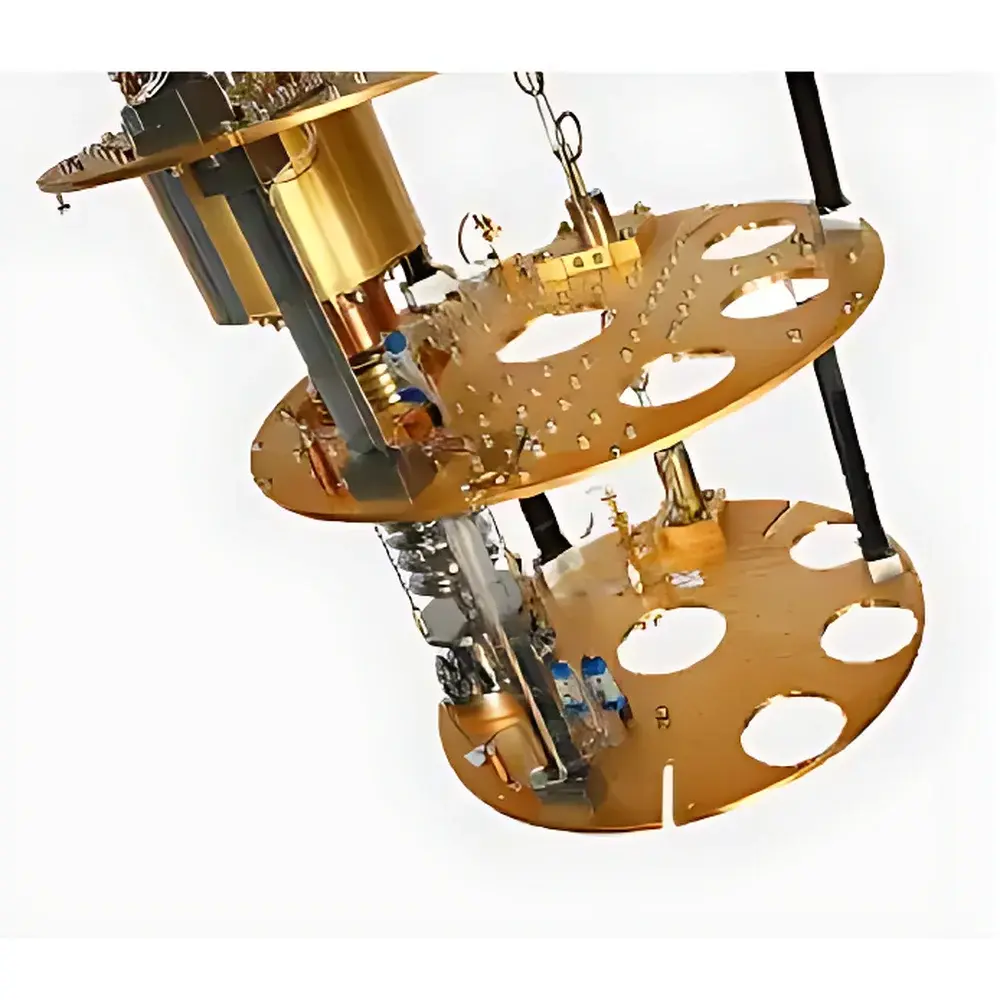
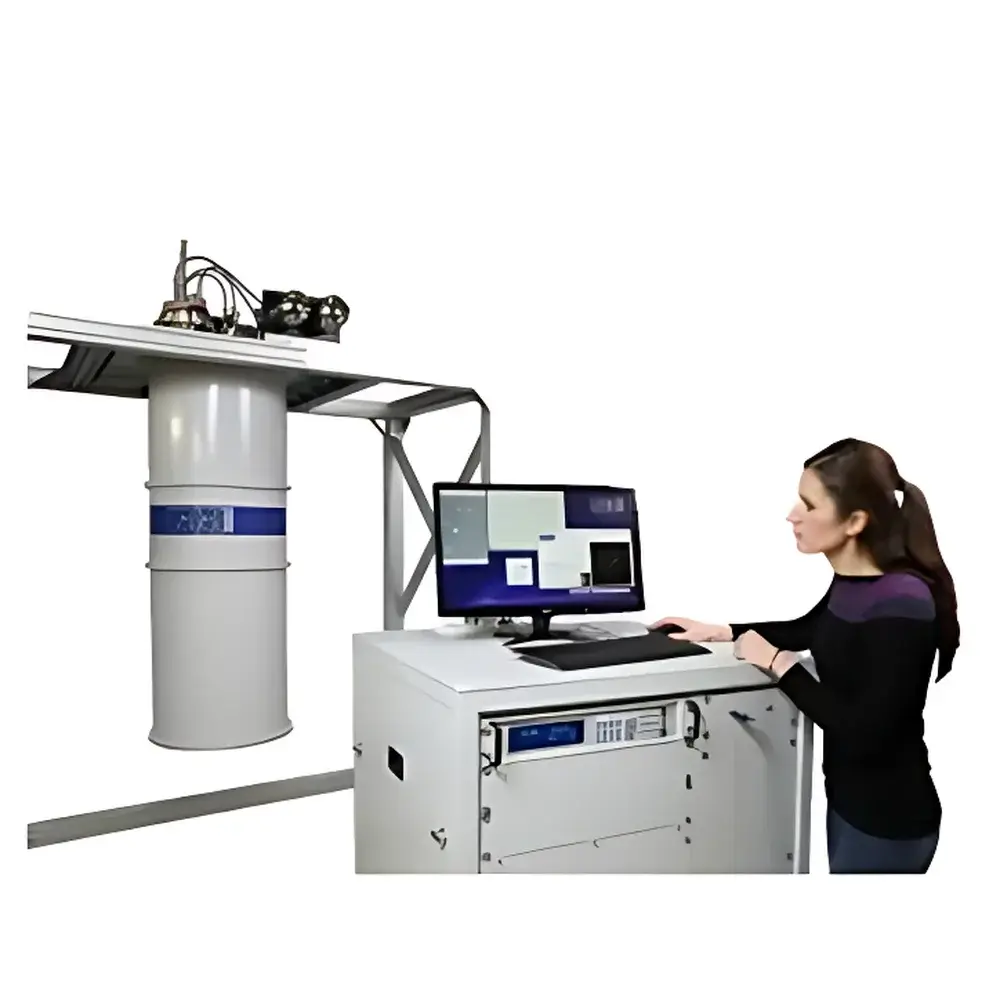
Oxford Instruments Triton Dry Dilution Refrigeration System
| Brand | Oxford Instruments |
|---|---|
| Origin | United Kingdom |
| Model | Triton |
| Cooling Power | >12 µW @ 20 mK (Triton 500), >6 µW @ 20 mK (Triton 300) |
| Base Temperature | < 10 mK |
| Sample Space | Ø290 mm × H240 mm (extendable to 440 mm) |
| Magnetic Field Compatibility | Up to 14 T |
| Helium-3 Inventory | 18 L (Triton 500), 11 L (Triton 300) |
| Cool-down Time | < 24 h |
| Operating Temperature Range | 10 mK – 30 K (full field) |
| Cryocooler | 1–2 W Pulse Tube Refrigerator |
| Compliance | Fully compatible with ISO/IEC 17025-aligned lab infrastructure, supports GLP/GMP audit trails via optional integrated logging |
Overview
The Oxford Instruments Triton Dry Dilution Refrigeration System is an engineered solution for quantum transport, superconducting qubit characterization, topological matter studies, and ultra-low-temperature condensed matter physics. Unlike traditional wet dilution refrigerators requiring periodic liquid helium refills, the Triton operates as a fully dry, closed-cycle system leveraging a high-reliability ^3He/^4He dilution process thermally anchored to a 1–2 W pulse tube cryocooler. Its core architecture integrates a hermetically sealed dilution unit with active vibration isolation—achieved through flexible copper braid interconnects and bellows-coupled cold heads—to maintain thermal stability and mechanical quietness essential for sub-mK coherence measurements. Designed and manufactured in the UK, the Triton meets stringent international standards for cryogenic instrumentation, including compatibility with ISO/IEC 17025-accredited laboratory environments and support for regulatory-compliant data integrity frameworks.
Key Features
- Sub-10 mK base temperature with demonstrated long-term stability (< ±5 µK over 72 h under static conditions)
- Dual-platform configuration: Triton 300 (6 µW @ 20 mK) and Triton 500 (12 µW @ 20 mK), both scalable to 450 µW @ 100 mK
- Modular magnet integration supporting solenoid and vector superconducting magnets up to 14 T, with factory-aligned field homogeneity mapping
- Top-and-bottom sample exchange mechanisms enabling rapid turnaround without thermal cycling of the entire dilution unit
- Vibration-optimized mechanical design: rigid floor-standing cryostat frame, electrically isolated gas lines and pump rack, and decoupled pulse tube mounting
- Clean vacuum architecture using a dry pumping stack (roots + diaphragm + turbomolecular pumps), eliminating oil vapor and particulate contamination risks associated with scroll pumps
- Full-welded, all-metal gas handling system with pneumatic actuation valves and quick-disconnect service interfaces for maintenance under ISO Class 5 cleanroom protocols
- Standardized RF infrastructure: four axial feedthrough ports (three Ø50 mm, one Ø65 mm) optimized for semi-rigid coaxial cabling and integrated microwave attenuation stages
Sample Compatibility & Compliance
The Triton accommodates diverse experimental geometries—including planar chip carriers, wire-bonded devices, fiber-coupled photonic platforms, and bulk single crystals—within its Ø290 mm × 240 mm primary sample space (expandable to 440 mm height). Optical access options include fused silica windows (UV–IR broadband transmission) and SMF-28 fiber feedthroughs with AR-coated terminations. All electrical, thermal, and optical interfaces comply with IEC 61000-6-4 emission limits and meet electromagnetic compatibility requirements for operation in shielded quantum labs. The system’s control firmware and data acquisition layer are designed to support 21 CFR Part 11-compliant electronic records when paired with Oxford Instruments’ optional IQM software suite, enabling full audit trail generation, user role-based access control, and secure timestamped parameter logging required for GLP and GMP workflows.
Software & Data Management
Operation is managed via Oxford Instruments’ Triton Control Software (v5.x), a platform-independent application offering real-time PID-controlled temperature regulation across the full 10 mK–30 K range—even under variable magnetic fields. The software provides command-line interface (CLI) support via TCP/IP and SCPI protocol for integration into automated test sequences (e.g., LabVIEW, Python-based quantum control stacks). Built-in safety interlocks monitor helium pressure differentials, cold-head temperatures, magnet quench status, and vacuum integrity, triggering configurable shutdown protocols. Data export follows HDF5 format with embedded metadata (including calibration certificates, sensor IDs, and timestamped environmental logs), ensuring traceability and interoperability with analysis pipelines used in quantum device benchmarking (e.g., QCoDeS, Qiskit Metal).
Applications
- Quantum computing hardware validation: transmon and fluxonium qubit coherence time mapping, two-level system (TLS) spectroscopy, and gate fidelity assessment below 20 mK
- Topological superconductor characterization: Majorana zero-mode detection via tunneling conductance and non-local transport
- Ultra-low-noise metrology: Johnson–Nyquist thermometry, bolometric radiation detection, and quantum-limited amplifier testing
- Strongly correlated electron systems: heavy fermion behavior, quantum critical point exploration, and spin liquid candidate materials
- Nanoscale thermal transport: phonon boundary scattering studies using suspended microdevices with integrated thermoreflectance readout
FAQ
What is the expected mean time between failures (MTBF) for the Triton dilution unit?
Based on field data from over 1,000 installed units, the dilution refrigerator module demonstrates an MTBF exceeding 36 months under continuous operation at base temperature, with no scheduled maintenance required during standard warranty coverage.
Can the Triton be operated remotely in unattended mode for multi-day experiments?
Yes—the system supports fully autonomous operation with redundant watchdog timers, remote CLI access via TLS-secured SSH, and automatic recovery from minor vacuum or cooling anomalies without user intervention.
Is third-party magnet integration supported beyond Oxford Instruments’ own superconducting systems?
The Triton’s mechanical and electrical interface specifications (including cryogenic current leads, field mapping protocols, and quench protection signaling) are publicly documented per IEC 60034-30-2 Annex D, enabling validated integration with magnets from Magnex, American Magnetics, and Cryomagnetics.
How does the Triton address helium-3 inventory management and replenishment logistics?
Each system ships with factory-charged, isotopically certified 3He (11 L or 18 L); Oxford Instruments offers a global 3He recovery and recertification service aligned with ISO 8573-1 Class 1 purity standards, minimizing long-term operational cost of ownership.
Are calibration certificates provided for all integrated sensors?
Yes—NIST-traceable calibration reports for all primary temperature sensors (RuO2, Cernox™, and RhFe) and pressure transducers are included, with uncertainty budgets conforming to EURAMET cg-12 guidelines.



