
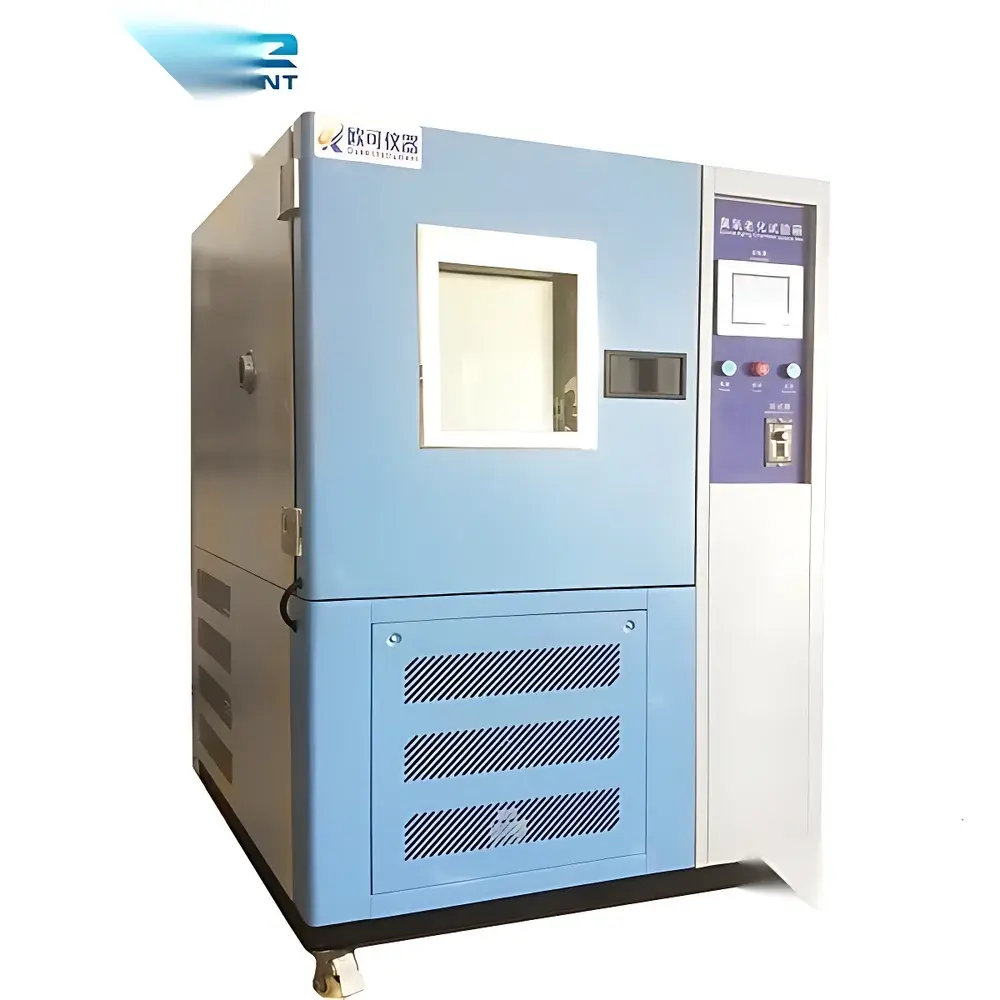
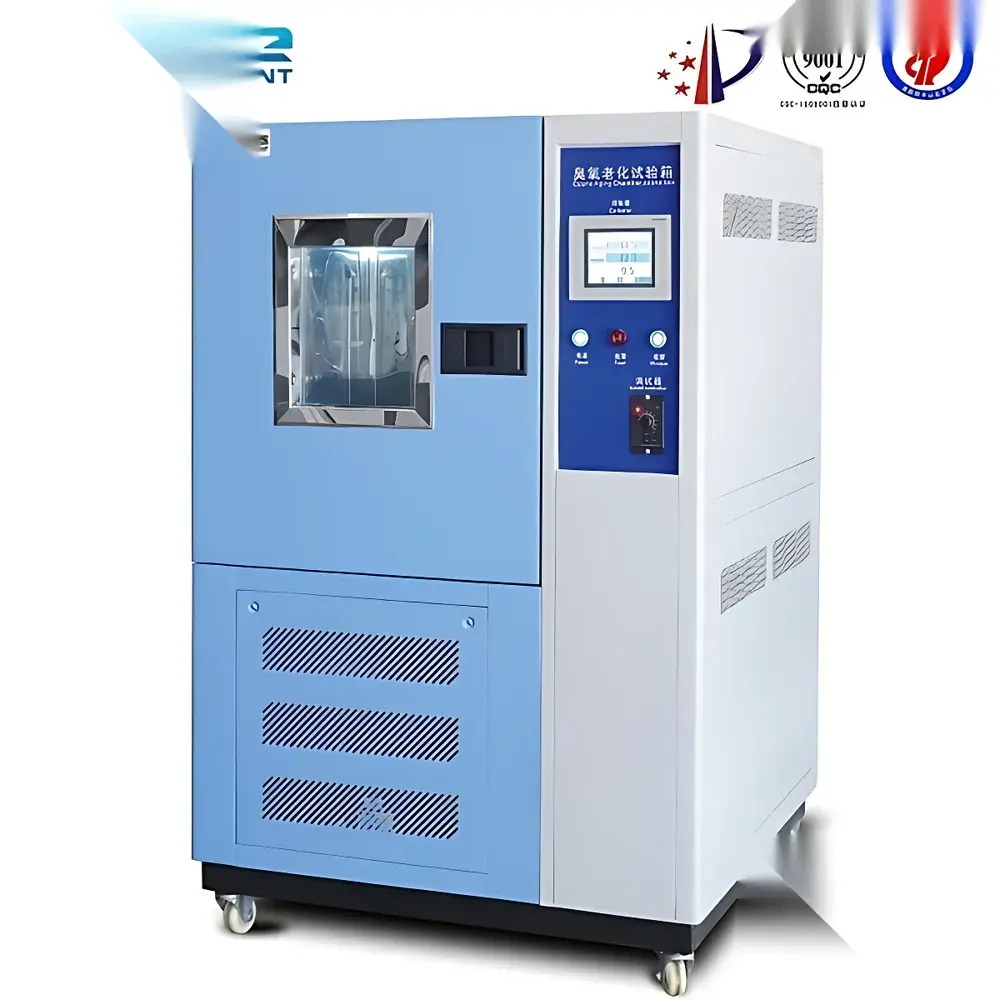
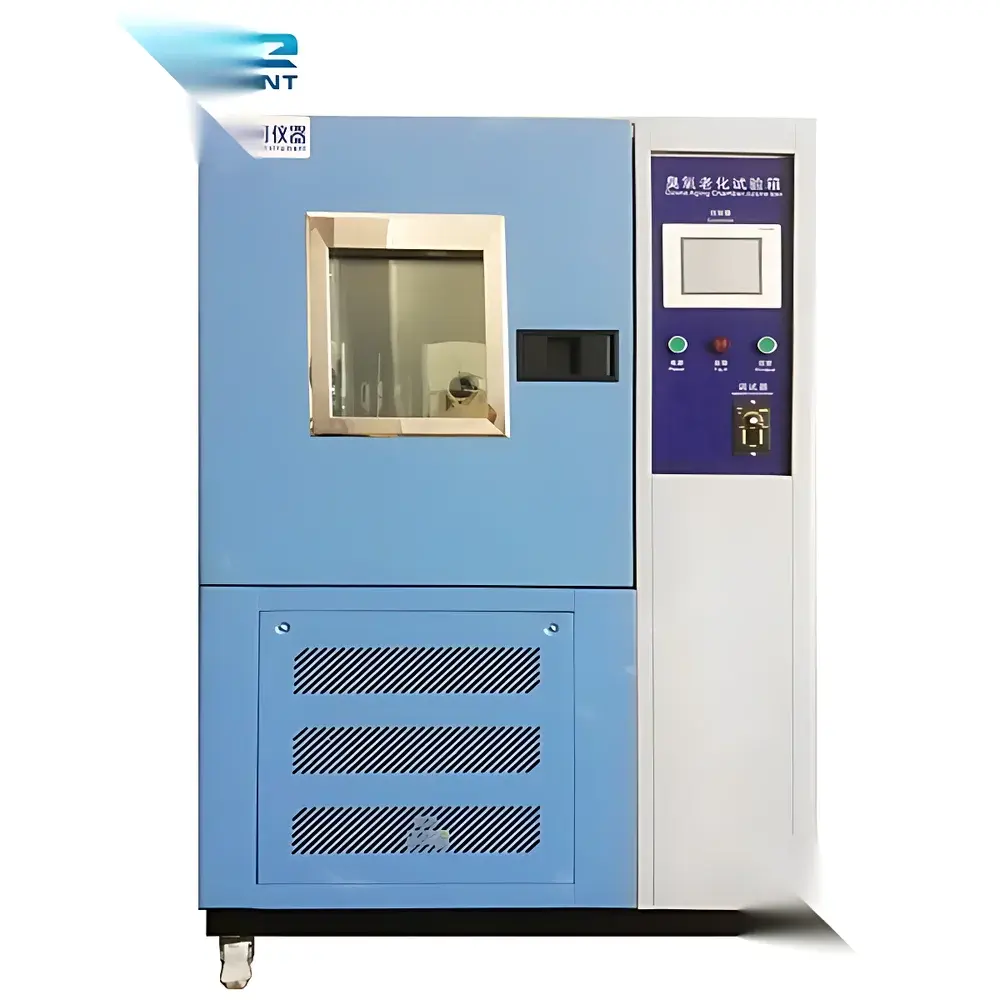
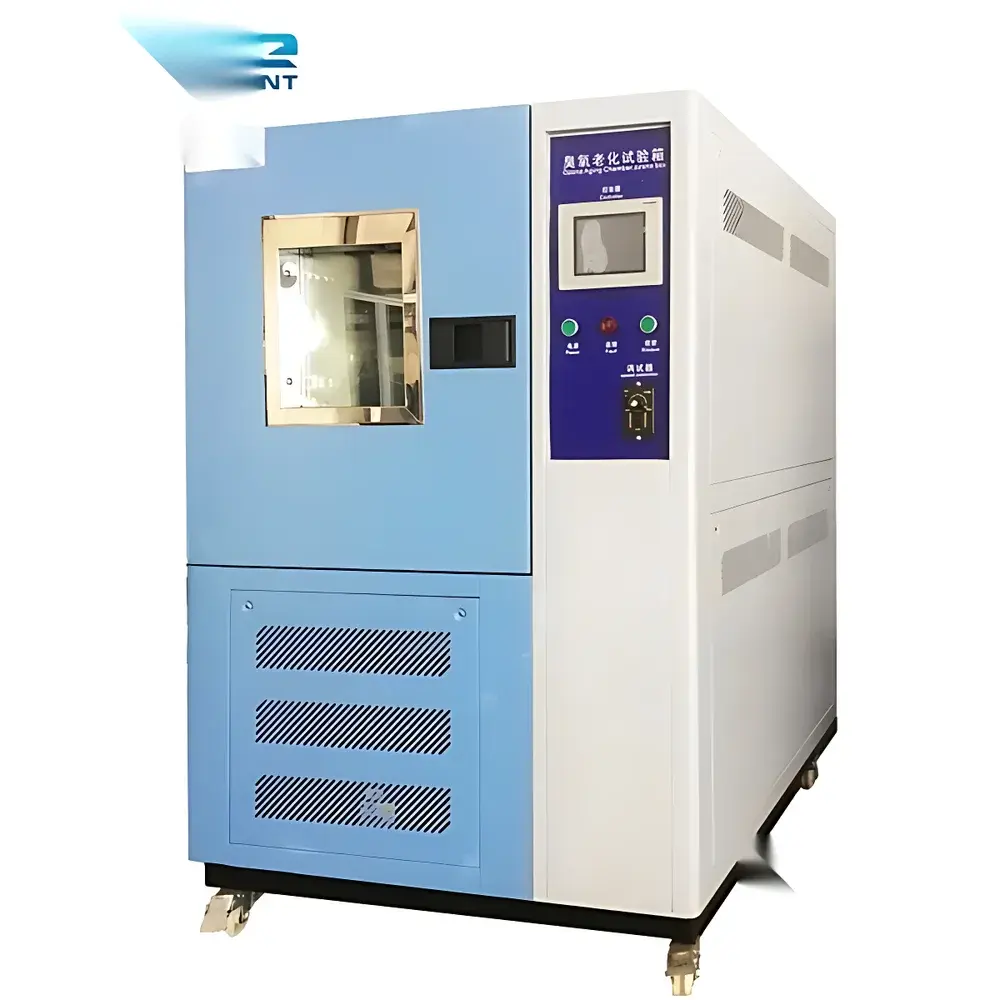
Ozone Aging Test Chamber QY-Series
| Brand | Other Brands |
|---|---|
| Origin | Imported |
| Manufacturer Type | General Distributor |
| Price | USD 4,950 (FOB) |
| Chamber Volume Options | 80 L / 225 L / 500 L / 1000 L |
| Temperature Range | 25–40 °C |
| Humidity Range | 30–65 % RH |
| Ozone Concentration Range | 50–1500 pphm |
| Temperature Uniformity | ±0.5 °C |
| Sample Rack | 360° continuous rotation at 1 rpm |
| Gas Flow Velocity | 8–16 mm/s |
| Ozone Generation Method | Silent Discharge Tube |
| Ozone Detection | Nondispersive UV Absorption Analyzer (≥5 yr service life) |
| Control System | Weilun Color Touchscreen + Siemens PLC |
| Safety Protections | Leakage, Short-Circuit, Overtemperature, Motor Overheat, Overcurrent |
| Power Supply | AC 380 V ±5 %, 50 Hz ±0.5 Hz |
Overview
The QY-Series Ozone Aging Test Chamber is an engineered environmental simulation system designed to evaluate the ozone resistance of elastomeric materials—including natural rubber, SBR, NBR, EPDM, and silicone compounds—under controlled, reproducible atmospheric conditions. It operates on the principle of accelerated aging via exposure to precisely regulated ozone concentrations within a sealed, recirculating gas loop. Unlike open-air or static ozone exposure methods, this chamber employs silent discharge ozone generation combined with nondispersive ultraviolet (UV) absorption spectroscopy for real-time, trace-level ozone quantification (50–1500 pphm). The system maintains strict thermal and humidity stability (±0.5 °C temperature fluctuation; 30–65 % RH), ensuring compliance with core international test standards including ASTM D1149, ISO 1431-1, and GB/T 7762. Its fully enclosed gas circuit eliminates operator exposure risk while enabling long-duration, unattended testing under GLP-aligned operational protocols.
Key Features
- Stainless steel test chamber with fully sealed, recirculating ozone gas loop—designed per ISO 1431-1 containment requirements
- Adjustable ozone concentration control (50–1500 pphm) with digital display and auto-regulation via feedback from UV absorption sensor
- Motor-driven sample rack supporting both static and dynamic test modes: 360° continuous rotation at 1 rpm (dynamic) or fixed-angle static mounting (optional)
- Nondispersive UV ozone analyzer with ≥5-year operational lifespan and built-in calibration port for metrological traceability
- Integrated Weilun color touchscreen HMI paired with Siemens S7-1200 PLC for deterministic control logic, PID auto-tuning, and event logging
- Dual-parameter setpoint control: independent regulation of ozone concentration, temperature, and relative humidity with real-time deviation monitoring
- Comprehensive safety architecture: earth leakage protection, overtemperature cutoff, motor thermal overload sensing, and short-circuit interruption
- Standard 4–20 mA analog output and RS232 serial interface for integration into centralized lab data acquisition systems or LIMS platforms
Sample Compatibility & Compliance
The QY-Series accommodates standard dumbbell-shaped specimens (ASTM D1149 Type A, B, C), ring tensile samples (ISO 1431-1), and custom-sized components up to 100 cm × 100 cm × 100 cm (QY-1000 model). All chamber variants support both static and dynamic deformation protocols—enabling evaluation of crack initiation and propagation under strain in accordance with ISO 1431-2. The sealed-loop design ensures zero ambient ozone leakage, meeting OSHA PEL (0.1 ppm) and EU Directive 2004/37/EC occupational exposure limits. Calibration interfaces conform to ISO/IEC 17025 documentation requirements, facilitating third-party verification and audit readiness for ISO 9001, IATF 16949, and FDA-regulated quality systems.
Software & Data Management
Embedded firmware supports time-stamped parameter logging at user-defined intervals (1 s to 60 min resolution), with onboard storage (≥1 million data points) and export via USB or RS232. The controller generates CSV-formatted reports containing ozone concentration, chamber temperature/humidity, elapsed test time, and alarm event timestamps—structured for direct import into statistical process control (SPC) software or Excel-based failure analysis. Audit trail functionality records all operator actions (setpoint changes, start/stop commands, calibration events) with user ID and timestamp, satisfying FDA 21 CFR Part 11 electronic record requirements when deployed with password-protected administrator access and electronic signature capability.
Applications
- Evaluation of ozone-induced surface cracking in automotive seals, hoses, and vibration isolators
- Quality assurance testing of cable insulation (rubber and thermoplastic elastomer grades)
- Material qualification for aerospace elastomeric components exposed to high-altitude ozone environments
- Research into antioxidant efficacy and protective coating performance under cyclic ozone stress
- Conformance validation for medical device tubing and gasketing materials per USP extractables profiling prerequisites
- Accelerated lifetime prediction modeling for rubber goods in tropical or urban atmospheric conditions
FAQ
What ozone concentration range does the QY-Series support, and how is it verified?
It delivers 50–1500 pphm with traceability to NIST-traceable UV absorption calibration. Each unit ships with factory calibration certificate and dedicated metrology port for annual revalidation.
Can the chamber operate continuously for extended durability tests?
Yes—designed for 7×24 operation with redundant thermal fusing, forced-air cooling for the ozone generator, and self-diagnostic PLC routines that log runtime hours and component wear metrics.
Is dynamic testing (rotating sample rack) mandatory, or can static exposure be performed?
Both modes are supported. Static fixtures are included; dynamic rotation (1 rpm) is enabled via programmable motor control and complies with ISO 1431-2 Annex A requirements.
Does the system meet regulatory requirements for pharmaceutical or medical device testing?
It satisfies environmental control prerequisites for ISO 10993-12 extractables studies and supports GMP-aligned documentation workflows when configured with audit trail and electronic signature modules.
What maintenance intervals are recommended for the ozone generator and UV sensor?
Ozone tubes require replacement every 8,000 operating hours; UV cells are rated for ≥43,800 hours (5 years) under continuous operation. Preventive maintenance schedule is embedded in the HMI and triggers service alerts.



