
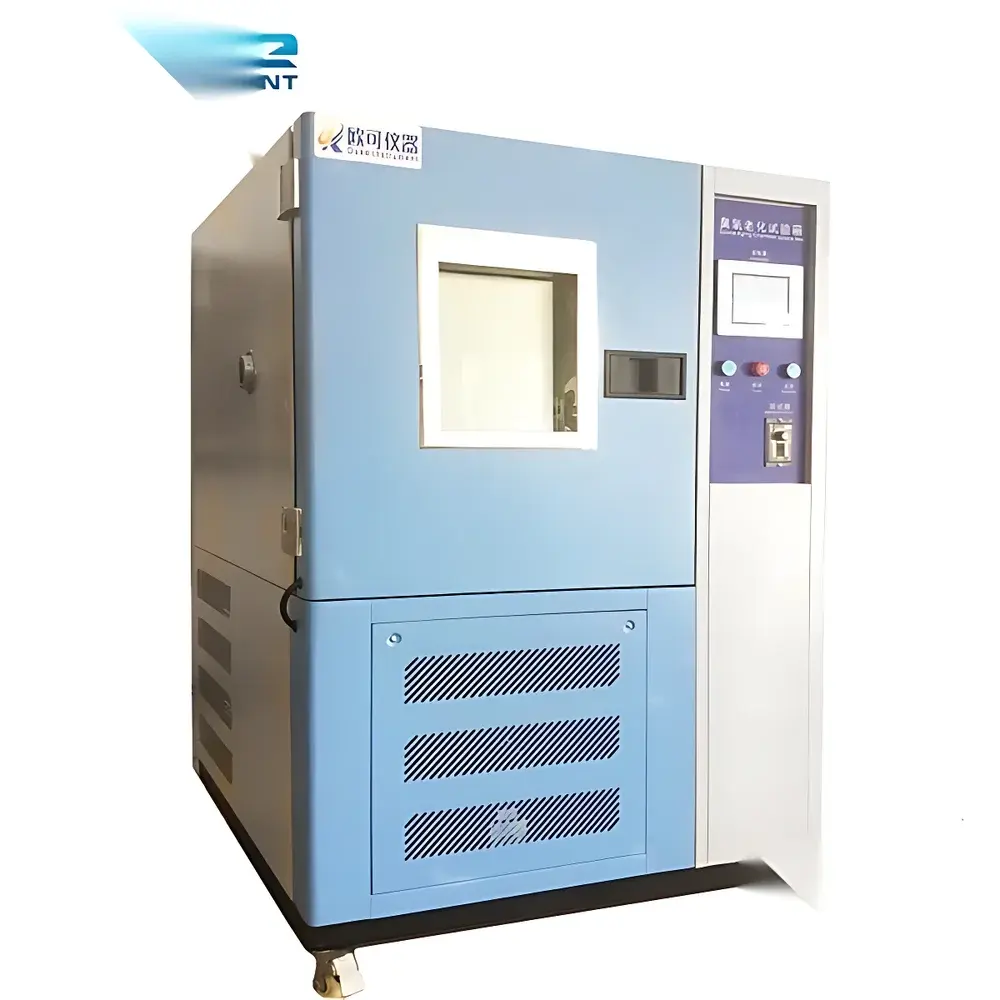
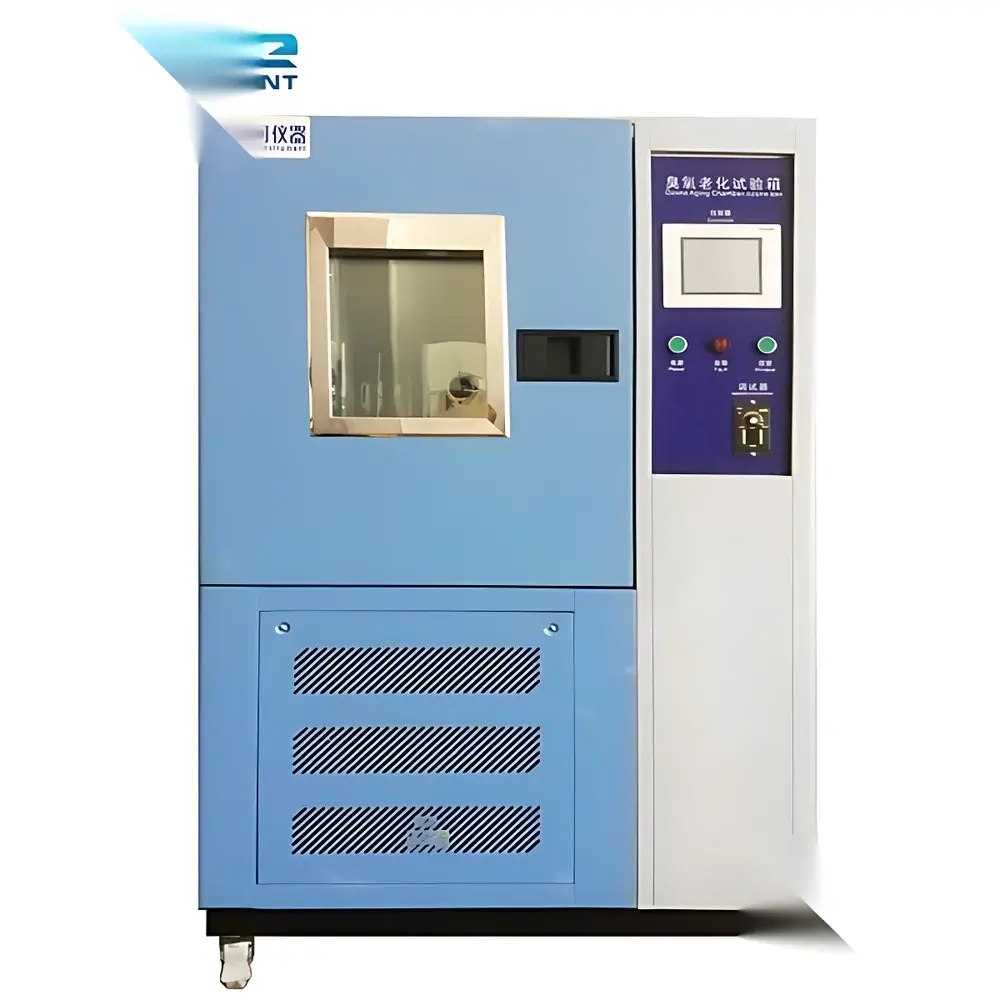
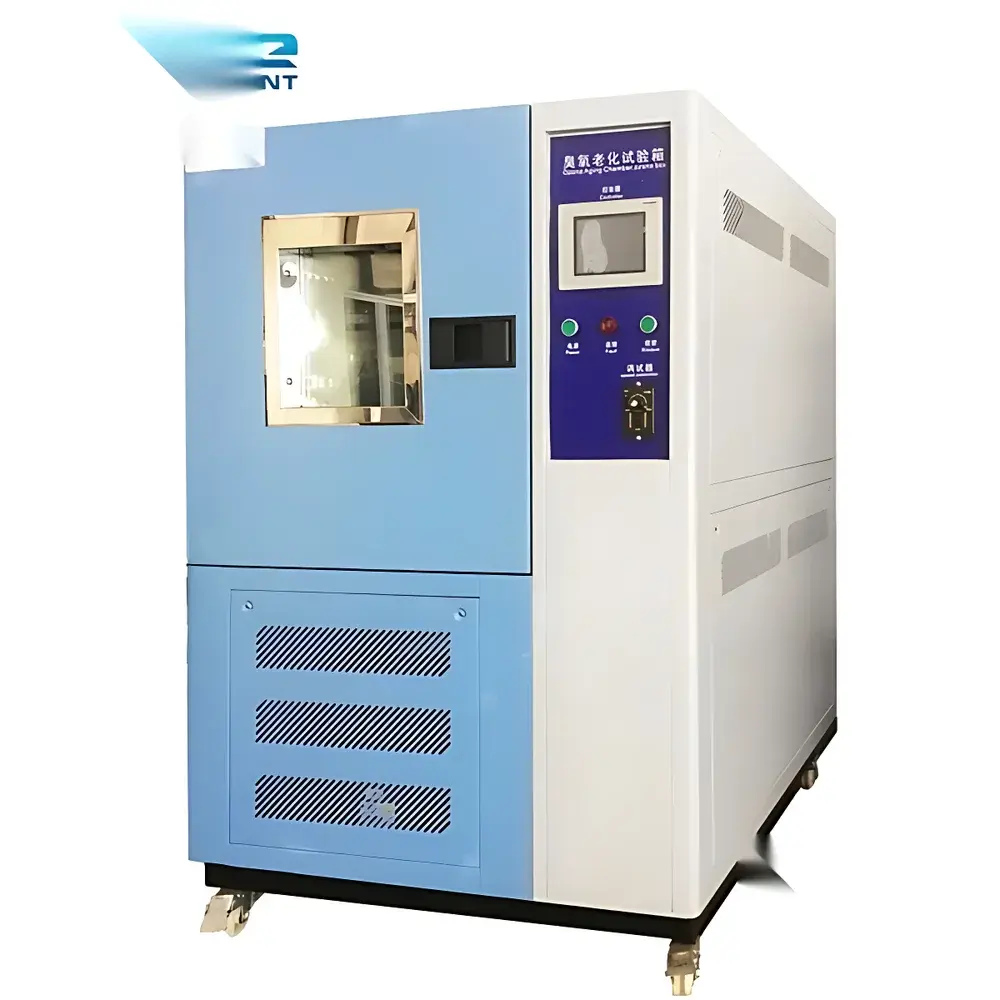
Ozone Aging Test Chamber QY-Series
| Brand | Other Brands |
|---|---|
| Origin | Imported |
| Manufacturer Type | General Distributor |
| Price | USD 6,200 (approx.) |
| Chamber Volume Options | 80 L / 225 L / 500 L / 1000 L |
| Temperature Range | 25–40 °C |
| Humidity Range | 30–65 % RH |
| Ozone Concentration Range | 50–1500 pphm |
| Ozone Generation Method | Silent Discharge Tube |
| Ozone Monitoring | Non-Dispersive UV Sensor (≥5 yr lifespan) |
| Control System | Siemens PLC + Weintek Color Touchscreen |
| Temperature Stability | ±0.5 °C |
| Sample Rotation | 360° motorized rack, 1 rpm |
| Gas Flow Velocity | 8–16 mm/s |
| Compliance Standards | GB/T 7762–2003, GB/T 2951.21–2008, GB/T 11206–2009, ISO 1431-1:2004 |
Overview
The QY-Series Ozone Aging Test Chamber is an engineered environmental test system designed to evaluate the resistance of elastomeric materials—particularly vulcanized rubber compounds—to ozone-induced surface cracking under controlled, accelerated conditions. Ozone (O₃), though present in trace concentrations in ambient air, initiates rapid oxidative chain scission at strained polymer surfaces, leading to characteristic fissures perpendicular to applied stress. This chamber replicates and intensifies that degradation mechanism via precise regulation of ozone concentration, temperature, humidity, and mechanical strain state (static or dynamic). Unlike general-purpose environmental chambers, the QY-Series integrates a fully sealed, recirculating gas loop with silent discharge ozone generation and real-time non-dispersive ultraviolet (UV) photometric detection—ensuring metrological traceability, operator safety, and repeatability required for QC labs, R&D centers, and certification bodies.
Key Features
- Fully enclosed stainless-steel test chamber with leak-tight gas circulation loop—eliminates ambient ozone interference and prevents operator exposure.
- Silent discharge ozone generator with stable output across 50–1500 pphm range; no nitrogen purge or external oxygen supply required.
- Non-dispersive UV ozone analyzer with onboard calibration capability, ≥5-year sensor lifetime, and 4–20 mA analog output for integration into centralized lab monitoring systems.
- Motor-driven 360° rotating sample rack (1 rpm), compliant with摆线 trajectory requirements for dynamic testing per ISO 1431-1.
- Dual PID-controlled environment: independent regulation of temperature (25–40 °C, ±0.5 °C stability) and relative humidity (30–65 % RH).
- Siemens S7-1200 PLC paired with Weintek cMT Series color touchscreen HMI—supporting recipe storage, multi-step test profiles, and audit-ready event logging.
- Integrated safety interlocks: over-temperature cutoff, ozone leakage detection, motor overcurrent protection, and ground-fault circuit interruption.
Sample Compatibility & Compliance
The QY-Series accommodates standardized dumbbell specimens (e.g., ISO 527-2 Type 1A, ASTM D412), cut strips, and molded parts up to 100 × 100 × 100 cm (QY-1000 model). Static testing fixtures apply constant tensile strain (typically 20% elongation); dynamic configurations utilize the rotating rack to induce cyclic flexing. All models are validated against internationally recognized standards including ISO 1431-1:2004 (rubber—determination of resistance to ozone cracking—part 1: static strain), GB/T 7762–2003 (equivalent Chinese national standard), and GB/T 2951.21–2008 (cable insulation evaluation). The sealed architecture and calibrated UV detection path meet GLP documentation requirements for method validation, and the RS232 interface supports data export for FDA 21 CFR Part 11–compliant electronic records when paired with validated laboratory information management systems (LIMS).
Software & Data Management
Embedded firmware enables full-cycle test automation: user-defined ozone ramping profiles, multi-stage temperature/humidity sequences, and synchronized start/stop triggers based on real-time ozone concentration feedback. All operational parameters—including setpoints, actual readings, alarm events, and PLC I/O states—are timestamped and stored locally on SD card (≥1 year retention at 1-second sampling). Export formats include CSV and PDF reports with embedded calibration certificates. Optional Ethernet module enables remote monitoring via Modbus TCP or OPC UA, facilitating integration into Industry 4.0 test cell architectures. Audit trails comply with ISO/IEC 17025:2017 clause 7.7.1 for measurement traceability and data integrity.
Applications
- Accelerated qualification of rubber compounds used in automotive seals, tires, and vibration dampers.
- Evaluation of antioxidant and antiozonant additive packages (e.g., p-phenylenediamine derivatives) under defined aging stress.
- Comparative lifetime modeling between natural rubber (NR), styrene-butadiene rubber (SBR), ethylene propylene diene monomer (EPDM), and nitrile butadiene rubber (NBR).
- Pre-compliance screening for UL 2556, IEC 60811-506, and MIL-DTL-24643C material specifications.
- Root-cause analysis of field failures attributed to ozone exposure in outdoor infrastructure components.
FAQ
What ozone concentration accuracy is achievable with the UV sensor?
Calibrated accuracy is ±5 pphm or ±3% of reading (whichever is greater) across the 50–1500 pphm range, verified annually using NIST-traceable ozone transfer standard.
Can the chamber operate without sample rotation for static testing only?
Yes—rotation is fully disableable via HMI; static fixtures conform to ISO 1431-1 Annex A geometry and clamping force specifications.
Is third-party calibration certification included with shipment?
A factory-issued calibration report covering ozone sensor, temperature, and humidity sensors is provided; UKAS or DAkkS-accredited field calibration is available as optional service.
How is ozone decommissioned after testing?
An integrated catalytic ozone destruct unit (MnO₂-based) reduces residual O₃ to ambient O₂ prior to exhaust—no external scrubber required.
What electrical infrastructure is needed for the QY-1000 model?
AC 380 V ±5%, 50 Hz ±0.5 Hz, three-phase + PE; minimum 16 A circuit breaker with dedicated grounding rod (earth resistance <4 Ω).



