
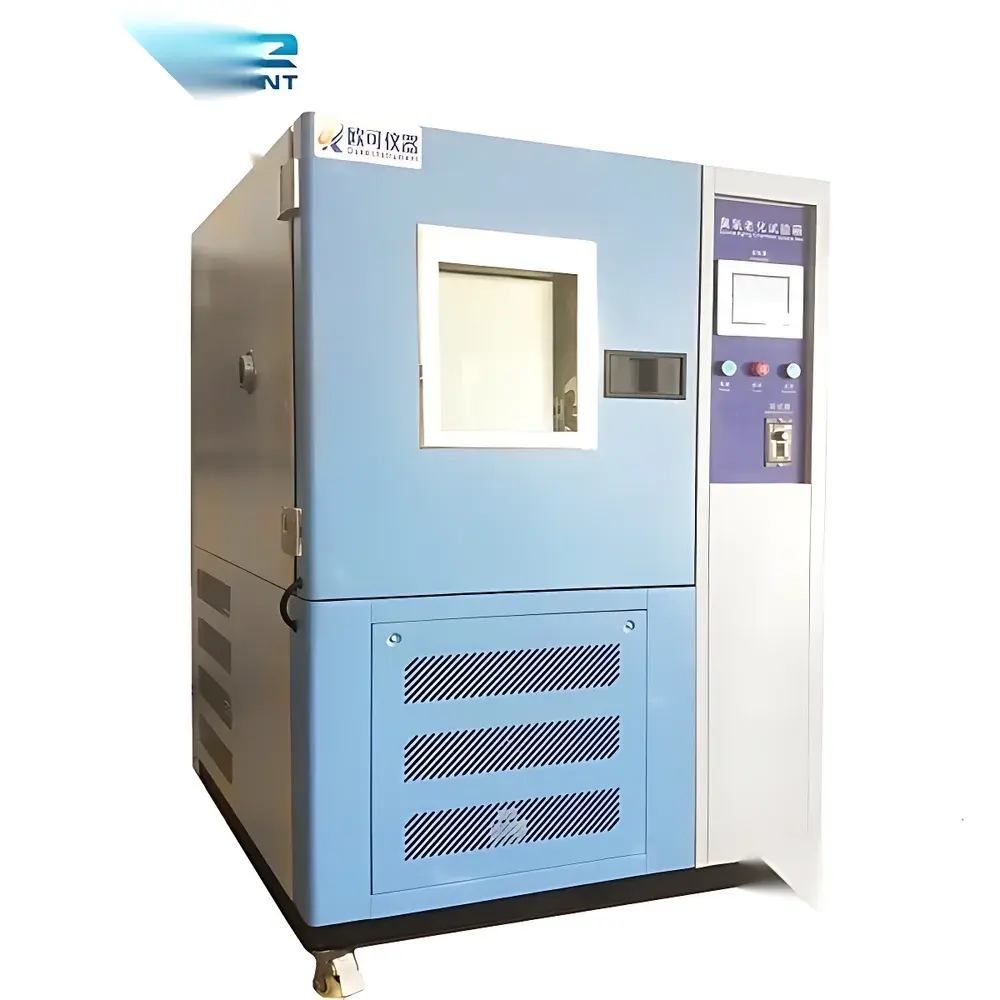
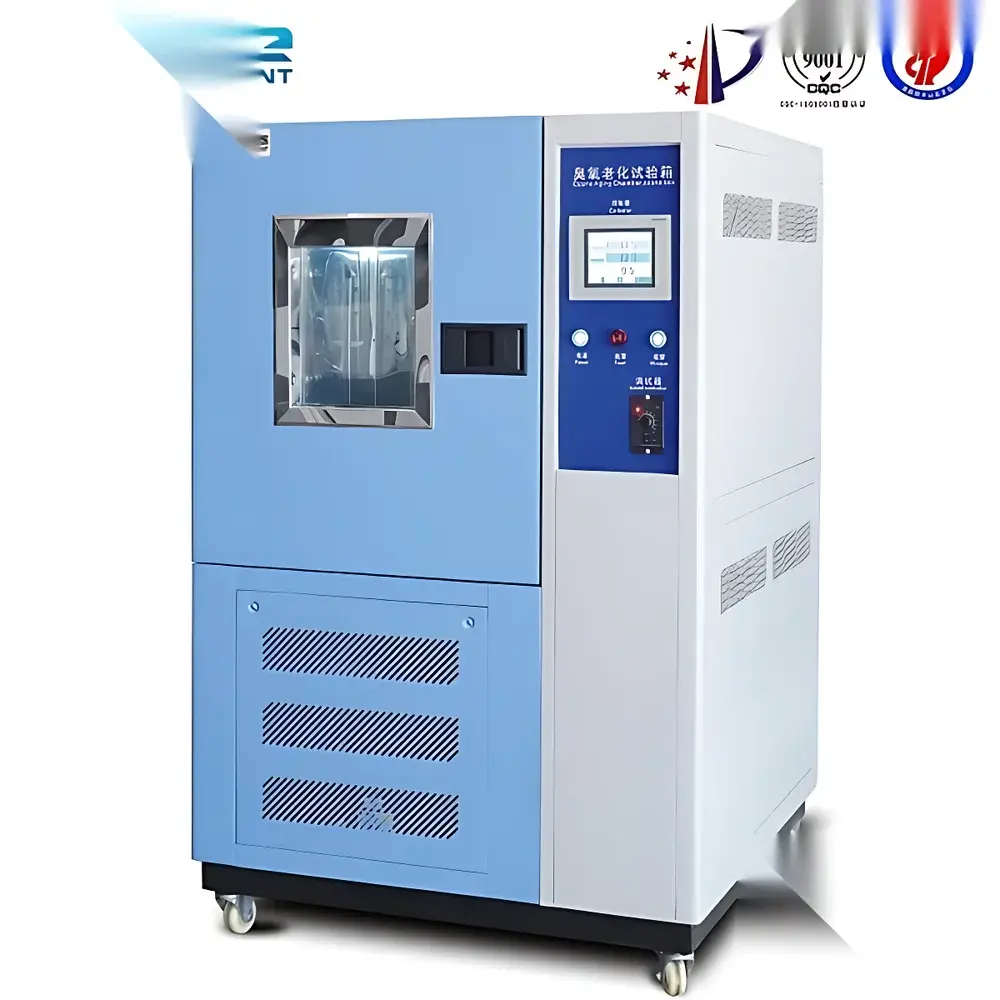
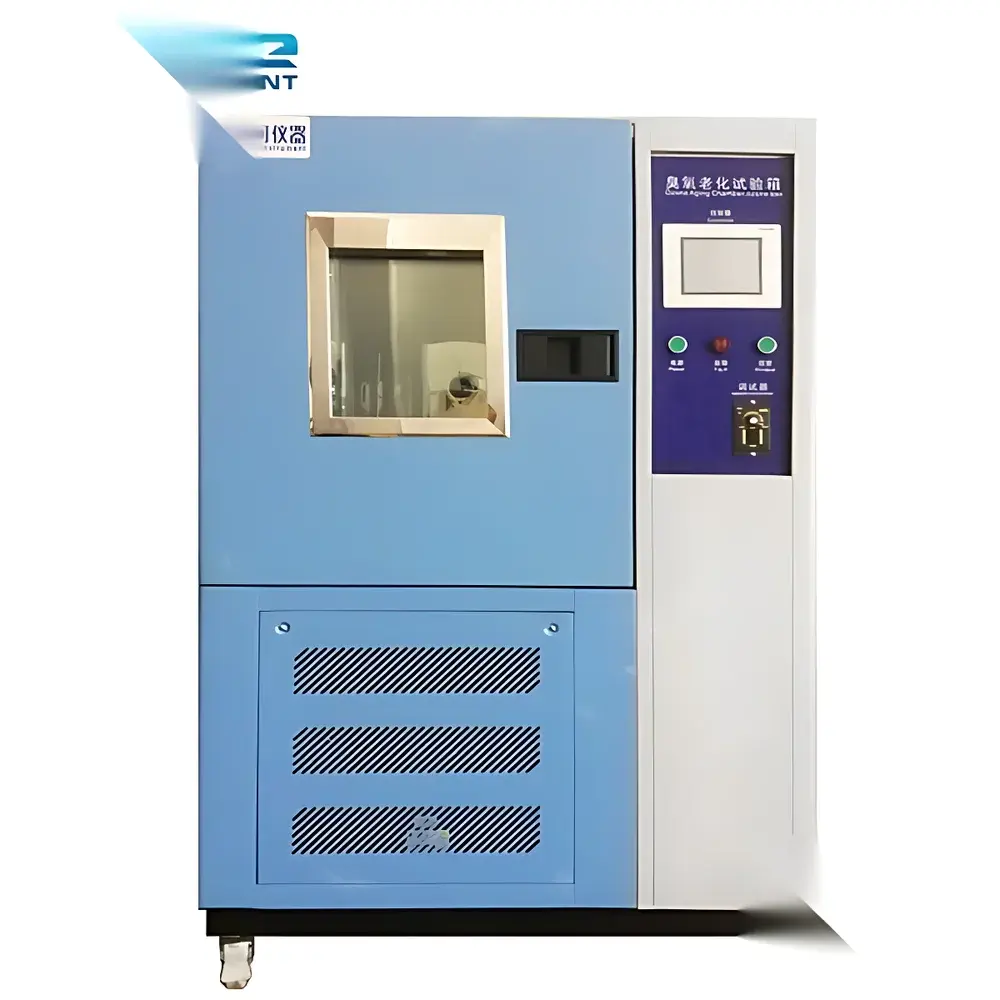
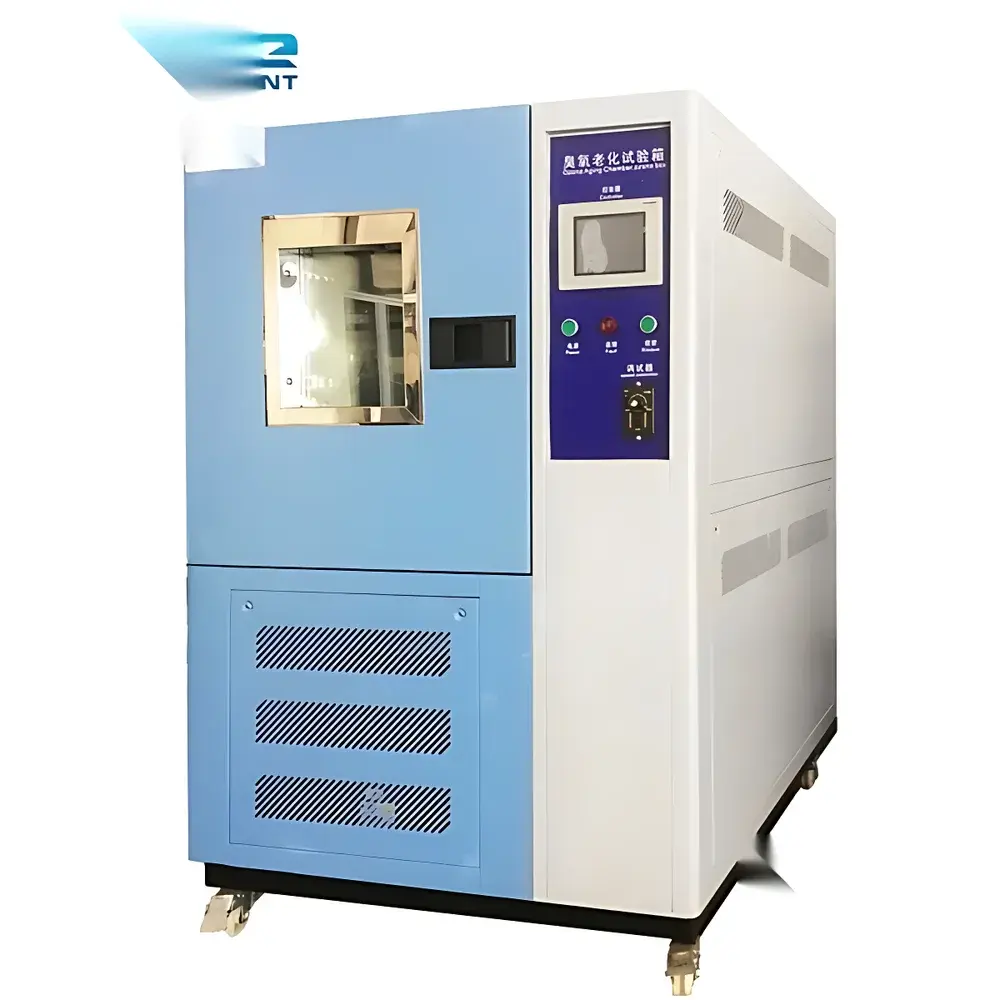
Ozone Aging Test Chamber QY-Series – Stainless Steel Environmental Test Chamber for Rubber & Elastomer Durability Assessment
| Key Features | Stainless steel ozone test chamber with fully enclosed silent-discharge ozone generation circuit |
|---|---|
| Ozone concentration range | 50–1500 ppm (pphm) |
| Temperature range | 25–40 °C, fluctuation ±0.5 °C |
| Humidity range | 30–65 % RH |
| Sample rack | 360° continuous rotation at 1 rpm (static/dynamic modes optional) |
| Gas flow velocity | 8–16 mm/s |
| Control system | Weilun color touchscreen + Siemens PLC |
| Ozone sensing | Non-dispersive UV absorption analyzer (≥5 yr service life) |
| Output | 4–20 mA analog + RS232 digital interface |
| Safety | Leakage, short-circuit, overtemperature, motor overheat, and overcurrent protection |
| Power supply | AC 380 ±5 V / 50 ±0.5 Hz |
| Compliance | GB/T 7762–2003, GB/T 2951.21–2008, GB/T 11206–2009, ISO 1431-1:2004 |
Overview
The QY-Series Ozone Aging Test Chamber is an engineered environmental test system designed to evaluate the ozone resistance of vulcanized rubber, elastomers, and polymer-based components under controlled, reproducible atmospheric conditions. Based on the principle of accelerated oxidative degradation, the chamber exposes specimens to precisely regulated ozone concentrations (50–1500 ppm), temperature (25–40 °C), and relative humidity (30–65 % RH) — replicating long-term atmospheric aging in a compressed timeframe. Its fully sealed gas circulation loop utilizes silent-discharge ozone generation and non-dispersive ultraviolet (UV) absorption detection, ensuring metrological traceability, operator safety, and compliance with internationally recognized material durability standards including ISO 1431-1:2004 and GB/T 7762–2003. The system is not a generic climate chamber but a purpose-built instrument for ASTM D1149 and ISO-compliant ozone cracking assessment, where surface micro-crack initiation and propagation kinetics are quantitatively monitored.
Key Features
- Fully enclosed stainless steel test chamber with seamless welds and inert internal surfaces to prevent catalytic ozone decomposition and ensure long-term calibration stability.
- Silent-discharge ozone generator with adjustable output and integrated thermal management, delivering stable ozone concentrations across the full 50–1500 ppm range without nitrogen oxide byproducts.
- Non-dispersive UV ozone analyzer with factory-calibrated photometric cell; provides continuous real-time measurement with ≤±2% full-scale accuracy and ≥5-year operational lifespan under routine use.
- Dual-mode sample handling: static mounting fixtures for fixed-strain evaluation and dynamic 360° rotating sample rack (1 rpm) generating cycloidal motion per ISO 1431-1 Annex A, enabling uniform exposure and mechanical stress simulation.
- Intelligent control architecture integrating Weilun HMI touchscreen interface and Siemens S7-1200 PLC for coordinated regulation of ozone concentration, temperature, humidity, and timing sequences via auto-tuned PID algorithms.
- Comprehensive safety interlocks: ground-fault detection, overtemperature cutoff (independent of main controller), motor thermal overload protection, ozone leak monitoring, and emergency ventilation activation.
- Standardized metrology interface (NIST-traceable port) for third-party calibration verification; all ozone generation, distribution, and measurement occur within a closed-loop recirculation path — eliminating ambient venting and operator exposure risk.
Sample Compatibility & Compliance
The QY-Series accommodates standard dumbbell-shaped, ring, or strip specimens per ISO 1431-1 and GB/T 7762. Custom chamber volumes (QY-80 to QY-1000 models) support both small laboratory coupons and larger molded components (e.g., automotive seals, cable jackets, or gasket assemblies). All configurations meet essential requirements for GLP-compliant testing environments: audit-trail-capable event logging, parameter lockout functionality, and user-access-level permissions. The system supports full traceability per ISO/IEC 17025:2017 for accredited laboratories performing rubber aging validation. It is routinely deployed in QC labs serving Tier-1 automotive suppliers, wire & cable manufacturers, and medical device polymer developers where ozone-induced embrittlement directly impacts field reliability.
Software & Data Management
Embedded firmware records time-synchronized data streams for ozone concentration (ppm), chamber temperature (°C), relative humidity (% RH), and elapsed test duration with millisecond timestamp resolution. Raw values are exportable via USB or RS232 to CSV or Excel-compatible formats. Optional PC-based software enables automated report generation aligned with ISO 1431-1 test templates — including crack density scoring, incubation time calculation, and pass/fail determination against acceptance criteria. The control system supports 21 CFR Part 11-compliant electronic signatures and audit trail archiving when integrated with validated LIMS platforms.
Applications
- Evaluation of antiozonant efficacy in natural rubber (NR), styrene-butadiene rubber (SBR), and nitrile-butadiene rubber (NBR) compounds.
- Qualification of elastomeric seals used in aerospace hydraulic systems exposed to high-altitude ozone profiles.
- Accelerated aging validation of insulated power cables per IEC 60811-506 and GB/T 2951.21.
- Comparative lifetime modeling of tire sidewall compounds under urban ozone exposure scenarios.
- Regulatory submission testing for FDA 510(k) or CE-marked medical devices containing silicone or thermoplastic elastomers.
FAQ
What ozone concentration range is supported, and how is it verified?
The chamber delivers 50–1500 ppm ozone using silent-discharge generation and measures concentration continuously via NIST-traceable UV absorption. Calibration verification is performed using standardized potassium iodide (KI) titration per ISO 1431-1 Annex B.
Does the system comply with ISO 1431-1:2004 for dynamic testing?
Yes — the 360° rotating sample rack operates at 1 rpm with geometrically optimized arm geometry to reproduce the prescribed cycloidal trajectory, satisfying Clause 6.3.2 of ISO 1431-1:2004.
Can test parameters be logged and exported for regulatory audits?
All critical process variables are time-stamped and stored internally; data export supports CSV format with optional PDF report generation including operator ID, calibration dates, and deviation flags.
Is external calibration required, and how often?
Annual third-party calibration is recommended; the built-in metrology port allows direct connection to certified ozone calibrators without disassembly.
What safety certifications does the unit carry?
The system conforms to IEC 61000-6-2 (EMC immunity) and IEC 61000-6-4 (EMC emissions); electrical safety complies with IEC 61010-1 for laboratory equipment. CE marking is provided for EU deployment.



